

Prophet Muhammad is defined as the final prophet of Islam and the Seal of the Prophets, the messenger through whom the Quran was revealed and the faith of Islam was established. Born in Mecca around 570 CE, he received his first revelation at age 40 and spent the next 23 years delivering a message that would reshape human civilization. He died in Medina on June 8, 632 CE, leaving behind a community, a scripture, and a way of life that now guides over a billion people. Whether you are Muslim or simply curious about Islamic history, understanding his life is one of the most rewarding studies you can undertake.
What do we know about the life of Prophet Muhammad?
The life of Muhammad is one of the most thoroughly documented biographies from the ancient world. His early years in Mecca earned him the titles Al-Amin (the Trustworthy) and Al-Sadiq (the Truthful) long before any prophetic claim. Merchants trusted him with their goods. Neighbors trusted him with their disputes. That reputation for integrity was not incidental. It was the foundation on which his mission would rest.
Key events in his prophetic mission
| Period | Event | Significance |
|---|---|---|
| 610 CE | First revelation in Cave Hira | Beginning of Muhammad’s revelations and prophetic mission |
| 622 CE | Hijrah to Medina | Establishment of the first Muslim community and Islamic calendar |
| 628 CE | Treaty of Hudaybiyyah | Demonstrated diplomatic skill and patience over conflict |
| 630 CE | Return to Mecca | Peaceful conquest; amnesty granted to former enemies |
| 632 CE | Farewell Sermon | Final ethical and social teachings delivered on Mount Arafat |
Muhammad’s revelations came progressively over 23 years, not all at once. That gradual process allowed the early Muslim community to absorb and apply each teaching before the next arrived. The Quran itself reflects this rhythm, addressing real situations faced by real people in real time.
The Hijrah to Medina in 622 CE marks a turning point that Muslims still use as the start of the Islamic calendar. It was not simply a relocation. It was the moment a persecuted minority became a functioning community with laws, alliances, and shared purpose. The Prophet negotiated the Constitution of Medina, a document that established rights and responsibilities for Muslims, Jews, and other tribes living together in the city.
- Birth and early life: Born in Mecca around 570 CE into the Quraysh tribe; orphaned young and raised by his grandfather and uncle
- Pre-prophetic reputation: Known for honesty and fairness in trade; worked as a merchant
- First revelation: Received at age 40 in Cave Hira; the angel Jibreel (Gabriel) delivered the first verses of the Quran
- Hijrah: Migration to Medina in 622 CE; foundation of the Muslim ummah (community)
- Farewell Sermon: Delivered in 632 CE on Mount Arafat, summarizing the ethical and social core of Islam
The Farewell Sermon on Mount Arafat included the revelation of Quran 5:3, which declared the completion of the religion. Muslims regard that moment as the capstone of a 23-year mission. The sermon addressed the rights of women, the prohibition of usury, racial equality, and the sanctity of human life. It reads less like a farewell and more like a constitution for human dignity.
What are the core teachings of Prophet Muhammad?
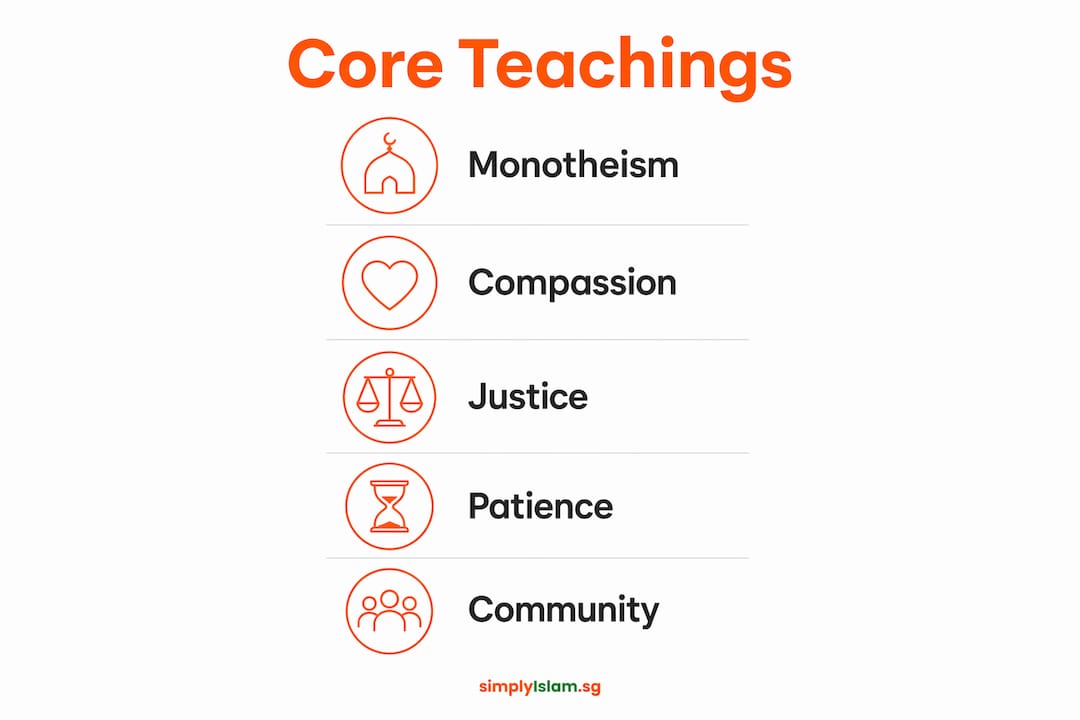
The teachings of Prophet Muhammad center on Tawhid, the absolute oneness of Allah, and on living that belief through daily conduct. He did not separate spiritual practice from social behavior. How you treat your neighbor, your employee, your spouse, and even a stranger on the road all fall within the scope of his teachings. That integration of faith and ethics is what makes the Sunnah so practically rich.
The Quran describes him directly in verse 68:4 as being “of an exalted standard of character,” and in verse 33:21 as a goodly model for believers to follow. These are not vague compliments. They are instructions. Muslims are called to study his conduct and apply it, not just admire it from a distance.
His core ethical teachings include:
- Mercy (Rahmah): He described himself as a mercy to all of creation, not only to Muslims
- Honesty (Sidq): He condemned deception in trade, speech, and personal conduct
- Humility: He mended his own clothes, helped with household chores, and refused to be treated as royalty
- Justice (Adl): He held the powerful accountable; he famously said that even his own daughter would face justice if she wronged others
- Patience (Sabr): He endured years of persecution in Mecca without retaliating with violence
Pro Tip: When studying the Sunnah, pair each hadith with its historical context. A teaching about patience means more when you know it was delivered during a period of active persecution. Context turns rules into wisdom.
The role of the Quran and Sunnah together forms what Islamic scholars call the two primary sources of guidance. The Quran provides the divine text. The Sunnah, recorded in collections of hadith, provides the lived example of how that text was applied. Neither is complete without the other in traditional Islamic understanding.
How did Prophet Muhammad shape Islam as a religion and a society?
Islam defines Muhammad as the Seal of the Prophets, meaning the final messenger in a line that began with Adam and included Ibrahim, Musa, and Isa. This theological position means his revelation is considered complete and final. No new prophet follows. That belief gives the Quran and Sunnah their permanent authority in Islamic law and practice.
His influence on governance was equally significant. The concept of shūrā, or mutual consultation, was central to how he led. He consulted his companions before major decisions. He changed his position when presented with sound reasoning. That model rejected autocracy and set a precedent for consultative governance that shaped early Islamic civilization.
His impact on interfaith relations is documented in his interactions with the Christians of Najran and in the Constitution of Medina, which guaranteed religious freedom to Jewish tribes. These were not symbolic gestures. They were binding agreements with legal force.
The following four areas show how his legacy shaped Islamic civilization:
- Islamic theology: Established the doctrine of Tawhid as the non-negotiable foundation of faith, rejecting polytheism and the deification of any human being, including himself
- Islamic law (Sharia): His rulings and practices became the basis for fiqh (jurisprudence), covering everything from inheritance to commercial contracts
- Community structure: Built the ummah as a brotherhood that transcended tribal and racial lines, declaring in the Farewell Sermon that no Arab has superiority over a non-Arab except through piety
- Spiritual practice: Established the five daily prayers, the fast of Ramadan, and the pilgrimage to Mecca as pillars of Muslim life
| Area of influence | Pre-Islamic Arabia | After Muhammad’s mission |
|---|---|---|
| Governance | Tribal autocracy | Consultative leadership (shūrā) |
| Social equality | Tribal hierarchy; slavery normalized | Racial equality declared; rights for the vulnerable |
| Women’s rights | Women as property | Inheritance rights, consent in marriage, right to divorce |
| Interfaith relations | Tribal exclusion | Legal protections for non-Muslim communities |
Why does Prophet Muhammad’s example still matter today?
The Sunnah functions as a practical manual for daily life, covering areas as specific as mindful eating and as broad as conflict resolution. The “one-third stomach rule,” where the Prophet advised filling one-third of the stomach with food, one-third with water, and leaving one-third empty, anticipates modern nutritional science by 1,400 years. His guidance on workplace ethics, fair wages, and honest dealing maps directly onto contemporary corporate responsibility frameworks.
His teachings address modern challenges including environmental care, racial equality, and mental wellness. These are not retrofitted interpretations. They are direct extensions of principles he articulated in 7th-century Arabia. The universality of those principles is precisely why the Sunnah remains a living curriculum rather than a historical artifact.
Pro Tip: Start with the Shama’il Muhammadiyyah, the classical text describing the Prophet’s physical and moral character, to build a personal and emotional connection to his example before studying legal rulings. Character before compliance is the traditional sequence.
Practical applications of his example today include:
- Mental wellness: His emphasis on gratitude, remembrance of Allah (dhikr), and community support mirrors evidence-based approaches to psychological resilience
- Business ethics: His prohibition of deception, price manipulation, and exploitation of workers aligns with modern fair-trade and ESG principles
- Environmental responsibility: He forbade the wasteful use of water even in ritual purification, establishing a principle of conservation
- Leadership: The shūrā model he practiced offers a template for participatory decision-making in families, organizations, and governments
Applying prophetic wisdom to contemporary life is not about nostalgia. It is about recognizing that the ethical problems humans face have not fundamentally changed. Greed, injustice, and disconnection from purpose are as present today as they were in 7th-century Mecca. His answers remain worth studying.
Key Takeaways
Prophet Muhammad’s life, teachings, and governance model form a unified system of ethics and spirituality that remains directly applicable to modern life across cultures and contexts.
| Point | Details |
|---|---|
| Final prophet of Islam | Muhammad is the Seal of the Prophets, delivering the Quran as the final divine revelation. |
| 23-year prophetic mission | His mission from 610 CE to 632 CE produced the Quran, the Sunnah, and the first Muslim community. |
| Ethics at the core | His teachings on mercy, justice, honesty, and humility are the practical expression of Tawhid. |
| Shūrā as governance | He modeled consultative leadership, rejecting autocracy and establishing precedents for social justice. |
| Sunnah as living guidance | The Sunnah addresses modern challenges including nutrition, workplace ethics, and mental wellness. |
What studying his life taught me about living with purpose
I have spent years reading about religious figures, and the one thing that consistently surprises people about the Prophet’s biography is how ordinary his daily life was. He swept his own floor. He joked with his companions. He cried at funerals. He asked for forgiveness. That ordinariness is not a flaw in the narrative. It is the point.
Most people approach his life looking for miracles or controversy. What they find, if they read carefully, is a man who was deeply shaped by his character long before any revelation arrived. The Quran did not create his honesty or his compassion. It confirmed and directed what was already there. That tells us something important: prophetic character is not supernatural performance. It is consistent, daily, unglamorous virtue.
The interfaith dimension of his legacy also deserves more attention than it typically receives. His documented agreements with Jewish and Christian communities were not diplomatic compromises. They were principled positions rooted in his theology. He believed in the dignity of all people who submitted to God, regardless of the specific tradition they came from. That is a starting point for respectful interfaith engagement that many communities are still working toward.
What I find most useful is treating his life not as a museum exhibit but as a mirror. The question is not only “What did he do?” The question is “What would that same principle look like in my workplace, my family, my neighborhood?” That shift from historical curiosity to personal application is where the real value lives.
— Lily
Deepen your understanding with SimplyIslam
SimplyIslam has supported over 22,000 participants in Singapore in building a grounded, practical understanding of their faith. For working adults who want to study the Prophet’s life and teachings without sacrificing their schedule, SimplyIslam offers structured options that fit real lives.
The Islamic education for working adults program covers the Sirah, the Sunnah, and applied Islamic ethics through ARS-certified instructors who prioritize understanding over memorization. If you prefer to start at your own pace, SimplyIslam’s free Islamic resources include lesson materials on the Prophet’s biography and character. Islamic evening classes are also available for professionals who want structured learning without daytime commitments. The Prophet’s example is worth studying seriously. SimplyIslam makes that possible.
FAQ
Who is Prophet Muhammad in Islam?
Prophet Muhammad is the final prophet and Seal of the Prophets in Islam, born in Mecca around 570 CE. Muslims believe he received the Quran through divine revelation and that his example, the Sunnah, is the authoritative guide for Muslim life.
What was the Farewell Sermon?
The Farewell Sermon was delivered by the Prophet on Mount Arafat in 632 CE and addressed racial equality, women’s rights, the prohibition of usury, and the sanctity of human life. It concluded with the revelation of Quran 5:3, marking the completion of the religion.
Is Prophet Muhammad worshipped by Muslims?
Muslims honor and follow the Prophet but do not worship him. Worship belongs exclusively to Allah, and the Prophet himself taught that elevating any human to divine status contradicts the core principle of Tawhid.
What is the Sunnah?
The Sunnah is the recorded words, actions, and approvals of the Prophet, compiled in hadith collections. It functions as a practical guide covering everything from daily hygiene and eating habits to conflict resolution and business ethics.
How long did Prophet Muhammad’s prophetic mission last?
His prophetic mission lasted 23 years, from the first revelation in 610 CE until his death in Medina on June 8, 632 CE. During that period, the Quran was revealed in stages and the Muslim community was established.
Recommended
- Khuluq al-Qur’an: The Reality of Prophet Muhammad’s Character in the Qur’an
- Prophet Muhammad and The Christians of Najran: Qur’anic Insights and Historical Dialogue Among the People of God
- Living the Sirah: Prophetic Wisdom in Times of Crisis – SimplyIslam.sg
- The Pulse of Iman: Love for the Prophet ﷺ as the Essence of Faith – SimplyIslam.sg