

What is sirah, and why does it matter?
The word sirah comes from the Arabic verb sāra, meaning “to travel” or “to be on a journey.” A person’s sirah is their journey through life, encompassing birth, character, significant events, and death. In Islamic tradition, the term refers specifically to Al-Sīrah Al-Nabawiyyah, the prophetic biography of Prophet Muhammad ﷺ, compiled over centuries by Muslim historians as a religiously venerated historical record.
Sirah is not simply a history book. It documents speeches, political treaties like the Constitution of Medina, military campaigns, letters to foreign rulers, and the Prophet’s ﷺ personal character traits. Early sirah literature grew out of oral storytelling traditions called maghazi, stories of military expeditions, before scholars like Ibn Shihab al-Zuhri and later Ibn Hisham shaped them into the written compilations Muslims rely on today.
The core components documented in sirah include:
- The Prophet’s ﷺ lineage, birth, and early childhood in Mecca
- His character before prophethood, known as Al-Amin (The Trustworthy) and As-Sadiq (The Truthful)
- The first revelation and the beginning of his prophetic mission
- The Meccan period of preaching, persecution, and patience
- The Hijrah (migration) to Medina and the establishment of the Islamic state
- Military campaigns, treaties, and interfaith engagements
- His ﷺ sermons, including the Farewell Pilgrimage address
- Stories of his companions, their virtues, and their struggles
- His final illness and death
Key events and phases in the Prophet’s ﷺ life
The sirah unfolds across distinct phases, each carrying its own lessons for Muslims today.
| Phase | Key Event |
|---|---|
| Early life | Birth in Mecca into the Quraysh tribe |
| Prophethood begins | First revelation in Cave Hira |
| Meccan period | Public preaching, persecution, early converts |
| Hijrah | Migration from Mecca to Medina |
| Medinan period | Battle of Badr, Treaty of Hudaybiyyah |
| Final years | Conquest of Mecca, Farewell Pilgrimage |
Prophet Muhammad ﷺ was born in Mecca in 570 CE into the noble Quraysh tribe, losing his father before birth and his mother at age six. Despite that hardship, he grew into a man his community trusted completely. At forty, he received the first verses of the Quran in Cave Hira, beginning a twenty-three-year mission that would reshape Arabian society from the ground up.
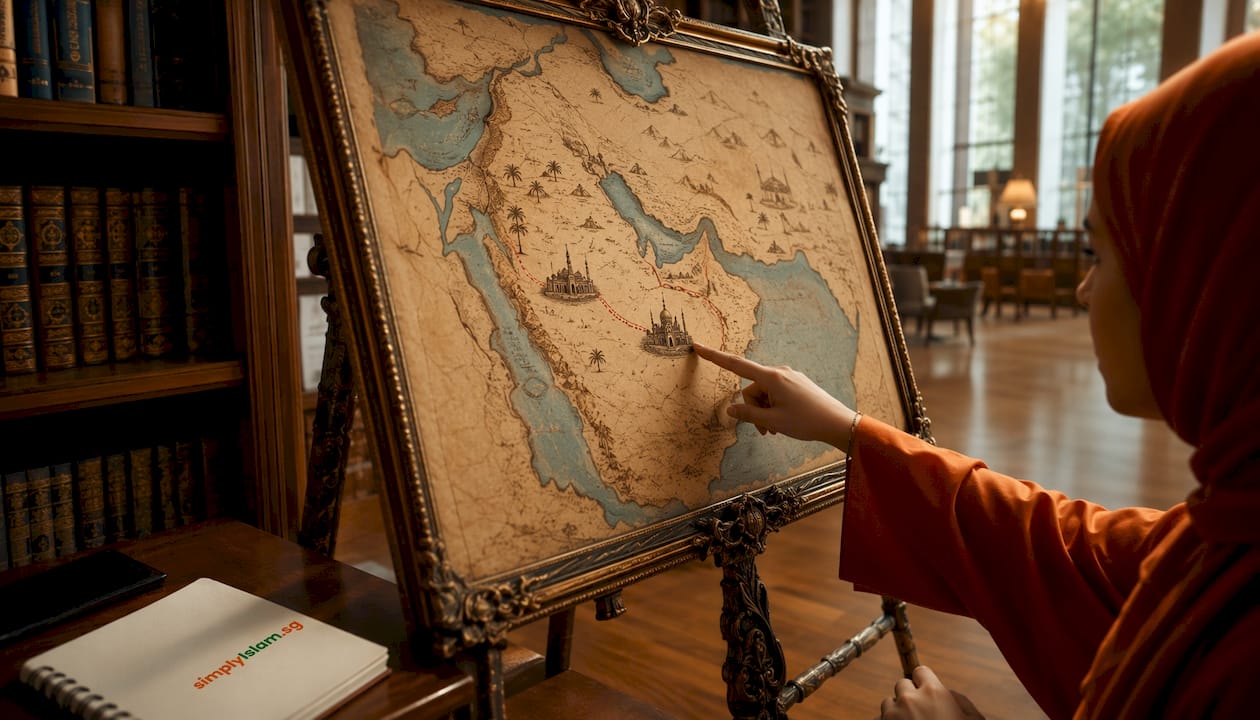
The Medinan period is where the sirah’s social and political dimensions come alive. The Prophet ﷺ established the Constitution of Medina, navigated alliances, led military campaigns like the Battle of Badr, and signed the Treaty of Hudaybiyyah, a document scholars consider one of the most consequential political agreements in early Islamic history. His Farewell Pilgrimage sermon stands as a defining statement of human equality and prophetic legacy.
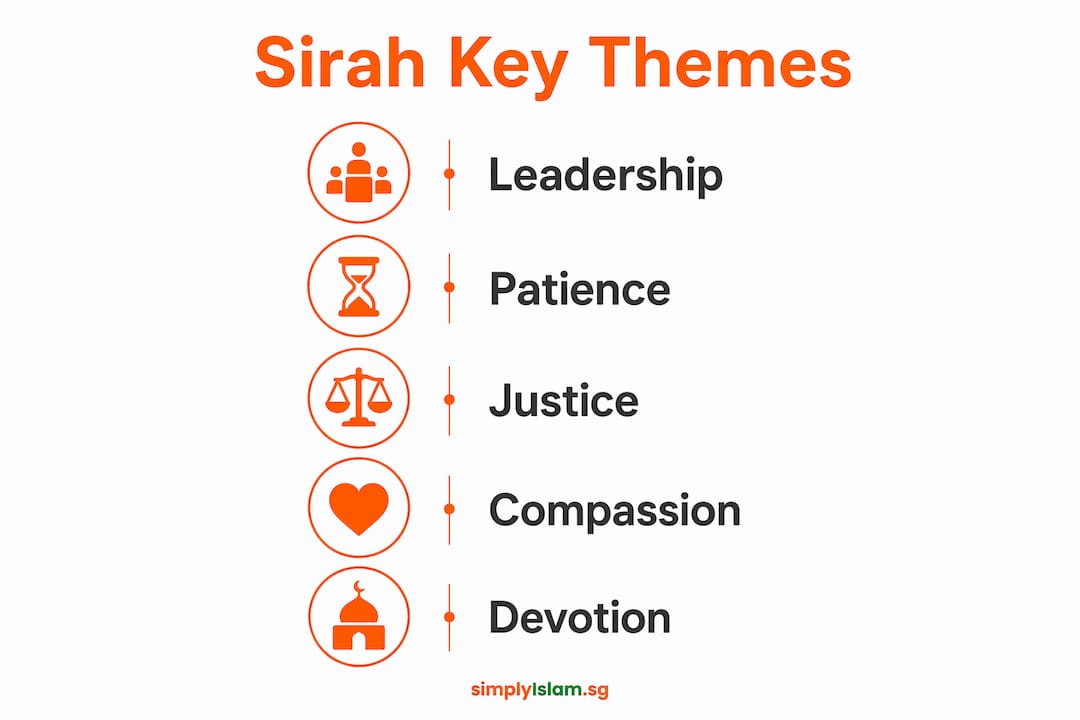
The major themes running through these events are leadership, patience, justice, compassion, and devotion to Allah. The sirah does not present a sanitized portrait. It shows a man tested repeatedly, and it shows how he responded each time with integrity and trust in Allah.
Why sirah is central to Islamic faith and education
Sirah is one of the three pillars Muslims draw on to understand their religion, alongside the Quran and hadith. Without it, many Quranic verses lose their context. Knowing when a verse was revealed, what situation prompted it, and how the Prophet ﷺ responded transforms abstract guidance into lived wisdom.
Scholars approach sirah as a foundational source for understanding the Sunnah in its full historical setting. This is why sirah study is woven into Islamic curricula from children’s programs to advanced seminary tracks. It builds faith not through abstract theology alone, but through the concrete example of a human being navigating real trials.
A few points worth holding onto:
- Sirah provides moral exemplars for every life stage, from youth to leadership to grief
- It contextualizes Quranic revelations, showing the circumstances behind specific ayat
- It grounds the Sunnah in historical reality, making the Prophet’s ﷺ choices understandable
- It addresses interfaith relations, as seen in the Prophet’s dialogue with the Christians of Najran
One honest challenge: early sirah sources carry varying degrees of historical reliability. Lawrence Conrad’s research notes that even the dates of the Prophet’s ﷺ birth span a range across early texts, reflecting what he called “the fluidity of the written period.” Islamic scholars address this through critical isnad analysis, weighing chains of transmission carefully rather than accepting every report at face value. This scholarly rigor is part of what gives sirah its credibility as a discipline.
How to study sirah effectively today
Modern learners have more access to quality sirah education than any previous generation. The key is choosing a format that matches your schedule and learning style, then committing to it consistently.
Structured courses work better than passive reading for most people. A course with a qualified instructor gives you context, answers your questions, and connects individual events to the broader arc of the Prophet’s ﷺ mission. Online sirah courses now make this accessible regardless of where you live in the United States.
Practical approaches that deepen understanding:
- Follow a chronological framework so events build on each other logically
- Use geographic mapping to visualize where events took place, connecting location to meaning
- Keep a reflection journal linking sirah events to your own spiritual practice
- Study the character of the Prophet ﷺ alongside historical events, not separately
- Pair sirah study with Quran reading to see how revelations responded to real situations
- Engage with the Shama’il Muhammadiyyah for a deeper look at his ﷺ personal qualities
Pro Tip: Using geographic and chronological metadata in historical study allows you to map revelations, battles, and personal events onto a layered timeline. This multidimensional approach reveals connections that a linear reading of the text alone will miss.
SimplyIslam offers programs like Living the Sirah and the Sirah Retreat Kids’ Camp, taught by ARS-certified instructors who emphasize interactive learning over rote memorization. For families looking to integrate sirah into children’s Islamic education, structured programs like these provide both depth and engagement.
What do sirah courses typically cost?
Sirah education spans a wide range of formats and price points, making it accessible at almost every level.
- Self-paced online courses start around $39 for a foundational series, ideal for independent learners
- Live instructor-led classes run higher, reflecting the depth of real-time Q&A and guided discussion
- Diploma-track programs at institutions like Cambridge Muslim College command premium fees for their academic rigor and structured progression
- Community-based weekly programs at local Islamic centers often run on a donation or low-cost model
- Kids’ camps and retreats combine experiential learning with sirah content, typically priced as short-term intensive programs
SimplyIslam’s courses sit in the structured, instructor-led category, with ARS-certified teachers and interactive methods that go well beyond a recorded lecture series. For working adults in the US, evening and flexible class formats make consistent study realistic without sacrificing quality.
Influential contemporary scholars in sirah studies
Several scholars have shaped how Muslims today engage with the prophetic biography.
Shaykh Abdal Hakim Murad (Dr. Timothy Winter), Shaykh Zayed Lecturer of Islamic Studies at Cambridge University, produced the Sira: A Journey of Transformation lecture series through Cambridge Muslim College, covering the Prophet’s ﷺ life through the Quran, poetry, and early classical sources across nine lectures.
Dr. Yasir Qadhi has produced one of the most widely accessed English-language sirah lecture series in the United States, running to dozens of hours and drawing on both classical Arabic sources and contemporary scholarship.
Martin Lings (Abu Bakr Siraj ad-Din) authored Muhammad: His Life Based on the Earliest Sources, a work praised by scholars across traditions for its literary quality and fidelity to classical sirah texts. It remains one of the most recommended English-language biographies of the Prophet ﷺ.
Sheikh Yasir Birjas and other North American scholars have made sirah accessible through mosque lecture series and online platforms, tailoring the content specifically for Muslim communities in the West.
Key Takeaways
Sirah is the prophetic biography of Prophet Muhammad ﷺ, rooted in Arabic oral tradition and compiled by classical scholars, serving as a foundational source for Islamic faith, Quranic context, and moral guidance.
| Point | Details |
|---|---|
| Sirah’s core meaning | Derived from the Arabic root for “journey,” it covers the Prophet’s ﷺ birth, character, mission, and death. |
| Classical sources | Ibn Shihab al-Zuhri and Ibn Hisham were among the key scholars who shaped sirah into written compilations. |
| Faith and context | Sirah contextualizes Quranic verses and the Sunnah, making both more meaningful for daily Muslim life. |
| Modern study formats | Self-paced courses start around $39; instructor-led and diploma-track programs reflect greater depth and interactivity. |
| Scholarly rigor | Scholars use critical isnad analysis to address historical fluidity in early sirah sources. |