
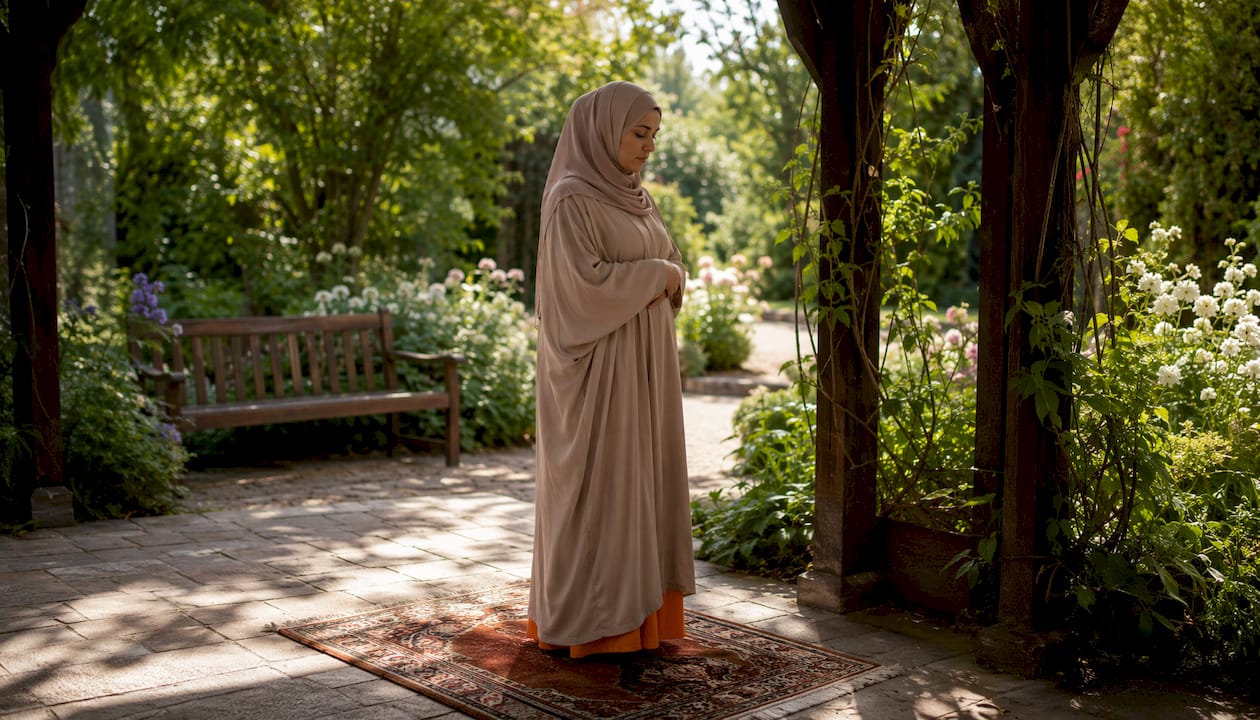



How women perform salah according to Hanafi fiqh
Hanafi fiqh prayer for ladies follows the same essential structure as men’s prayer, but with specific postural and modesty adjustments rooted in the principle of sitra (concealment). These differences are not minor preferences. They are established rulings traced to the female Companions of the Prophet ﷺ and codified by classical jurists like Ibn Abidin in Radd al-Muhtar. Every Muslim woman who prays according to the Hanafi madhhab should know them clearly.
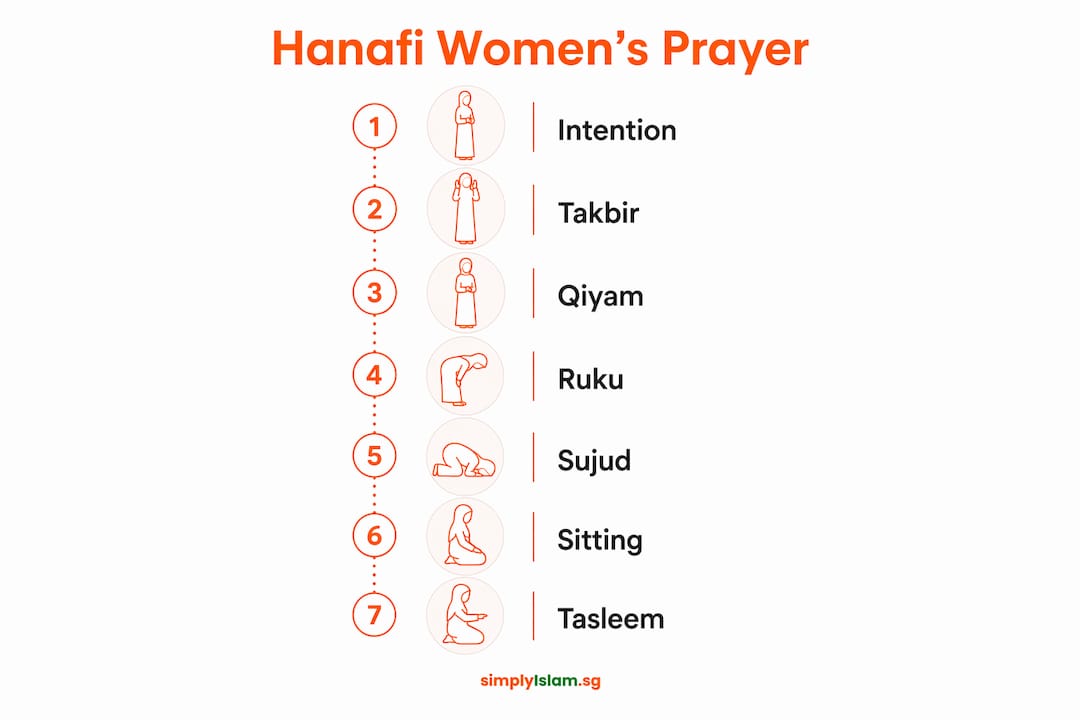
Here is the complete step-by-step sequence for a woman’s salah:
- Intention (Niyyah): Make the intention in your heart for the specific prayer (Fajr, Zuhr, Asr, Maghrib, or Isha). Words are not required, but saying them softly helps focus the mind.
- Opening Takbir: Raise both hands to shoulder level (not ear level as men do), palms facing forward, without removing hands from sleeves to avoid exposing the forearms. Say “Allahu Akbar” (اللهُ أَكْبَر) audibly enough to hear yourself.
- Qiyam (Standing): Place the right inner palm on top of the left hand and rest both on the chest, without clasping. Men place hands below the navel and clasp; women do not.
- Opening Du’a (Thana’): Recite silently:
- Ta’awwudh and Tasmiyyah: Say “A’udhu billahi min ash-shaytan ir-rajim” then “Bismillah ir-Rahman ir-Rahim.”
- Recitation of Surah al-Fatiha: Recite all seven verses silently (or at a soft voice when praying alone in Maghrib, Isha, or Fajr with no unrelated men present). Follow with a short surah such as Surah al-Ikhlas.
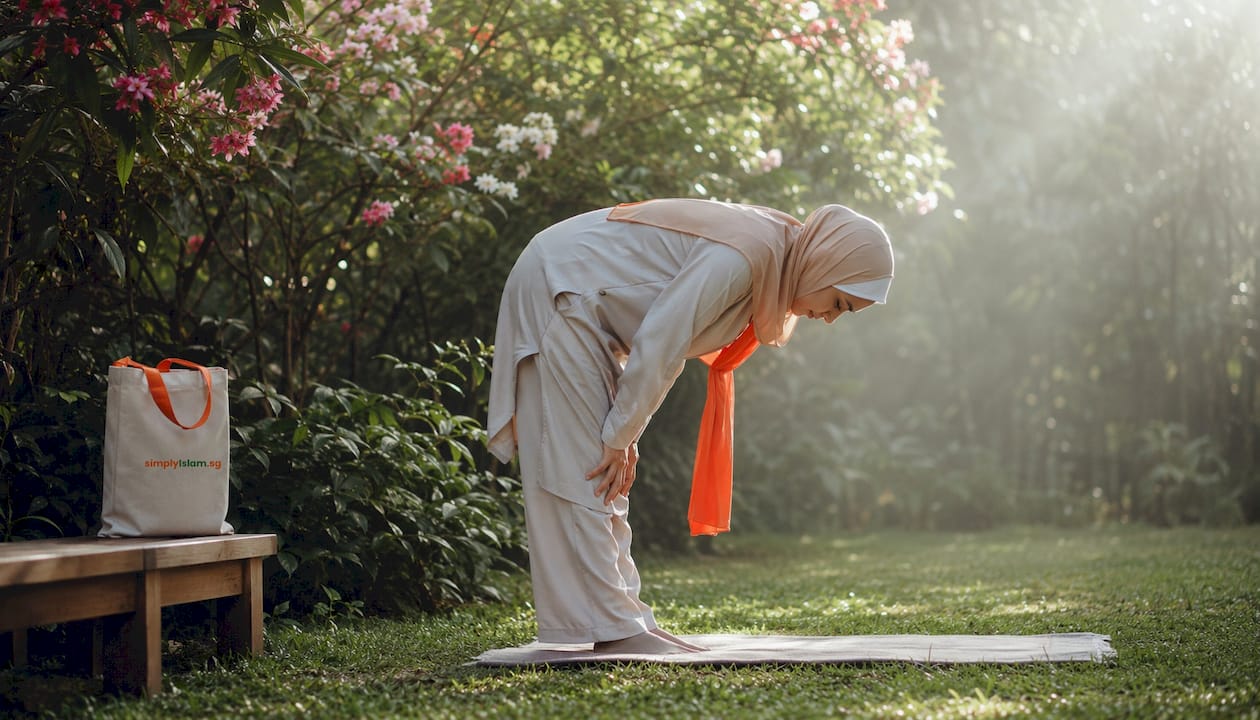
- Ruku (Bowing): Bow slightly, just enough for the palms to rest on the knees without grasping them. Keep fingers closed together, knees slightly bent, and upper arms close to the sides. Do not straighten the back fully as men do.
- Rising from Ruku: Say “Sami’allahu liman hamidah” while rising, then “Rabbana wa lakal-hamd.”
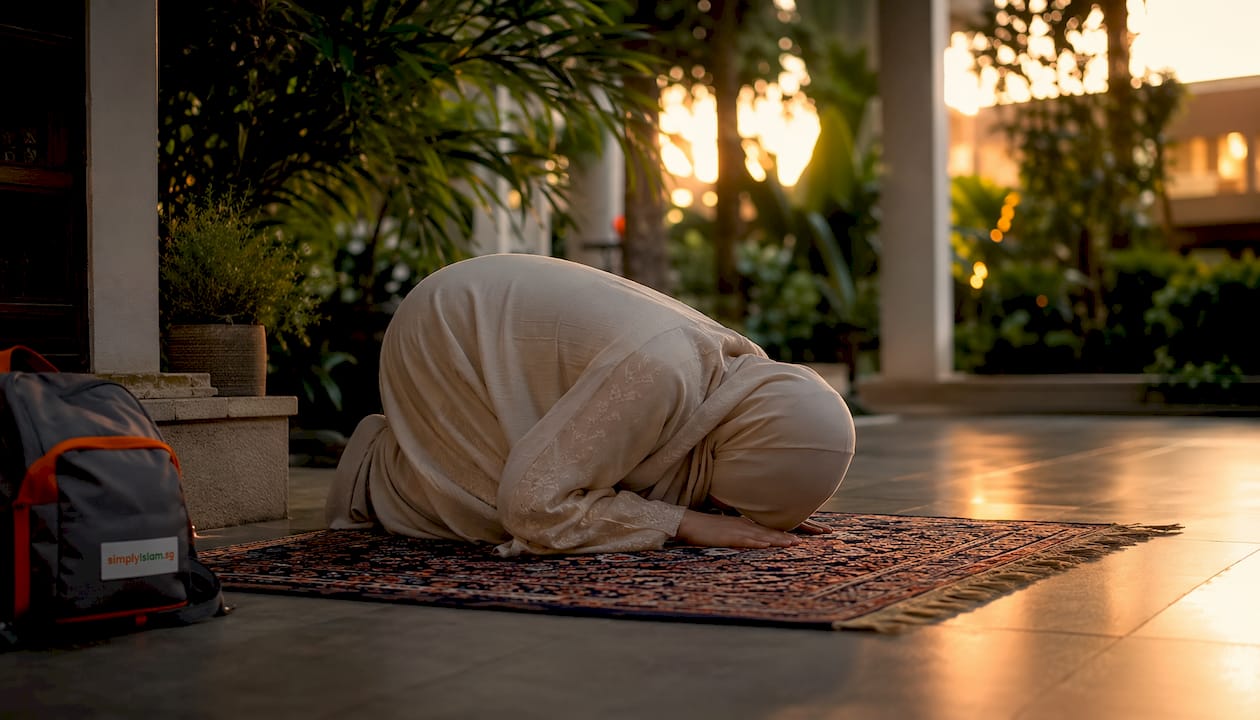
- Sujud (Prostration): Lower to the ground, placing the forehead and nose down. Rest the forearms flat on the ground, keep the abdomen on the thighs, and draw all limbs inward. Do not raise the toes upward.
- Sitting between Prostrations (Jalsah): Sit upright and say “Rabbighfir li” (رَبِّ اغْفِرْ لِي) — “My Lord, forgive me.”
- Second Prostration: Repeat as above.
- Tashahud Sitting (Tawarruk): Sit on the left buttock with both legs extended to the right side, right thigh resting on the left. Place hands flat on the thighs, fingers closed, with fingertips reaching the knees.
- Tashahud Recitation: Recite softly:
At-tahiyyatu lillahi was-salawatu wat-tayyibatu, as-salamu ‘alayka ayyuhan-nabiyyu wa rahmatullahi wa barakatuh, as-salamu ‘alayna wa ‘ala ‘ibadillahis-salihin. Ashhadu an la ilaha illallah wa ashhadu anna Muhammadan ‘abduhu wa rasuluh.
- Salawat on the Prophet ﷺ: Recite Salawat Ibrahimiyyah softly.
- Final Salam: Turn the head to the right and say “As-salamu ‘alaykum wa rahmatullah,” then repeat to the left.
Pro Tip: Before you begin, take three slow breaths and remind yourself who you are standing before. Khushu (spiritual presence) is not a feeling you wait for — it is a posture of the heart you choose at the start of every prayer.
Understanding each movement in depth for women
Hands and chest placement in qiyam
Women place the right inner palm directly on top of the left hand, resting both on the chest. This position differs from men’s, who clasp hands below the navel. The chest placement keeps the body compact and is the established Hanafi ruling for women’s standing posture.
Bowing (ruku) done the right way
During ruku, a woman bows only enough for her palms to touch her knees. She does not straighten her back to a horizontal position as men do. Her fingers stay closed together, her knees bend slightly, and her upper arms remain pressed against her sides throughout the bow.
| Prayer Position | Women’s Hanafi Ruling | Men’s Practice |
|---|---|---|
| Opening takbir hands | Raised to shoulder level | Raised to ear level |
| Hand placement in qiyam | Right on left, resting on chest | Clasped below navel |
| Ruku depth | Slight bow, palms touch knees | Full horizontal back alignment |
| Fingers in ruku | Closed together | Spread apart |
| Sujud forearms | Flat on ground, limbs drawn in | Arms raised, elbows off ground |
| Toes in sujud | Not raised upward | Pointed toward qibla |
| Tashahud sitting | Tawarruk (left buttock, legs right) | Iftirash or tawarruk varies |
Prostration (sujud) and concealment
Women keep their forearms flat on the ground during sujud, with the abdomen resting on the thighs and all limbs drawn inward. This is the Sunnah practice for women, distinct from men who lift their elbows and separate the stomach from the thighs. The Prophet ﷺ specifically instructed women to press their limbs to the ground, as recorded in the Marasil of Abu Dawud.
The tawarruk sitting position
Classical Hanafi texts prescribe tawarruk as the sitting posture for women in all tashahud positions. She sits on her left buttock with both legs extended to the right, right thigh resting on the left, feet kept horizontally on the ground. This is an explicit fiqhi ruling, not a custom, and it applies in every sitting of the prayer.
Pro Tip: If you find the tawarruk position uncomfortable at first, practice it outside of prayer time until it becomes natural. The body adapts quickly, and the posture itself is a form of worship.
Distinctive Hanafi rules and modesty practices for women’s prayer
The organizing principle behind every difference in a woman’s prayer is sitra, the concept of maximum concealment during worship. Imam Bayhaqi articulated this clearly:
This principle explains why women bow less deeply, keep limbs drawn inward during prostration, and sit in tawarruk. None of these rulings are arbitrary. Each one traces back to authentic narrations and the practice of female Companions like Umm al-Darda, whose example Hanafi scholars cite as foundational jurisprudential evidence.
Covering the ‘awrah in prayer
A woman must cover her entire body except the face and hands during prayer. Covering the feet is superior and preferred, given the scholarly difference of opinion on whether feet are part of the ‘awrah. Clothing must be opaque and loose enough that it does not describe body contours. Sheer fabric that reveals hair color or skin tone invalidates the prayer’s covering requirement.
Voice level during prayer
Recitation is kept at a soft voice (sirr al-sawt) when a woman prays alone or in a mixed setting. She must still recite at a level where she can hear herself, as this is a condition for the prayer’s validity. In a women-only congregation, she may recite aloud in the prayers that call for it (Fajr, Maghrib, Isha) when no unrelated men are within earshot.
Adhan and iqama for women
- Women do not give the adhan in any setting.
- The iqama is recommended for women praying alone or in a women-only group.
- If unrelated men are nearby, giving the iqama is not recommended.
- In the Hanafi madhhab, it is prohibitively disliked for a woman to give the adhan in a general setting.
Congregational prayer rules
When praying behind a male imam, women stand in the rows furthest from the imam. If a woman leads other women in prayer, she stands in the middle of the front row rather than ahead of it. Women do not lead men in prayer under any circumstance in the Hanafi school.
Practical guidance and common questions for women praying Hanafi
Frequently asked questions
Can a woman correct the imam’s mistake during prayer?
Yes, but not by speaking. Women signal by clapping once, without excessive movement, whereas men say “SubhanAllah” aloud. This is a specific Hanafi ruling that preserves the woman’s silence in a mixed congregation.
Does a woman need to attend Friday prayer?
She is not obligated to attend Jumu’ah. If she does attend and completes it, it counts as her Dhuhr prayer for that day.
Is Eid prayer obligatory for women?
No. Attending the Eid prayer is not obligatory (wajib) for women in the Hanafi madhhab, unlike for men.
What if she makes a mistake mid-prayer?
Minor errors in recitation do not invalidate the prayer. If she skips a wajib act (like a required recitation), she performs the prostration of forgetfulness (sujud al-sahw) at the end before the final salam.
Do’s and don’ts for women’s salah
- Do cover the entire body including feet (preferred) before beginning.
- Do keep all limbs drawn inward during ruku and sujud.
- Do recite at a level you can hear yourself, even in silent prayers.
- Do sit in tawarruk for every tashahud position.
- Don’t raise hands above shoulder level during the opening takbir.
- Don’t spread fingers apart in ruku or tashahud.
- Don’t raise toes upward during sujud.
- Don’t lead men in prayer or give the adhan.
For women praying in congregation, maintaining focus is easier when you choose a spot with minimal visual distraction and arrive before the imam begins. The essentials of prayer become second nature once the postures are practiced consistently outside of prayer time.
Pro Tip: Write out the key differences between your postures and men’s postures on a small card and review it weekly. Muscle memory builds faster when the mind is clear on the “why” behind each movement.
Why scholarly grounding matters for women learning their prayer
Teaching women’s prayer correctly requires more than reciting a list of differences, as explained in this practical guide for pilgrims. It requires understanding the fiqhi rationale behind each ruling so that the prayer feels meaningful, not mechanical.
The Hanafi madhhab’s approach to women’s prayer is grounded in the example of the female Sahaba. Umm al-Darda’s practice of raising hands to the shoulders, recorded in Musannaf Ibn Abi Shaybah, is one of the clearest pieces of evidence the madhhab relies on. This is not a matter of cultural preference. It is institutional jurisprudence backed by chains of transmission.
For Muslim women in the United States seeking structured learning, the challenge is often finding instruction that goes beyond surface-level descriptions. A qualified female educator who understands both the classical texts and the lived experience of modern women makes a real difference in how confidently a student can apply these rulings.
SimplyIslam’s ARS-certified instructors teach the fiqh of women’s prayer with exactly this depth, connecting each ruling to its textual basis so students understand what they are doing and why. For women who want to pray with both correctness and spiritual presence, that combination of knowledge and confidence is the goal.
Pro Tip: If you are unsure whether your prayer posture is correct, record yourself praying and compare each position against the Hanafi rulings listed in this guide. Seeing your own posture is far more effective than reading alone.
Rulings on praying during menstruation and postpartum bleeding
A menstruating woman does not pray. This is a firm ruling in all four schools of Islamic law, including the Hanafi madhhab. Prayer is suspended for the duration of menstruation (hayd), and missed prayers during this period are not made up afterward. This is one of the clearest distinctions between prayer and fasting: missed fasts from Ramadan must be made up, but missed prayers during menstruation are permanently waived.
Postpartum bleeding (nifas) follows the same ruling. A woman who is experiencing nifas does not pray until the bleeding stops and she has performed the ritual bath (ghusl). The maximum period for nifas in the Hanafi school is forty days. If bleeding stops before forty days, she performs ghusl and resumes prayer immediately.
After either hayd or nifas ends, performing ghusl correctly is the prerequisite for returning to prayer. The ghusl must cover the entire body, including the hair roots, and water must reach every part of the skin. Once ghusl is complete, she resumes her full prayer schedule from that point forward without needing to compensate for prayers missed during the bleeding period.
During menstruation and nifas, a woman can maintain her spiritual connection through dhikr, listening to Quran recitation, and making du’a. These acts of worship remain open to her and help preserve the rhythm of devotion even when formal prayer is suspended.
Key Takeaways
Hanafi fiqh prayer for ladies follows the same core structure as men’s prayer, with specific postural and modesty differences that are obligatory, not optional, and rooted in authentic narrations from the Prophet ﷺ and the female Companions.
| Point | Details |
|---|---|
| Postural differences are obligatory | Women’s ruku, sujud, and sitting positions differ from men’s by explicit Hanafi ruling, not custom. |
| Sitra governs every difference | Every adjustment in women’s prayer traces back to the principle of maximum concealment during worship. |
| Tawarruk is the required sitting posture | Women sit on the left buttock with legs extended to the right in every tashahud position. |
| Menstruation suspends prayer entirely | Missed prayers during hayd or nifas are not made up; ghusl is required before resuming. |
| SimplyIslam teaches this with depth | SimplyIslam’s ARS-certified instructors connect each ruling to its textual basis for confident, correct practice. |
SimplyIslam offers structured Hanafi fiqh learning for women
Knowing the rules is one thing. Praying with confidence and correctness, every single day, is another. SimplyIslam was built for exactly this gap.

SimplyIslam’s women’s fiqh courses go beyond a checklist of postures. ARS-certified instructors walk through each ruling with its textual evidence, so you understand the “why” behind every movement, from the tawarruk sitting position to the soft recitation rules. The platform has served over 22,000 participants and raised more than $1.1 million for charity, reflecting a community that takes Islamic education seriously. For working women and busy mothers who want structured, accessible learning without long commutes, SimplyIslam’s evening classes for professionals offer a practical path to mastering the fiqh of prayer at your own pace. Start with the course that fits your schedule and pray with the clarity your worship deserves.