

Conversational Arabic is defined as the practical spoken communication skill that lets you connect with native speakers in real, everyday situations. Whether your goal is to strengthen family bonds, prepare for travel to an Arab country, or build professional relationships, learning Arabic for conversation is the fastest path to genuine connection. With the right approach, including smart dialect selection and consistent speaking practice, basic conversational fluency is achievable in 3–4 months. This guide gives you the exact steps to get there.
What is Arabic for conversation, and which form should you learn?
Arabic exists in two main forms, and confusing them is the single biggest mistake beginners make. Modern Standard Arabic (MSA) is the formal, written register used in newspapers, official speeches, and religious texts. Dialects are what native speakers actually use when talking to each other every day.
The most widely spoken dialects include:
- Egyptian Arabic: Understood across the Arab world due to Egypt’s film and media influence. A strong choice for general communication.
- Levantine Arabic: Spoken in Syria, Lebanon, Jordan, and Palestine. Natural for travel or relationships in the eastern Mediterranean.
- Gulf Arabic: Used across Saudi Arabia, the UAE, Kuwait, and Qatar. Practical for professional contexts in the Gulf region.
- Moroccan Arabic (Darija): Distinct and heavily influenced by French and Berber. Best chosen only if your focus is North Africa.
Mixing MSA with dialects early in your learning creates confusion and slows real conversational progress. The two systems have different vocabulary, pronunciation patterns, and sentence rhythms. Trying to use both at once is like learning two languages at the same time before you are comfortable in either.
A hybrid approach works well once you have a foundation. Use MSA for reading, formal writing, and understanding religious content. Use your chosen dialect for speaking and daily interaction. This gives you competence in both formal and informal contexts without the early confusion.

Pro Tip: Pick one dialect and commit to it for your first six months. Switching between dialects before you have a solid base will fragment your progress and make it harder to sound natural in any of them.
What phrases do you need to start an Arabic conversation?
High-frequency polite phrases are the first real milestone in spoken Arabic. Focusing on these expressions builds rapport with native speakers before you ever master complex grammar. They signal respect, cultural awareness, and genuine effort.
Start with greetings and basic social phrases:
- “As-salamu alaykum” (Peace be upon you): The universal Islamic greeting, appropriate in nearly every Arab context.
- “Marhaba” (Hello): Casual and widely understood across dialects.
- “Keifak?” / “Keifek?” (How are you? masculine/feminine): A standard opener in Levantine Arabic.
- “Shukran” (Thank you): One of the first words every learner picks up, and one of the most used.
- “Afwan” (You’re welcome / Excuse me): Doubles as a polite response and a way to get someone’s attention.
- “Fursa sa’ida” (Nice to meet you): Used when meeting someone for the first time.
- “Ismi…” (My name is…): The foundation of any self-introduction.
- “Ana min…” (I am from…): Tells people where you are from and opens natural follow-up questions.
Arabic marks gender in speech, which surprises many English speakers. The phrase “Keifak?” addresses a man, while “Keifek?” addresses a woman. Verbs and adjectives also change form depending on who you are speaking to. Learning these variations early prevents awkward moments and shows cultural sensitivity.
Pronunciation is where many learners develop bad habits. Arabic contains sounds that do not exist in English, including the guttural “ayn” (ع), the emphatic “ha” (ح), and the deep “kha” (خ). Practicing these sounds with audio resources or a native speaker from the start prevents those habits from hardening.
“Polite greetings and professional etiquette create immediate cultural respect. Mastering a handful of high-frequency phrases opens more doors than knowing hundreds of vocabulary words you cannot use in real time.”
How do you build Arabic conversation skills quickly?
Active speaking practice is the core of rapid fluency. Role-played dialogue produces 40% better vocabulary retention than passive memorization. That gap is significant. It means every hour you spend speaking is worth nearly twice as much as an hour spent reading flashcards or listening without responding.
The most effective methods, ranked by impact:
-
Substitution drills: Take a sentence structure and swap out one element at a time. “Ana min Singapore” becomes “Ana min Masr” (Egypt) or “Ana min Lubnan” (Lebanon). Substitution drills build spontaneous fluency faster than memorizing isolated words because they train your brain to generate sentences, not just recall them.
-
Role-play realistic scenarios: Practice ordering food, asking for directions, or introducing yourself in a professional setting. Contextual vocabulary sticks because it is tied to a situation you can visualize and repeat.
-
Short daily sessions: Ten minutes of daily practice beats one 90-minute session per week. Consistency prevents errors from becoming permanent habits and keeps new vocabulary active in your memory.
-
AI conversation tools: Apps and AI chat tools offer low-pressure environments to practice spoken phrases without fear of judgment. They are useful for drilling greetings, basic questions, and responses before you speak with a real person.
-
Native speaker feedback: No tool replaces a native speaker who can correct your pronunciation in real time. Pronunciation feedback on sounds absent in English is critical to avoid hardening bad habits. Throat sounds and emphatic letters need a trained ear to correct.
-
Structured courses with live practice: Programs that dedicate the majority of class time to speaking, rather than grammar lectures, produce faster results. The Berlitz Method, for example, dedicates 80% of class time to active oral practice. That ratio reflects what research consistently shows about language acquisition.
Pro Tip: Combine scripted practice with spontaneous speaking. Use structured drills to build confidence, then push yourself into unscripted conversations with a native speaker or language partner at least once a week.
What are the most common mistakes in learning spoken Arabic?
Most learners plateau not because Arabic is too hard, but because they repeat the same avoidable mistakes. Recognizing these patterns early saves months of frustration.
-
Mixing MSA and dialect too early. This is the most common error. Committing to one dialect initially creates a stable foundation. Mixing the two before you are fluent in either produces speech that sounds unnatural to native speakers.
-
Prioritizing grammar over function. Arabic grammar is complex, but native speakers do not expect perfection from learners. They respond to meaning and effort. Spending 80% of your study time on grammar rules and 20% on speaking produces the opposite of what you need.
-
Fear of making mistakes. Silence is the enemy of fluency. Every error you make out loud is a correction opportunity. Every error you avoid by staying quiet is a missed one.
-
Ignoring pronunciation feedback. Bad pronunciation habits form quickly and become harder to break over time. Seek feedback early, even if it feels uncomfortable.
-
Over-relying on textbooks. Textbooks teach MSA and formal structures. Real Arabic conversation skills come from real conversations. Textbooks are a supplement, not a substitute.
-
Inconsistent practice. Skipping days allows vocabulary to fade and errors to solidify. Even five minutes of speaking practice on a busy day maintains momentum.
Cultural awareness also accelerates communication. Understanding when to use formal versus informal greetings, how gender affects speech, and what topics are sensitive in Arab culture makes you a more effective communicator. Language and culture are inseparable. You learn one by engaging with the other.
Key Takeaways
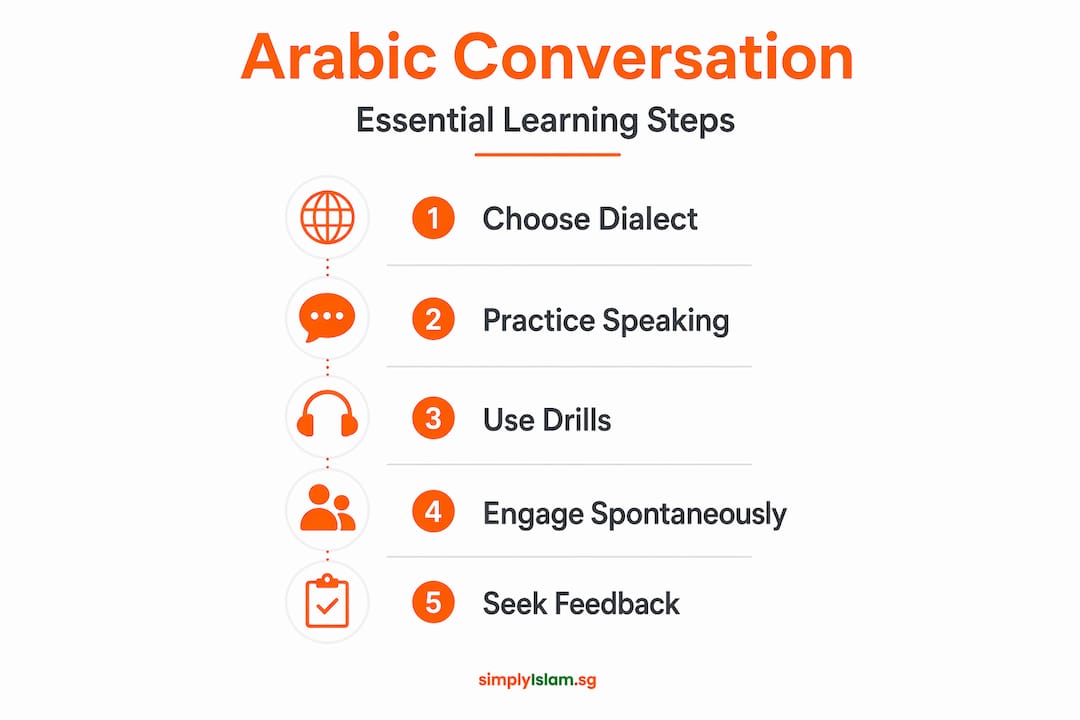
Conversational Arabic fluency comes from consistent speaking practice, smart dialect selection, and a focus on high-frequency phrases before complex grammar.
| Point | Details |
|---|---|
| Choose one dialect first | Commit to Egyptian, Levantine, or Gulf Arabic before mixing in MSA to avoid confusion. |
| Start with polite phrases | Greetings and social expressions build rapport immediately and open real conversations. |
| Speak daily, even briefly | Ten minutes of daily practice outperforms longer, infrequent sessions for retention and fluency. |
| Use substitution drills | Swapping elements in sentence patterns trains your brain to generate speech, not just recall words. |
| Get pronunciation feedback early | Correcting Arabic throat sounds and emphatic letters early prevents habits that are hard to break later. |
Why speaking first changed everything for me
Most people approach Arabic the way they approached high school Spanish: grammar worksheets, vocabulary lists, and a textbook that bears no resemblance to how anyone actually speaks. I did the same thing for months. I could conjugate verbs. I could not order a cup of tea.
The shift came when I stopped waiting until I felt “ready” to speak and just started speaking badly. Badly, and often. A native speaker does not need you to be perfect. They need you to try. That first stumbling conversation, full of wrong words and awkward pauses, taught me more than three months of textbook study.
What I have seen consistently, both in my own learning and in watching others, is that courage matters more than preparation at the early stages. You can learn conversational Arabic through structured courses, but the real acceleration happens the moment you use what you know in a real exchange. The grammar catches up. The vocabulary fills in. But only if you are already speaking.
The other thing most guides will not tell you: dialect choice is personal, not just practical. If your heart is drawn to the Quran and Islamic scholarship, MSA gives you access to a world of sacred text. If your goal is to connect with family, colleagues, or communities, a regional dialect gets you there faster. Both are valid. Both are worth pursuing. Just not at the same time, not at the start.
Embrace the mistakes. They are not setbacks. They are the method.
— Lily
SimplyIslam’s Arabic learning programs for working adults
SimplyIslam offers structured Arabic learning programs designed for busy adults who want real conversational progress, not just theoretical knowledge. Courses are taught by ARS-certified instructors who prioritize live speaking practice and immediate feedback, the two factors that research consistently links to faster fluency.
SimplyIslam’s approach suits working professionals and families who cannot commit to rigid schedules. Flexible evening and weekend options mean you can build Arabic conversation skills around your life, not the other way around. With over 22,000 participants and a track record of practical, faith-centered education, SimplyIslam brings the same depth to Arabic that it brings to all its Islamic studies programs. Explore the evening classes for professionals or browse the full range of Islamic courses to find the right fit for your goals.
FAQ
How long does it take to learn basic conversational Arabic?
Learners who combine two to three weekly sessions with consistent daily practice can reach basic conversational ability in 3–4 months. The key factor is active speaking practice, not passive study.
Should I learn Modern Standard Arabic or a dialect first?
Start with a dialect if your goal is everyday conversation. MSA is formal and used in writing and media, while dialects are what native speakers use daily. Mixing both too early slows practical progress.
What are the most useful Arabic phrases for beginners?
Greetings like “As-salamu alaykum,” “Marhaba,” and “Shukran” are the highest-priority phrases. Self-introduction tools like “Ismi…” and “Ana min…” let you hold a basic exchange from day one.
How do I practice Arabic speaking without a native speaker?
AI conversation tools and substitution drills provide low-pressure speaking practice between sessions with real partners. Structured role-play scenarios, such as ordering food or asking directions, build contextual vocabulary effectively.
Why is pronunciation so important in Arabic?
Arabic contains sounds that do not exist in English, including emphatic consonants and guttural throat sounds. Getting pronunciation feedback early prevents these errors from becoming permanent habits that are difficult to correct later.