

Islamic moral education is defined as a holistic, lifelong process of cultivating noble character (Akhlaq) in children, grounded in the Qur’an and Sunnah, and spanning spiritual, intellectual, social, and physical development. Scholars refer to this process as Tarbiyah, a term that captures both the nurturing and the purposeful shaping of a person’s entire being. For parents and educators, understanding what is Islamic moral education means recognizing that it goes far beyond teaching children to pray or memorize verses. It is the deliberate formation of a child’s inner life, behavior, and relationship with Allah, other people, and the world around them.
What are the core principles of islamic moral education?
Islamic moral education is built on five foundational objectives known as the Maqasid al-Shariah. These five core objectives protect religion, life, intellect, progeny, and property. Together, they form the ethical compass that guides every moral decision a Muslim makes, from how a child treats a sibling to how an adult conducts business.
Two concepts sit at the heart of these principles:
- Taqwa (God-consciousness): The awareness that Allah sees every action, thought, and intention. Taqwa motivates children to behave ethically even when no adult is watching.
- Ihsan (spiritual excellence): Defined in the famous hadith of Jibril as worshipping Allah as if you see Him. When a child reaches this level, ethical self-regulation becomes natural rather than forced.
Beyond these, Islamic moral education integrates Aqidah (faith) and Akhlaq (character) as inseparable partners. A child who understands Tawheed, the oneness of Allah, has a coherent reason for every moral rule. That coherence is what makes Islamic ethics stable across different environments and pressures.
The process also includes tazkiyat al-nafs, the purification of the soul. This is not simply about avoiding sin. It is about actively refining one’s inner disposition so that good behavior flows from a pure heart rather than from external pressure or fear of punishment.
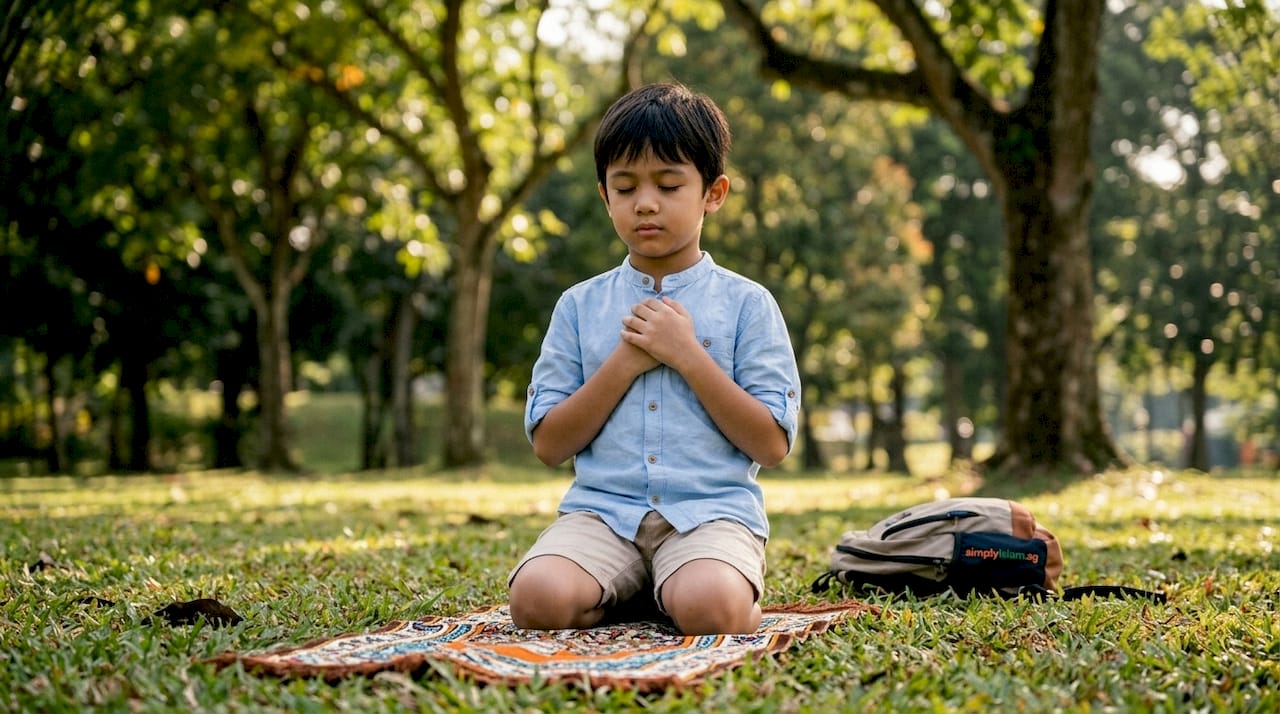
Pro Tip: When explaining moral rules to children, always connect the rule back to their relationship with Allah. “We tell the truth because Allah loves those who are truthful” is far more motivating than “We tell the truth because I said so.”
How does islamic moral education develop the whole child?
Tarbiyah is the comprehensive nurturing process that addresses every dimension of a child’s growth. It prepares children for both this life and the Hereafter by developing them across four interconnected domains.
| Dimension | Focus in Islamic Moral Education | Practical Example |
|---|---|---|
| Spiritual | Worship, God-consciousness, self-reflection | Daily prayers, du’a before meals, gratitude practices |
| Intellectual | Knowledge, reasoning, ethical understanding | Studying Qur’anic stories, discussing moral dilemmas |
| Social | Behavior, etiquette, community responsibility | Greeting elders, helping neighbors, respecting teachers |
| Physical | Health, cleanliness, physical discipline | Observing Sunnah hygiene practices, physical activity |
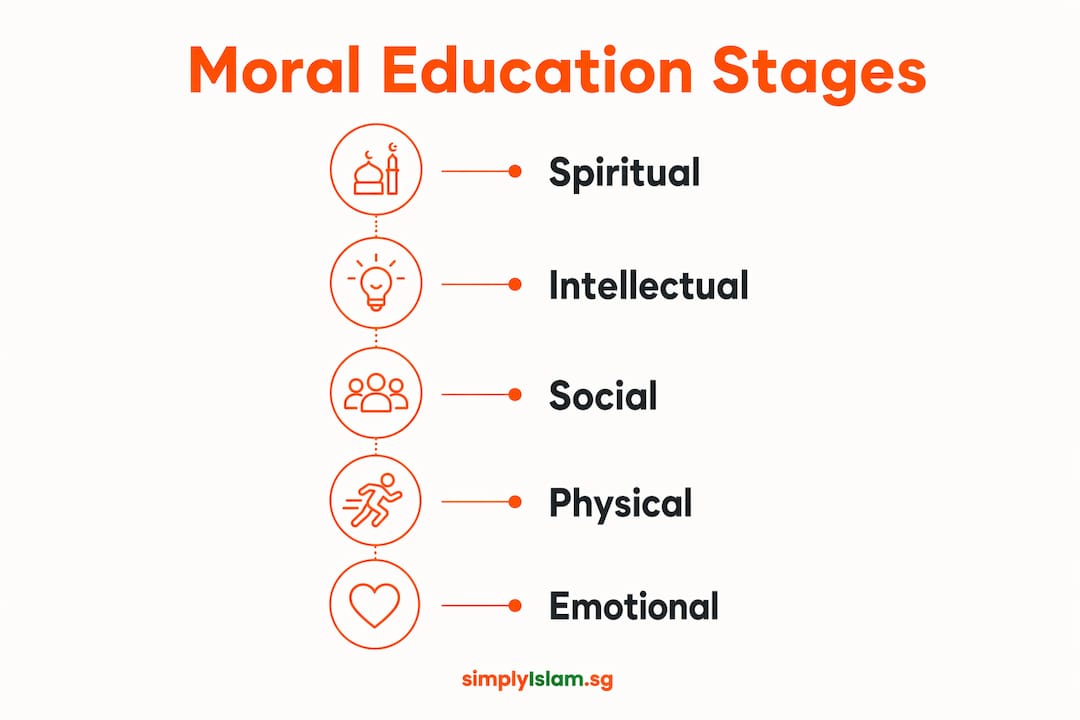
Each dimension reinforces the others. A child who prays regularly (spiritual) develops discipline that carries into their studies (intellectual) and their treatment of others (social). This synergy is what makes Tarbiyah distinct from narrower approaches that focus only on behavior or only on knowledge.
Moral education in Islamic perspective is both theoretical and practical. It links normative Islamic teachings with real-life implementation to develop spiritually strong and socially responsible individuals. This means a child’s character is shaped not just in the classroom or the mosque, but at the dinner table, on the playground, and in every small interaction of daily life.
What practical methods teach islamic morals to children?
The most effective methods for teaching Islamic morals are grounded in both classical scholarship and sound educational practice. They share one common thread: they prioritize internalization over compliance.
-
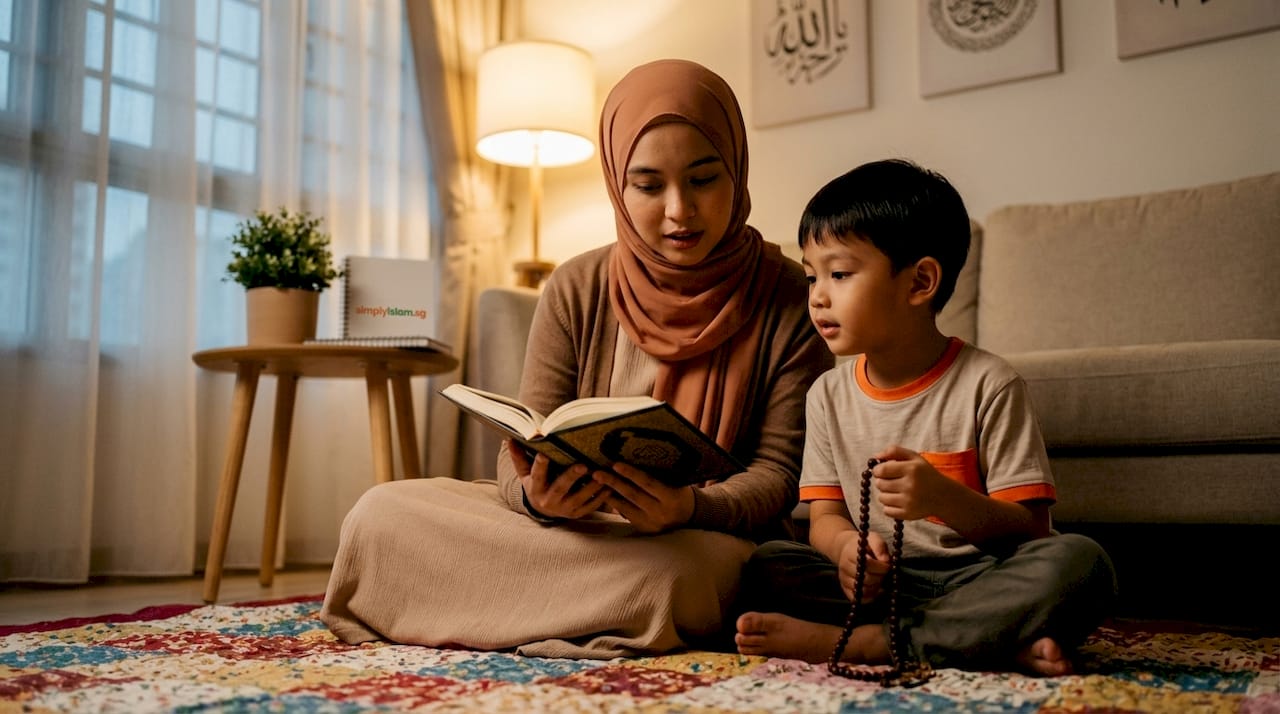
Model the behavior you want to see. The hidden curriculum of parental and teacher conduct is more powerful than any formal lesson. Children internalize morals by observing consistent adult behavior. A parent who speaks kindly to a stranger teaches generosity more effectively than a lecture on the topic.
-
Use habituation (tadrib) through small, consistent actions. Imam Al-Ghazali taught that morality is a stable disposition of the soul cultivated through repeated, intentional action. Assign age-appropriate responsibilities: a five-year-old can set the table with the intention of serving the family; a ten-year-old can take on Amanah (trustworthiness) by managing a small household task independently.
-
Tell stories with moral depth. Qur’anic narratives about Prophets Ibrahim, Yusuf, and Musa are not just history. They are moral case studies. Ask children what they would have done in each situation. This builds ethical reasoning, not just knowledge.
-
Practice muhasabah (self-reflection) as a family. Imam Al-Ghazali’s framework includes spiritual discipline and self-reflection as core tools. A simple end-of-day question, “What is one thing you did today that you think Allah was pleased with?” builds the habit of moral self-examination in children.
-
Frame all morality within Tawheed. Children taught morality through their connection to Allah show higher levels of moral autonomy than those taught through parental discipline alone. When a child understands that honesty, kindness, and fairness are expressions of their love for Allah, those values become part of their identity.
Pro Tip: Avoid the trap of only correcting bad behavior. Acknowledge and name good character when you see it. “That was very generous of you, and generosity is one of the qualities Allah loves” reinforces identity-level moral development.
How does islamic moral education differ from secular approaches?
Parents and educators often ask how Islamic moral education compares to general character education programs. The differences are significant and worth understanding clearly.
| Feature | Islamic Moral Education | Secular Moral Education |
|---|---|---|
| Foundation | Qur’an, Sunnah, and divine accountability | Social consensus, philosophical ethics |
| Motivation | Love of Allah, Taqwa, hope for the Hereafter | Social approval, civic responsibility |
| Ultimate Goal | Ihsan: spiritual excellence and self-regulation | Ethical citizenship and social harmony |
| Soul Development | Tazkiyat al-nafs: purification of the inner self | Behavioral compliance and emotional intelligence |
| Community Focus | Brotherhood (Ummah) and collective responsibility | Individual rights and social contracts |
The most significant distinction is the inseparability of faith and character. Separating religious knowledge from ethical refinement is the biggest mistake parents make. In secular frameworks, a child can be taught to be honest because honesty is socially useful. In Islamic moral education, honesty is an expression of Iman (faith) and a reflection of the child’s relationship with Allah. That difference in motivation produces a different quality of character.
Secular approaches also tend to focus on social compliance. Islamic moral education aims for something deeper: a child who does good because their soul is oriented toward goodness, not because they fear social consequences. The complete Islamic parenting guide addresses this distinction in practical terms for Muslim families in Singapore.
Key takeaways
Islamic moral education succeeds when faith, character, and daily practice are treated as one unified process rather than separate subjects.
| Point | Details |
|---|---|
| Tarbiyah is the core framework | It develops children across spiritual, intellectual, social, and physical dimensions simultaneously. |
| Maqasid provide the ethical compass | The five objectives protect religion, life, intellect, progeny, and property as the basis for all moral decisions. |
| Ihsan is the ultimate goal | Children who reach God-consciousness become internally motivated to act ethically without external pressure. |
| Modeling outperforms instruction | Consistent adult behavior shapes children’s morals more effectively than verbal teaching alone. |
| Tawheed unifies moral motivation | Connecting every ethical rule to the child’s relationship with Allah builds lasting moral autonomy. |
Why i think we’re teaching morality backwards
The most common pattern I see among well-meaning parents is this: they teach Islamic knowledge in one space and expect moral behavior in another, and then wonder why the two never connect. A child can memorize the 99 names of Allah and still lie to their teacher the next morning. That gap is not a failure of the child. It is a failure of integration.
Imam Al-Ghazali understood this more than 900 years ago. Morality is not a subject. It is a disposition, built slowly through repeated action and honest self-reflection. The parent who reads Surah Al-Hujurat with their child and then models backbiting at the dinner table has undone the lesson before it took root.
The challenge today is not a lack of Islamic content. There is more access to lectures, apps, and online courses than any previous generation. The challenge is consistency between what we teach and how we live. Children are extraordinarily perceptive. They do not absorb our words. They absorb our patterns.
One practical shift that changes everything: stop treating moral correction as the primary tool. Most parents intervene when a child does something wrong. The more powerful habit is to name and affirm good character when you see it. “You shared without being asked. That is generosity, and it is one of the qualities of the Prophet, peace be upon him.” That sentence does more for a child’s moral identity than ten corrections.
The other thing I would say to educators specifically: the role of Islamic religious education in character formation cannot be outsourced to the school alone. Teachers can plant seeds, but parents water them daily. The most effective moral education happens when both environments are aligned and consistent.
— Lily
How SimplyIslam supports your child’s moral development
If you are a parent or educator looking for structured support in applying these principles, SimplyIslam offers programs designed specifically for this purpose.

SimplyIslam has reached over 22,000 participants through its programs in Singapore, combining ARS-certified instructors with interactive, practical learning methods. The Ihsan Camp gives children a hands-on experience of spiritual excellence in a community setting, making abstract concepts like Taqwa and Ihsan tangible and memorable. For parents who want to deepen their own understanding, the Al-Mishkat Certificate provides structured study of Islamic principles including ethics and character. You can also explore upcoming Islamic events and access free Islamic resources to support your family’s learning at home.
FAQ
What is the meaning of tarbiyah in islamic education?
Tarbiyah is the comprehensive process of nurturing a child’s spiritual, moral, intellectual, social, and physical development according to Islamic principles. It prepares individuals for both this life and the Hereafter.
What is the difference between akhlaq and aqidah?
Aqidah refers to Islamic faith and belief, while Akhlaq refers to moral character and behavior. Islamic moral education treats them as inseparable: sound belief produces noble character.
Why is tawheed central to teaching morality in islam?
Tawheed connects every moral rule to a child’s relationship with Allah, giving ethics a stable and meaningful foundation. Children taught morality through this connection show stronger moral autonomy than those taught through rules alone.
How can parents apply islamic moral education at home?
Parents can use daily habituation through small responsibilities, storytelling from Qur’anic narratives, end-of-day self-reflection, and consistent personal modeling of the values they want their children to develop.
What is ihsan and why does it matter in moral development?
Ihsan is the highest level of worship and ethical conduct, defined as acting as though you see Allah at all times. It is the ultimate goal of moral education, producing children who are self-regulating and ethically excellent from the inside out.