
A structured Islamic curriculum is a sequenced educational program that integrates core Islamic subjects across developmental stages to build stable belief, consistent worship habits, and visible moral character in children. Unlike scattered lessons or isolated memorization exercises, this approach organizes Aqeedah (Islamic creed), Fiqh (Islamic law and practice), Seerah (the Prophet’s biography), Quranic Studies, and Arabic into a coherent progression from age 5 through 18. Established series like IQRA International and Safar Publications have demonstrated that sequenced Islamic learning produces children who not only know their faith but live it. For parents and educators, understanding this framework is the first step toward raising confident Muslim youth grounded in both knowledge and character.
What is a structured islamic curriculum, and how is it organized?
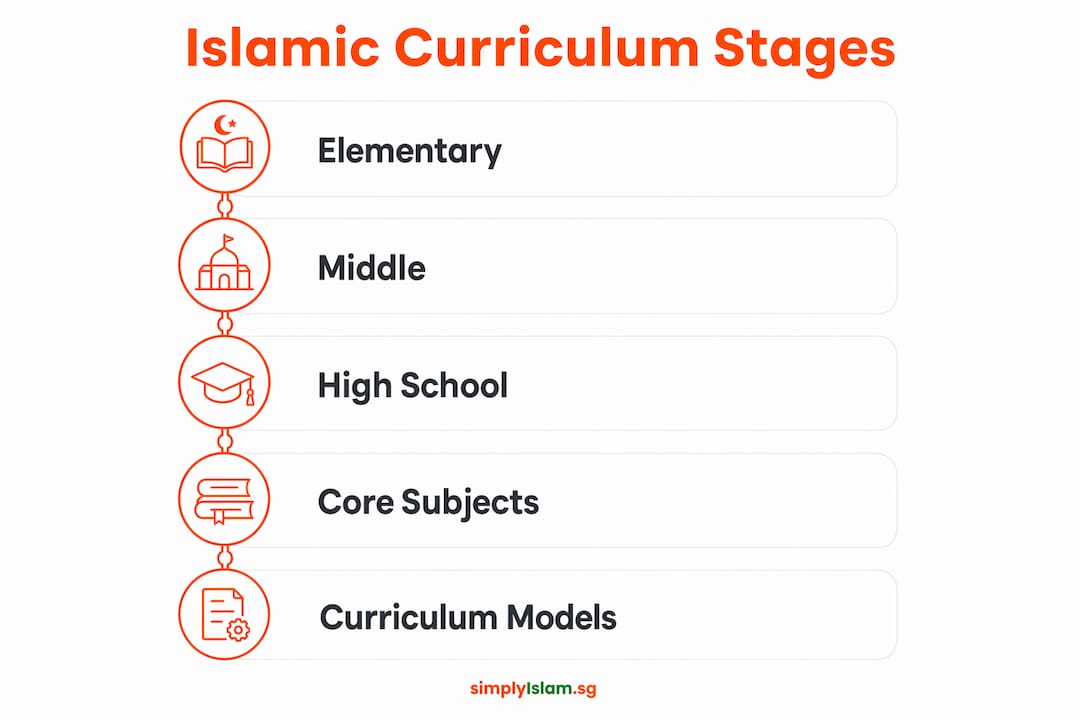
A structured Islamic curriculum spans from age 5 to 18, organized into three developmental stages: elementary, middle, and high school. Each stage builds on the previous one, ensuring children deepen their understanding of Tawhid (the oneness of Allah), worship practices, and Islamic ethics as they mature. This cumulative design prevents the common problem of children reaching adulthood with fragmented, disconnected religious knowledge.
The five core subjects covered across all stages are Aqeedah, Fiqh, Seerah, Quranic Studies, and Arabic. Aqeedah anchors a child’s worldview in the oneness of Allah and the articles of faith. Fiqh teaches the practical rules of worship and daily conduct. Seerah connects children to the Prophet Muhammad (peace be upon him) as a living model of character and leadership. Quranic Studies and Arabic give students direct access to the primary source of Islamic guidance.
Three primary models shape how schools and families deliver this content. Understanding each model helps you choose the right fit for your community or home.
| Model | Description | Best Suited For |
|---|---|---|
| Standalone Islamic Studies | Islamic subjects taught as a separate class alongside secular subjects | Weekend maktabs, supplementary programs |
| Integrated Islamic Curriculum | Islamic values and references woven into all subjects (science, history, language) | Full-time Islamic schools |
| Full Islamic Worldview Curriculum | All knowledge framed through an Islamic lens, including ethics and purpose | Homeschooling, immersive Islamic schools |
Most weekend maktabs use the standalone model because it fits limited class time. Full-time Islamic schools, such as those affiliated with Allamah Education or MFERD, often use the integrated or full-immersion approach. Homeschooling families tend to favor the full Islamic worldview model because it gives them control over every subject’s framing.
Pro Tip: Choose your curriculum model based on how many hours per week your child engages with Islamic education. If it is fewer than five hours weekly, a standalone model with strong scope and sequence is more realistic and sustainable than attempting full integration.
Why does a structured approach to islamic learning matter?
A structured approach to Islamic learning matters because it transforms knowledge into identity. Children who study Islam through a coherent framework do not just memorize facts. They develop the confidence to practice their faith, the language to explain it, and the character to embody it.
Experts describe this holistic development as Tarbiyah, which means the integrated growth of a child’s intellectual, moral, and spiritual dimensions. Research confirms that effective Islamic education must avoid reducing Islamic Studies to a purely academic subject. When Tarbiyah is the goal, curriculum design deliberately cultivates habits like daily prayer, patience, honesty, and humility alongside theological knowledge.
Children growing up in non-Muslim environments face a particular challenge. Structured curricula help these children maintain their Muslim identity and navigate cultural differences with confidence and grace rather than confusion or shame. This is not a minor benefit. It is the difference between a child who quietly abandons their faith under social pressure and one who holds it with quiet strength.
The key benefits of structured Islamic learning include:
- Identity formation: Children develop a clear, confident sense of who they are as Muslims.
- Worship habits: Regular, structured exposure to Fiqh builds consistent prayer, fasting, and du’a practices.
- Moral character: Lessons in Seerah and Aqeedah shape honesty, humility, and compassion as daily behaviors.
- Cultural resilience: Children in minority contexts learn to respect others while remaining grounded in their own values.
- Cumulative knowledge: Each year builds on the last, so children arrive at adulthood with depth, not just surface familiarity.
“The goal of Islamic education is not merely to fill the mind with information but to shape the heart, purify the soul, and direct the will toward what is good.” This principle, rooted in the tradition of Tarbiyah, is what separates a structured Islamic education framework from a simple religion class.
How to implement an islamic curriculum in schools and at home
Implementing a structured Islamic curriculum requires more than selecting a textbook series. It demands deliberate planning, consistent delivery, and regular review. The scope and sequence of a curriculum, meaning the detailed map of what is taught each week, term, and year, is the single most important planning tool educators and parents can use. Without it, lessons repeat, gaps appear, and children lose the thread of cumulative learning.
Well-known series like Safar Islamic Studies and IQRA International provide this spine. Both cover Grades K–12 with detailed teacher guides, student workbooks, and assessment tools. Comprehensive teacher support materials reduce lesson preparation time by up to 50%, which means educators spend more energy on delivery quality and student engagement rather than building resources from scratch.
Faith Publications takes a modern approach by emphasizing practical application and identity formation through relatable examples, age-appropriate activities, and attention to student mental health. This makes their materials particularly effective for children in urban, multicultural settings like Singapore.
Here are the first steps for implementing a structured Islamic curriculum in your school or home:
- Assess your context. Determine how many hours per week are available for Islamic education and whether you are running a weekend program, full-time school, or homeschool.
- Select a curriculum series. Choose a series like Safar Islamic Studies or IQRA International that provides a full scope and sequence from the grade level you are starting at.
- Map your academic year. Divide the curriculum’s scope and sequence across your school terms, assigning specific topics to each week.
- Gather teacher support materials. Collect activity guides, project templates, and assessment tools before the first lesson. Do not improvise these mid-year.
- Set measurable learning goals. Define what students should know, practice, and demonstrate at the end of each term, not just what they should have read.
- Build in review cycles. Schedule monthly reviews to reinforce prior learning and identify gaps before they compound.
- Involve parents. Share the scope and sequence with families so they can reinforce lessons at home through conversation, du’a, and practice.
Pro Tip: If you are starting mid-year or with older students who have no prior structured learning, use a diagnostic assessment to identify gaps before placing them in a grade-level program. Placing a 12-year-old in Grade 7 content when they have Grade 3 knowledge creates frustration, not growth. You can find free Islamic resources to support this initial assessment process.
Common challenges in delivering structured islamic curricula
The most common mistake educators make is treating a curriculum as a static collection of lessons rather than a dynamic roadmap. A curriculum is not a folder of worksheets. It is a living plan that requires regular review, adaptation, and teacher development to stay effective.
Several specific challenges arise repeatedly in Islamic education settings:
- Treating Islamic Studies as purely intellectual: When teachers focus only on facts and definitions, students pass tests but do not pray, reflect, or act with Islamic character. Research confirms that cognitive, affective, and psychomotor domains must be integrated. Separating them produces graduates who know Islam but do not live it.
- Ignoring student engagement: Rote memorization without context kills curiosity. Students who cannot connect Seerah lessons to their own lives disengage by middle school.
- Inconsistent teacher training: A strong curriculum delivered by an undertrained teacher produces weak results. Teacher development is not optional. It is the delivery mechanism for everything the curriculum promises.
- Parental disconnection: When parents are unaware of what their children are studying, the learning stops at the classroom door. Faith is practiced at home, not only in school.
The solution to most of these challenges is the same: treat the curriculum as a community project, not a school task. Teachers, parents, and students all play a role. You can explore how microlearning in Islamic studies supports families in reinforcing structured learning between formal lessons.
Pro Tip: Schedule one parent information session per term where you walk families through the upcoming curriculum topics. When parents know what is coming, they ask better questions at dinner, reinforce vocabulary at home, and model the behaviors the curriculum is trying to build.
Key takeaways
A structured Islamic curriculum is the most reliable path from scattered religious knowledge to confident, practicing Muslim identity in children.
| Point | Details |
|---|---|
| Definition and scope | A structured Islamic curriculum spans ages 5–18, covering Aqeedah, Fiqh, Seerah, Quran, and Arabic in sequence. |
| Three curriculum models | Standalone, integrated, and full Islamic worldview models each suit different settings and time commitments. |
| Tarbiyah as the goal | Effective curricula integrate intellectual, moral, and spiritual growth rather than treating Islamic Studies as purely academic. |
| Scope and sequence is critical | A detailed weekly and yearly plan prevents repeated or disconnected lessons and supports cumulative learning. |
| Community delivery | Teachers, parents, and students must all engage with the curriculum for it to produce lasting faith and character. |
What i’ve learned from watching structured islamic education work
I have spent years observing how children respond to Islamic education, and the pattern is consistent. Children who receive structured, sequenced Islamic learning carry their faith differently. They ask better questions. They connect Quranic verses to real situations. They are not embarrassed by their identity. They are grounded by it.
What surprises most parents is that the structure itself is the gift. Many families assume that more love and more exposure to Islamic content is enough. But without sequence, children accumulate fragments. They know the five pillars but cannot explain why Tawhid makes them matter. They can recite du’as but have never been taught when or why to use them. Structure turns isolated facts into a coherent worldview.
The hardest truth I have encountered is this: a child’s Islamic education is only as strong as the adults around them. A well-designed curriculum delivered by a disengaged teacher or unsupported by parents at home will underperform every time. The curriculum is the map. The adults are the guides. Both are needed.
My encouragement to every parent and educator reading this is to stop waiting for the perfect program and start with a good one. Safar Publications, IQRA International, and Faith Publications all offer strong starting points. Choose one, commit to the scope and sequence, and build the community around it. The youth identity development work that follows is worth every effort.
— Lily
How SimplyIslam supports your child’s islamic education
SimplyIslam is built for exactly the challenge this article describes: giving busy Muslim families in Singapore access to quality, structured Islamic education without compromise.
SimplyIslam’s ARS-certified instructors deliver courses grounded in the same principles of Tarbiyah and sequenced learning outlined here. With over 22,000 participants and more than $1.1 million raised for charity, the platform has earned its place as a trusted resource for Singapore’s Muslim community. Whether you are looking for foundational knowledge through the Absolute Essentials of Islam course or want to supplement your child’s learning with structured programs, SimplyIslam offers a clear path forward. Explore the full range of online Islamic courses and upcoming Islamic events to find the right fit for your family.
FAQ
What subjects does a structured islamic curriculum cover?
A structured Islamic curriculum covers Aqeedah, Fiqh, Seerah, Quranic Studies, and Arabic, organized progressively from elementary through high school to build cumulative knowledge and practice.
Which curriculum model is best for a weekend islamic school?
The standalone Islamic Studies model is best for weekend maktabs because it fits limited class time and focuses Islamic content into dedicated lessons without requiring full subject integration.
What is tarbiyah and why does it matter in islamic education?
Tarbiyah is the holistic development of a child’s intellectual, moral, and spiritual dimensions. Curricula built on Tarbiyah produce students who not only know Islamic teachings but practice and embody them daily.
How do i know if a curriculum has a good scope and sequence?
A strong scope and sequence maps specific topics to each week, term, and year across grade levels. Series like Safar Islamic Studies and IQRA International provide this structure in their teacher guides.
Can structured islamic curricula work for homeschooling families?
Yes. The full Islamic worldview model is particularly well-suited to homeschooling because it allows parents to frame every subject through an Islamic lens, giving children a coherent and integrated education.