



Overview:
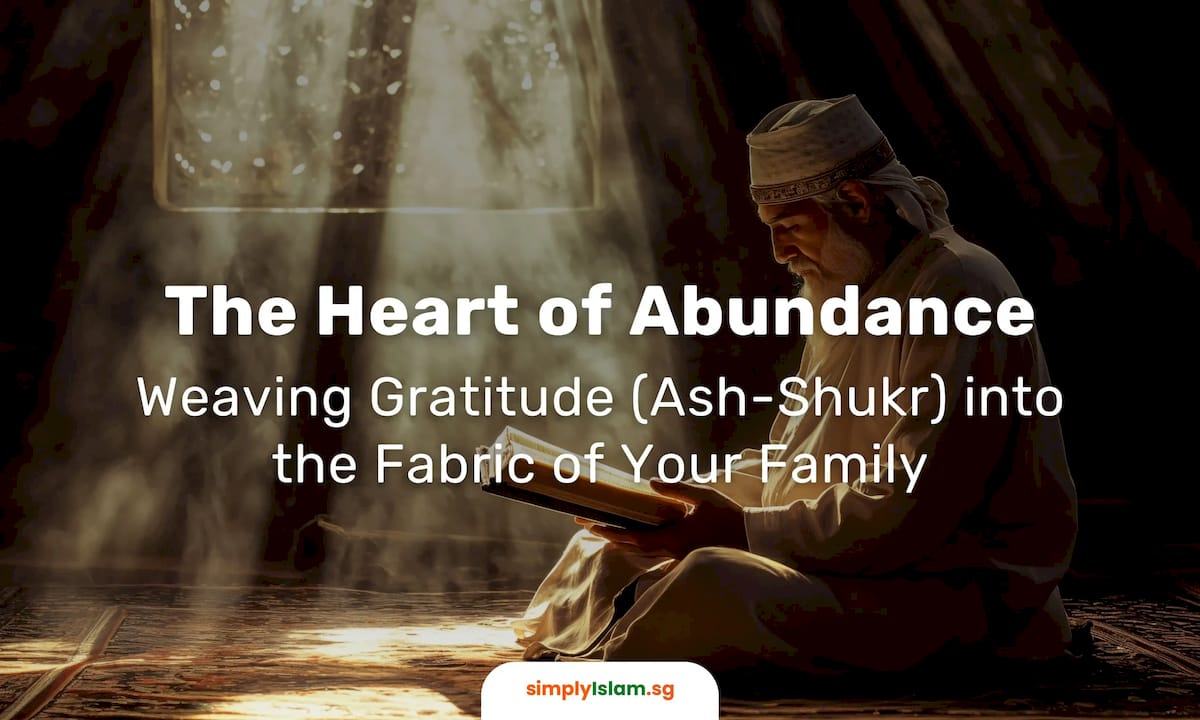
In a world that constantly whispers “you are not enough,” “you do not have enough,” and “you need more,” the Islamic value of الشكر (Ash-Shukr), or gratitude, is not just a polite courtesy. It is a spiritual necessity, a fortress for the heart, and the very key to a life of abundance.
As parents, we are the primary architects of our family’s emotional and spiritual atmosphere. We strive to provide our children with the best of everything, yet we often find ourselves in a quiet struggle against a pervasive tide of entitlement. How many times have we seen a new toy or privilege enjoyed for a moment, only to be cast aside in the pursuit of the next thing?
The antidote, both profound and powerful, is Shukr. And it comes with a direct, personal, and unbreakable promise from our Creator.
Allah ﷻ makes a contract with us in the Qur’an:
“If you are grateful, I will surely increase you” (Surah Ibrahim, 14:7)
This “increase” (barakah) is not just about a bigger home or a better car. It is an increase in peace, in contentment, in the capacity to see the good, and in the spiritual wealth of a heart at rest. Gratitude shifts a family’s entire perspective from “what we lack” to “what we have,” and it is our job, as parents, to hand our children this key.
What is Shukr? Beyond Just “Thank You”
To truly imbibe gratitude, we must understand that it is far more than the simple phrase “Alhamdulillah.” Scholars like Ibn al-Qayyim explained that Shukr is a complete state of being, practised in three parts:
- Shukr of the Heart (Al-Qalb): This is the internal recognition. It is the sincere, quiet acknowledgement that every single blessing—from the air we breathe to the smile of our child—is not from our own power or intelligence, but a direct, unearned gift from Allah ﷻ.
- Shukr of the Tongue (Al-Lisān): This is the vocalisation. It is the “Alhamdulillah” we say when we taste our food, the “JazakAllahu khair” we say to a person who helps us, and the praise we offer in our du’a.
- Shukr of the Limbs (Al-Jawāriḥ): This is the action. It is the most vital and often-forgotten part. It means using our blessings in a way that pleases the One who gave them.
Allah ﷻ reminds us that our very faculties were given to us for this purpose:
“And Allah has extracted you from the wombs of your mothers… and He gave you hearing, sight, and hearts that you might be grateful.” (Surah An-Nahl, 16:78).
This verse is a powerful reminder for parents. When we see our children hearing, seeing, and learning, we must guide them to understand that these abilities are gifts to be used in obedience and gratitude.
This is the exact advice the wise Luqman gave to his son—a direct model for parental teaching:
“And We had certainly given Luqman wisdom [and said], ‘Be grateful to Allah.’ And whoever is grateful is only grateful for [the benefit of] himself.” (Surah Luqman, 31:12).
The Prophet of Gratitude: Our Role Model
Our children learn far more from our actions than from our lectures. The most excellent model of gratitude is, without question, the Prophet Muhammad (ﷺ). He was a living exemplar of Shukr.
He was known by the title ‘abdan shakura – a grateful servant. The famous hadith, narrated by Aisha (ra), is that the Prophet (ﷺ) would stand in prayer at night until his feet swelled. She asked him, “Why do you do this, O Messenger of Allah, when Allah has forgiven your past and future sins?” He (ﷺ) replied with a question that should echo in every parent’s heart: “Should I not be a grateful servant?” (Sahih Bukhari).
His gratitude was not reserved for grand moments. It was woven into the mundane everyday life. He (ﷺ) taught us that “Allah is pleased with a servant who eats a meal and praises Him for it, or drinks a drink and praises Him for it.” (Sahih Muslim).
This is a profoundly simple and accessible starting point for our families. We can be a family that pleases Allah ﷻ simply by acknowledging Him after a sip of water. This is the level of mindfulness we aim to model.
Gratitude Begins with Us: Modelling Shukr as Parents
Our children are mirrors. They will not learn gratitude if they see us modelling discontent.
- Vocalise Your Thanks: Make “Alhamdulillah” the soundtrack of your home. Let your children hear you say it for the small things: a good parking spot, a meal that came out right, a quiet moment. Thank your spouse in front of your children. Thank your children for their help. This normalises appreciation.
- Reframe Challenges: This is where Shukr meets Sabr (Patience). The Prophet (ﷺ) said: “How wonderful is the affair of the believer, for his affairs are all good… If prosperity attends him, he expresses gratitude to Allah… and if adversity befalls him, he endures it patiently…” (Sahih Muslim). Instead of “Ugh, I’m so tired from work,” try, “Alhamdulillah, I have a job to provide for our family.” Instead of “This house is a mess,” say, “Alhamdulillah, we have a home filled with the sounds of healthy children.”
- Adopt the “Downward Gaze”: In an age of social media, our children (and we) are wired for comparison. The Prophet (ﷺ) gave us the direct antidote: “Look at those who are beneath you and do not look at those who are above you, for it is more worthy that you do not belittle the bounties of Allah.” (Sahih Muslim). Actively point this out. “Alhamdulillah, we have a roof over our heads. Not everyone does.” “Alhamdulillah, we have food on our table. Let’s pray for those who are hungry.”
Nurturing a Grateful Family: Practical Steps
Once we are living Shukr, we can gently weave it into our family’s routines.
- Create a Gratitude Ritual:
☐ At the Dinner Table: Go around and have each family member share one thing they were grateful for that day. It can be simple: “I’m grateful for the sunshine,” or “I’m grateful for my teacher.”
☐ At Bedtime: As you tuck them in, ask, “What are three things we can say ‘Alhamdulillah’ for today?”
☐ The “Shukr Jar”: Keep a jar and small slips of paper. When something good happens, write it down and put it in the jar. When the jar is full, or at the end of the month, read them all aloud as a family.
- Practice Gratitude in Action (Shukr of the Limbs):
☐ Connect Shukr to Sadaqah: Frame charity as an act of gratitude. “Alhamdulillah, Allah gave us good food. As Shukr, let’s go through our pantry and give some food to the needy.”
☐ Connect Shukr to Iḥsān (Excellence): Teach them to show gratitude for their abilities by using them well. “How can we show Shukr for our healthy bodies? By running and playing, and also by using our strong hands to help tidy up.”
☐ Connect Shukr to Service: “Alhamdulillah, we have a safe community. As Shukr, let’s help clean up the local park or Mosque.”
This approach teaches the all-important “third part” of gratitude—that a blessing is a responsibility.
The Enemies of Gratitude
We must also be aware of the traps that pull us away from Shukr. Allah ﷻ himself warns us that gratitude is not the default:
“But few of My servants are grateful.” (Surah Saba, 34:13)
This means gratitude is a conscious choice, a jihad against our own nafs (ego). The main enemies are:
- Entitlement: The belief that we deserve our blessings.
- Comparison: The social media trap that makes our blessings feel small.
- Ghaflah (Heedlessness): Simply forgetting. This is why rituals are so important; they are the cure for heedlessness.
The most incredible tool we have is du’a or supplication. The Prophet (ﷺ) taught Mu’adh ibn Jabal to say after every prayer:
اللّهُـمَّ أَعِـنِّي عَلـى ذِكْـرِكَ وَشُكْـرِك ، وَحُسْـنِ عِبـادَتِـك
Allahumma a’inni ‘ala dhikrika wa shukrika wa husni ‘ibadatik
“O Allah, help me to remember You, to be grateful to You, and to worship You in an excellent manner.”
Teach this to your children. Make it your family’s du’a.
Shukr is the worldview that transforms a family. It turns a house of complaints into a home of hamd (praise). It is the choice to find joy in what we have rather than anxiety in what we don’t. By making it a pillar of your home, you are not just teaching a value — you are giving your children the key to lifelong contentment and fulfilling the promise of Allah ﷻ: “If you are grateful, I will surely increase you.”