





Islamic education for children in Singapore spans a wide range of structured programs, from mosque madrasahs to certified weekend classes, and knowing the types of Islamic courses for kids in Singapore helps teachers deliver focused, curriculum-aligned lessons from day one. For Islamic studies teachers at SimplyIslam Madrasah, Semester 2 is a fresh start. The first five minutes of your first class set the tone for everything that follows. Clear expectations, a visible agenda, and smart time management are not optional extras. They are the foundation of every productive session.
1. Types of Islamic courses for kids in Singapore: the full picture
Singapore offers a well-structured ecosystem of Islamic education for children. MUIS’s aLIVE programme is structured for ages 5 to 20, delivered through mosque madrasahs on weekends or weekday evenings with a standardized curriculum. That structure means teachers across Singapore are working toward defined developmental targets, not improvising week to week.
The aLIVE programme organizes learning into four developmental levels aligned by age group. It is English-medium, which suits the majority of Singapore Muslim children and makes content more accessible. At the Kids level, ages 5–10, the program emphasizes foundational Quranic literacy and Islamic character building using the Iqra’ method.
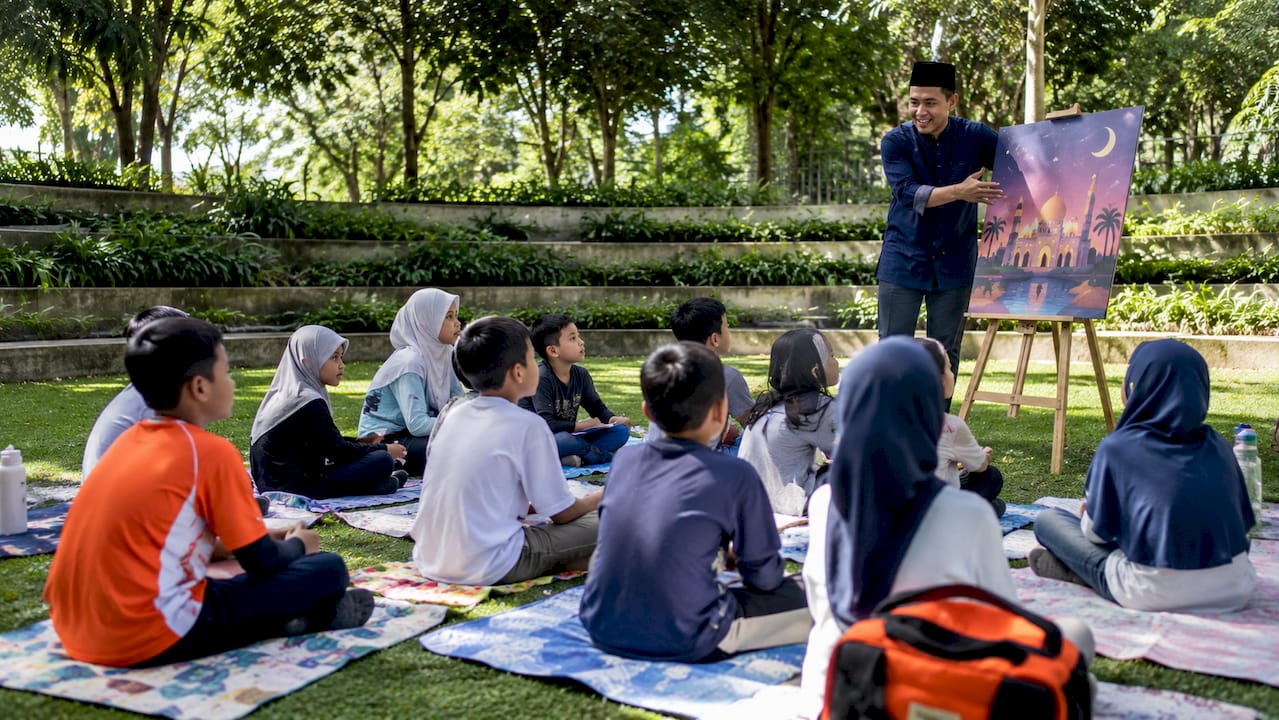
MUIS also runs MBK, a network of 15 mosque-based kindergartens for children aged 3 to 6, providing holistic Islamic early childhood education. Masjid Al-Islah offers weekly Quran and Solat classes for ages 7 to 18, covering Quran memorization and prayer practices on flexible weekday and weekend schedules. Understanding this broader landscape helps you, as a SimplyIslam Madrasah teacher, see where your students have come from and where they are headed.
2. Start the first five minutes with expectations and an agenda
Clear communication of daily class expectations improves student engagement and reduces behavioral disruptions. This is not a theory. It is a classroom reality that experienced Islamic studies teachers see every semester.
The moment your students sit down, write or display two things: your expectations for the session and the agenda for today’s class. Expectations might include speaking respectfully, staying on task, and completing activities within the time given. The agenda tells students exactly what will happen and in what order, so they are not guessing or testing boundaries.
Here is why this matters. When students know what is coming, they feel settled. A settled student learns. An uncertain student fidgets, distracts others, and loses time. The Islamic Early Childhood Education Programme framework confirms that integrating structure across the learning day, rather than relying on isolated instructions, boosts knowledge absorption. Your first five minutes are the most powerful teaching tool you have.
Pro Tip: Write your expectations and agenda on the whiteboard before students enter the room. When they walk in and see it, the class has already started.
Key items to cover in your opening five minutes:
- State your behavioral expectations clearly (respect, focus, participation)
- Share the session agenda with estimated time for each activity
- Remind students of any carry-over tasks from Semester 1
- Confirm the learning goal for the day in one simple sentence
3. Use a digital timer for every activity
Digital timers are the single most effective tool for managing activity length in a madrasah class. Teachers use visual timers and clear verbal cues to pace instruction and keep transitions smooth. A timer does what a teacher’s voice alone cannot: it gives students a visual, objective countdown that removes argument and ambiguity.
When you set a timer for an activity, students stop negotiating and start working. They know the clock is running. This is especially useful for Quran recitation practice, written exercises, and group discussions, where students can easily drift if there is no visible endpoint.
Here is how to use timers well in your SimplyIslam Madrasah class:
- Set a timer for each activity block before it begins, not after students have already started drifting
- Display the timer on a screen or board where all students can see it
- Use a short audio alert, not a jarring alarm, to signal the end of an activity
- For younger students, use a visual countdown timer with a color bar that shrinks as time passes
- For recitation activities, set shorter intervals (5–8 minutes) to maintain focus
Pro Tip: Free apps like Google Timer or ClassTimer work well on a tablet or laptop connected to a classroom screen. You do not need specialist software.
Timers also train students over time. By mid-semester, your class will naturally pace themselves because they have internalized the rhythm of your sessions.
4. Transition techniques: how to shift activities without losing momentum
Transitions are where classroom momentum dies. A student who is mid-task and suddenly told to stop will resist, delay, or disengage. The fix is a simple phrase used consistently: “You have 2 more minutes to finish up.”
This phrase does three things at once. It warns students that a change is coming. It gives them enough time to reach a natural stopping point. And it signals that you are in control of the session’s pace. Effective time management in madrasahs relies on exactly this kind of clear verbal cue paired with a visual timer signal.
Use these transition techniques in your Semester 2 classes:
- Give a two-minute verbal warning before every activity change
- Pair the verbal warning with a timer that shows the remaining time
- Use a consistent closing phrase for each activity, such as “Pens down, eyes on me”
- After the transition, restate the next activity in one sentence before students begin
- For younger children, add a physical cue like clapping a rhythm to signal the shift
The goal is predictability. When students know the pattern, they move through transitions faster and with less resistance. By week three of Semester 2, your class will respond to the two-minute warning automatically.
5. Refer to weekly madrasah targets every single session
Regularly referring to weekly madrasah targets helps teachers track curriculum progress and adjust lesson pacing. This is not a suggestion for end-of-term reviews. It is a weekly practice that keeps your teaching aligned with what the curriculum requires.
SimplyIslam Madrasah, like MUIS-aligned programs, operates on defined weekly targets. These targets tell you what students should know and be able to do by the end of each week. Ignoring them mid-semester creates a gap that is very hard to close by the final class.
Here is how to make madrasah targets a working part of your teaching:
- Check your targets before every class. Pull up the weekly target sheet at the start of your planning session. Know exactly what you are working toward before you design any activity.
- Display the week’s target for students. Write it on the board or include it in your printed agenda. When students know the target, they understand the purpose of each activity.
- Assess progress mid-session. At the halfway point of your class, ask yourself: are students on track to meet this week’s target? If not, adjust the remaining activities.
- Record what was covered. Keep a simple log of which targets were met each week. This makes it easy to spot gaps before they become problems.
- Adjust pace based on evidence. If students consistently meet targets ahead of schedule, add depth. If they are struggling, slow down and revisit foundational concepts.
Anchoring teaching to developmental stages, as MUIS’s MBK and aLIVE frameworks demonstrate, simplifies planning and keeps delivery focused. Your madrasah targets are the curriculum’s backbone. Treat them as non-negotiable reference points, not optional checkboxes.
Key takeaways
Effective Semester 2 teaching at SimplyIslam Madrasah requires clear expectations, digital timers, consistent transition cues, and weekly alignment with madrasah curriculum targets.
| Point | Details |
|---|---|
| Open with expectations and agenda | State behavioral goals and today’s plan in the first five minutes to reduce disruption. |
| Use digital timers for every activity | Visual countdowns keep students on task and make transitions faster and less contested. |
| Apply the two-minute transition warning | Saying “you have 2 more minutes” prepares students for activity shifts without resistance. |
| Check madrasah targets weekly | Review curriculum targets before every class to keep lesson pacing aligned with learning goals. |
| Display targets for students | Sharing weekly targets with students increases their awareness and sense of purpose. |
My honest take on starting Semester 2 right
I have seen teachers walk into the first class of a new semester without a plan and spend the next three weeks recovering. The students sense the uncertainty immediately, and it costs you credibility that takes weeks to rebuild.
The two-minute transition warning sounds almost too simple to matter. It matters enormously. The first time you use it, students ignore it. The second time, they slow down. By the third week, they are wrapping up on their own before you even say it. That is the power of consistency in a madrasah setting.
The hardest part of referring to weekly targets is not finding them. It is resisting the urge to skip the check when a class goes well and you feel confident. Confidence is not the same as alignment. I have watched teachers deliver genuinely engaging lessons that covered the wrong content entirely. The SimplyIslam Weekend Madrasah curriculum is structured for a reason. Trust the targets.
Mixed age groups and different learning speeds are real challenges in Islamic classes for children in Singapore. Timers help here too. Faster students finish and review. Slower students have a clear endpoint that keeps them from feeling lost. The structure protects everyone.
— Lily
SimplyIslam resources for Semester 2 teachers
SimplyIslam supports Islamic studies teachers with structured programs, certified instructors, and curriculum-aligned resources built for Singapore’s Muslim community.

SimplyIslam has reached over 22,000 participants through its programs, and its approach emphasizes practical learning over rote memorization. Teachers preparing for Semester 2 can access a full range of Islamic courses and teaching resources through SimplyIslam Academy, including structured lesson frameworks and supplementary materials. For families and teachers looking to extend learning beyond the classroom, SimplyIslam’s free Islamic resources offer accessible tools that reinforce what students cover each week. The SimplyIslam Ihsan Camp also provides an interactive Islamic learning experience for children that complements madrasah study with hands-on character education.
FAQ
What should I do in the first five minutes of a madrasah class?
State your behavioral expectations and share the session agenda clearly. Listing expectations upfront sets the tone and reduces disruptions for the rest of the class.
How do digital timers help in Islamic studies classes?
Timers give students a visible countdown for each activity, which reduces off-task behavior and makes transitions faster. They work especially well for Quran recitation and written exercises.
What are madrasah targets and how often should I check them?
Madrasah targets are weekly curriculum benchmarks that define what students should know by the end of each session. Aligning weekly activities with these targets leads to measurable and structured student learning outcomes.
What is the best transition phrase to use in class?
“You have 2 more minutes to finish up” is the most effective transition cue for Islamic studies classes. It gives students enough time to reach a natural stopping point without disrupting their focus.
What Islamic courses are available for kids in Singapore?
Singapore offers mosque madrasah programs through MUIS’s aLIVE programme for ages 5–20, MBK kindergartens for ages 3–6, and physical Quran and Solat classes at mosques like Masjid Al-Islah for ages 7–18. SimplyIslam also offers structured Islamic education programs for children across different age groups and learning levels.