



Storytelling in Islamic teaching is the practice of transmitting faith, morals, and identity through narratives drawn from the Quran, Prophetic traditions, and Islamic history.
This is not a supplementary method. It is a core pedagogical approach rooted in divine revelation itself. Allah Almighty addresses the Prophet Muhammad (ﷺ) in Surah Yusuf: “We relate to you the best of stories.” Research confirms what Muslim educators have long understood: storytelling accounts for 77.1% of the variance in intrinsic motivation among sixth-grade Quranic students. That figure is not a coincidence. It reflects how deeply narrative shapes the Muslim learner’s heart and mind. For educators and parents seeking to understand the role of storytelling in Islamic teaching, this guide offers both the evidence and the practical path forward.
What is the role and purpose of storytelling in Islamic teaching?
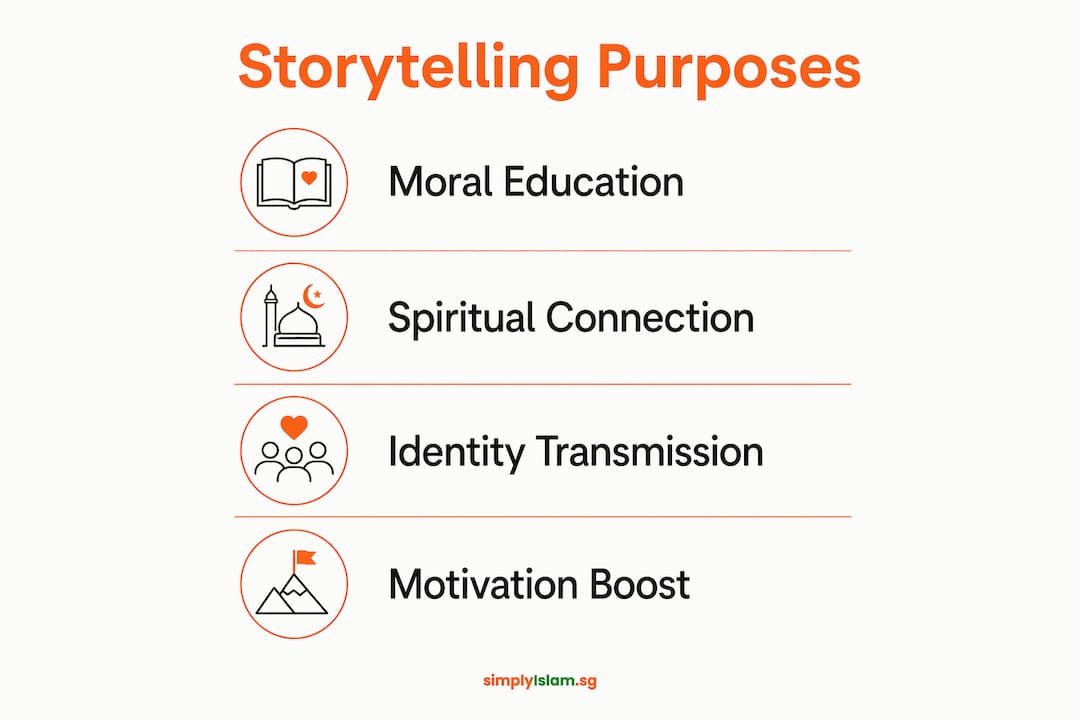
Storytelling in Islam serves three distinct and interconnected purposes: moral education, spiritual connection, and identity formation. These are not separate goals. They work together to shape a Muslim who understands faith as a lived reality, not an abstract set of rules.
The Quran itself is the most authoritative example of this method. Stories of the Prophets, including Ibrahim, Musa, Yusuf, and Isa (peace be upon them all), are not historical footnotes.
They are ethical templates. Each narrative presents a human being tested by Allah Almighty, responding with patience, trust, or repentance, and emerging with a lesson that applies directly to the reader’s own life. The story of Prophet Yusuf (as), for instance, teaches resilience, forgiveness, and Tawakkul in a single, continuous narrative arc that children and adults can return to at every stage of life.
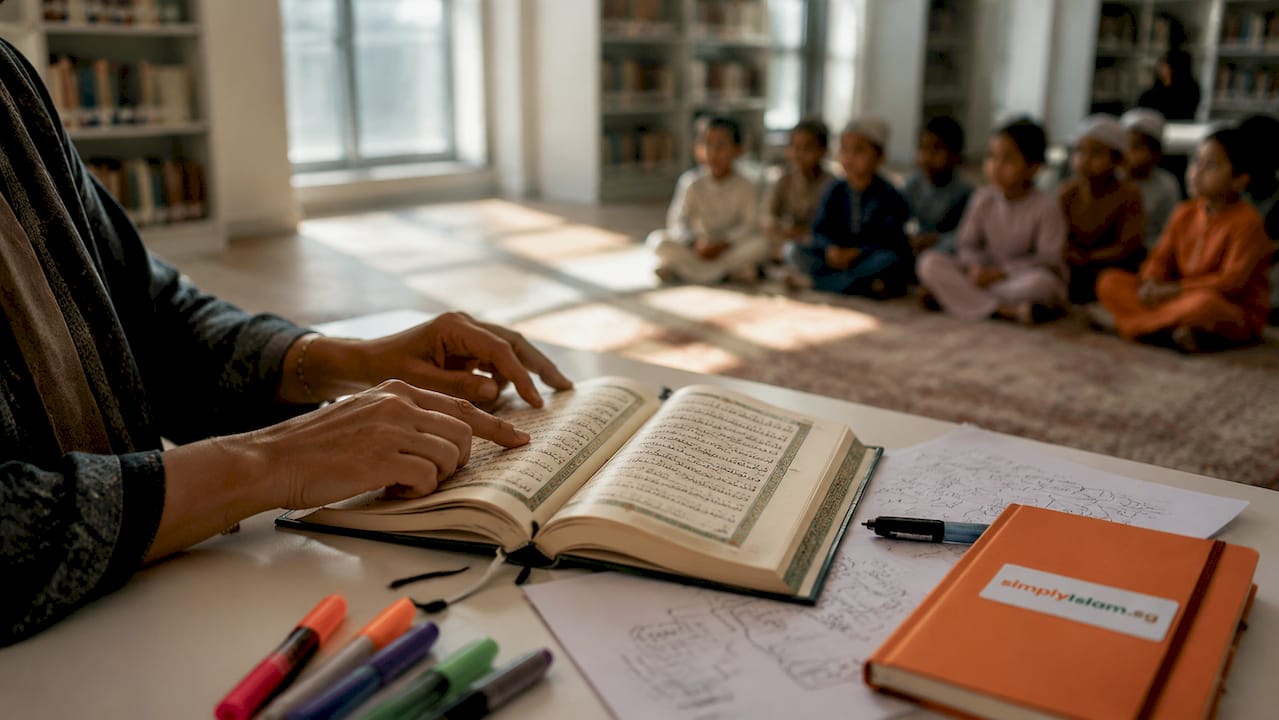
Islamic stories shape hearts and characters, functioning as a pedagogical amanah. That word matters. Amanah means a trust, a sacred responsibility. When an educator chooses a story to tell, they are not simply filling class time. They are making a moral and spiritual choice about what values to plant in their students.
The specific purposes of storytelling in Islamic education include:
- Moral modeling: Stories from the Sunnah show how the Prophet (peace be upon him) responded to injustice, poverty, and conflict, giving learners concrete behavior to emulate.
- Iman as lived experience: Narratives move faith from the intellect to the heart, helping students feel the weight of accountability, the mercy of Allah, and the reality of the Hereafter.
- Cultural and religious identity: Hearing the stories of their tradition repeatedly helps Muslim children and adults understand who they are and where they belong.
- Emotional engagement: A well-told story creates empathy. Students who feel connected to a character are more likely to internalize the values that character demonstrates.
Understanding Islamic moral education for children requires recognizing that stories are not illustrations of lessons. They are the lesson itself.
How does storytelling enhance motivation and value internalization?
The evidence for storytelling’s educational power in Islamic contexts is specific and measurable. A study with 33 sixth-grade students found that Quranic storytelling produced a statistically significant correlation of r = 0.878 with intrinsic motivation. This means students were not learning because they feared a grade. They were learning because the stories made them want to understand.
Intrinsic motivation is the engine of lasting value internalization. A student who memorizes a rule because they must will forget it. A student who hears the story of Prophet Yusuf forgiving his brothers will carry that lesson for decades.
Research on early childhood Islamic education identifies a cyclical-integrative storytelling model as the most effective framework for internalizing Islamic values. This model works in four stages:
- Contextual preparation: The educator sets the scene, connects the story to the student’s current life, and establishes the moral question the story will address.
- Interactive delivery: The story is told with dramatic expression, voice variation, and pauses that invite the student to predict, feel, and respond.
- Participatory activation: Students retell, act out, or discuss the story, moving from passive listeners to active participants.
- Daily reinforcement: The moral lesson is connected to real situations the student faces at home, at school, or in the community.
This four-stage approach integrates the cognitive, affective, and psychomotor domains of learning. Students think about the story, feel it, and then practice its values in real life.
Research grounded in Jerome Bruner’s narrative pedagogy confirms that monologic storytelling limits emotional engagement and reflection. A teacher who simply recites a story without inviting response is leaving most of the educational value on the table.
Pro Tip: After telling a story, ask one open question before offering any explanation. “What do you think Ibrahim (peace be upon him) was feeling at that moment?” gives students space to connect personally before the moral is named.
What storytelling techniques work in modern Islamic education?
Effective storytelling techniques in Islamic education draw from both classical tradition and contemporary media. The two are not in conflict. They are complementary tools for reaching learners where they are.
Classical narrative sources
The Quran, Hadith collections, and Islamic history provide an inexhaustible library of narratives. Each source serves a different pedagogical function. Quranic stories carry divine authority and are ideal for teaching Tawhid, patience, and trust in Allah. Hadith narratives show the Prophet’s (peace be upon him) character in daily situations, making them powerful for teaching social ethics and interpersonal behavior. Stories from Islamic history, including the lives of the Sahabah and early scholars, demonstrate how ordinary people lived extraordinary faith.
Digital storytelling platforms
Teachers in both public and Islamic schools use platforms like YouTube and WhatsApp to deliver Islamic narratives in English language learning contexts. This approach works. It meets students in the digital spaces they already occupy. However, teacher digital literacy and professional training are critical factors. A poorly selected video or an unmoderated WhatsApp story can undermine the very values the educator intends to teach.
Digital storytelling enhances outcomes when paired with moral narratives, but lack of professional training limits its full potential. Educators who invest in their own development produce measurably better results.
Participatory student story creation is one of the most powerful modern techniques. Students who create digital stories reflecting Islamic values during problem-solving activities integrate ethics authentically with academic subjects like STEM and English. This approach treats Islamic morality not as a separate subject but as a lens through which all learning is filtered.
Pro Tip: Encourage students to write or record a short story from the perspective of a Quranic figure facing a modern challenge. This exercise builds empathy, critical thinking, and moral reasoning simultaneously.
The table below compares storytelling formats by learning context:
| Format | Best for | Key strength |
|---|---|---|
| Oral narrative with expression | Young children, classroom settings | Emotional connection and memorability |
| Digital video with discussion | Older students, online learning | Visual engagement and accessibility |
| Student-created stories | Teens and adults | Deep value internalization through creation |
| Family storytelling circles | Home-based learning | Intergenerational transmission of faith |
For educators seeking microlearning tools for families, short narrative formats delivered via digital platforms offer a practical entry point.
How can Muslim educators apply storytelling across age groups?
Applying storytelling effectively requires intentional choices at every stage, from story selection to follow-up conversation. The method must match the learner’s age, emotional maturity, and life context.
For children aged 4–10, the priority is emotional connection and repetition. Young children learn through hearing the same stories multiple times. Each retelling deepens the impression. Educators and parents should:
- Select stories with clear moral outcomes and relatable characters, such as the story of the boy and the king from Surah Al-Buruj.
- Use voice, gesture, and facial expression to make the narrative vivid and memorable.
- Ask simple reflection questions after the story: “Was that fair? What would you have done?”
- Connect the story to the child’s daily life: “Remember how Musa trusted Allah? You can do that too when you feel scared.”
For older students and adults, the approach shifts toward dialogue and ethical complexity. Adults benefit most from storytelling that is dialogical and reflective. A story told without space for discussion produces passive listeners, not active believers.
Practical steps for adult learners include:
- Choose stories that address real moral dilemmas, such as the story of the man who killed 99 people and sought repentance, which speaks directly to the mercy of Allah and the reality of human failure.
- Facilitate open discussion after the narrative, inviting learners to connect the story to their own experiences.
- Integrate reflective writing or journaling as a follow-up practice.
- Reinforce the story’s lesson over multiple sessions, returning to it when relevant life situations arise.
Storytelling tips for children that spark real engagement emphasize the same principle that Islamic educators have always known: a story that connects to the listener’s real life is a story that changes behavior.
The niyyah, or intention, behind story selection matters as much as the story itself. An educator who chooses a narrative to entertain is doing something different from one who chooses it to plant a specific value. Both may tell the same story. Only one will see lasting results.
Key takeaways
Storytelling is the single most evidence-supported method for building intrinsic motivation and lasting moral values in Islamic education, requiring intentional story selection, interactive delivery, and consistent daily reinforcement.
| Point | Details |
|---|---|
| Storytelling drives motivation | Quranic storytelling accounts for 77.1% of the variance in intrinsic motivation among students. |
| Use the four-stage model | Contextualize, deliver interactively, activate participation, and reinforce daily for lasting impact. |
| Stories are an amanah | Every story an educator selects is a moral and spiritual responsibility, not a neutral choice. |
| Digital tools extend reach | Platforms like YouTube and WhatsApp work well when paired with teacher training and moral framing. |
| Dialogue is non-negotiable | Monologic storytelling limits reflection; always build in space for student response and discussion. |
Why storytelling is more than a teaching method
I have spent years observing how Islamic education works in practice, and the gap between what educators know about storytelling and what they actually do in the classroom is striking. Most teachers understand that stories are powerful. Far fewer treat story selection as a sacred act.
The concept of spiritual storytelling as dhikr reframes the entire practice. Dhikr is remembrance of Allah. When a story is told with that intention, it becomes an act of worship, not just instruction. The educator who tells the story of Musa parting the sea is not recounting history. They are inviting the student into a living relationship with Allah’s power and mercy.
The risk I see most often is passive storytelling. A teacher reads from a book, students listen politely, and the class moves on. No questions. No connection to real life. No follow-up. That approach produces students who know the stories but have not been shaped by them. The family storytelling approach offers a corrective model: stories told within relationships, with space for response, become part of a person’s identity.
My honest conviction is that the future of Islamic education depends on educators reclaiming storytelling as a spiritual practice first and a pedagogical technique second. The technique can be learned. The intention must be cultivated. When both are present, the results are not just better test scores. They are students who carry their faith into every room they enter.
SimplyIslam’s resources for educators and learners
SimplyIslam supports young Muslim in Singapore who love learning through storytelling and values-based lessons. SimplyIslam Weekend Madrasah are designed for busy families and working adults who are looking to offer their child quality Islamic education.
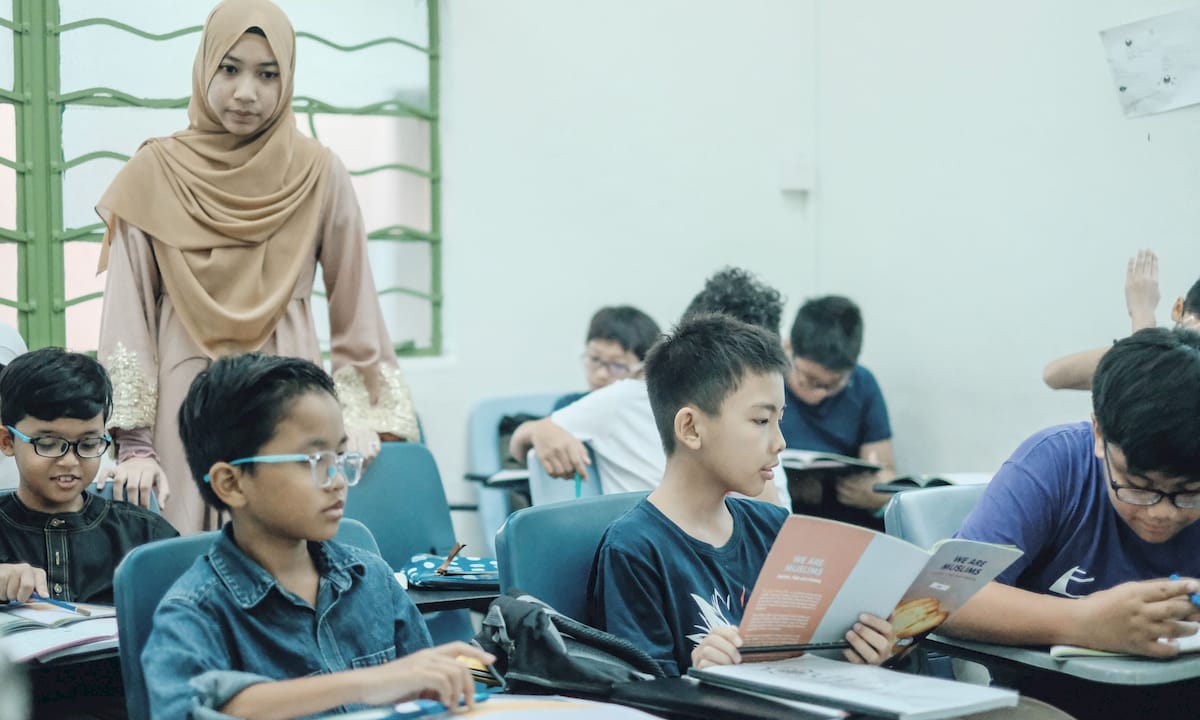
SimplyIslam’s ARS-certified instructors use interactive methods that reflect the same principles discussed here: dialogue over monologue, reflection over recitation, and real-life application over abstract theory.
Whether you are a teacher looking to strengthen your classroom practice or an adult learner building your own foundation, the Islamic education guide for adults is a practical starting point. SimplyIslam has engaged over 22,000 participants and raised more than $1.1 million for charity, reflecting a community that takes learning seriously.
FAQ
What is the role of storytelling in Islamic teaching?
Storytelling in Islamic teaching transmits moral values, spiritual identity, and faith through narratives from the Quran, Hadith, and Islamic history. It is a core pedagogical method, not a supplementary one, rooted in divine revelation itself.
How does storytelling affect student motivation in Islamic education?
Research shows that Quranic storytelling accounts for 77.1% of the variance in intrinsic motivation among sixth-grade students. This means narrative engagement drives genuine desire to learn, not just compliance.
What storytelling techniques are most effective in Islamic classrooms?
The most effective approach uses a four-stage model: contextual preparation, interactive delivery, participatory activation, and daily reinforcement. Dialogical storytelling, where students respond and reflect, consistently outperforms monologic recitation.
How is digital storytelling used in Islamic education?
Teachers use platforms like YouTube and WhatsApp to deliver Islamic narratives, particularly in language learning contexts. Outcomes improve when educators receive professional training and pair digital content with structured moral discussion.
Why is story selection an amanah for Muslim educators?
Stories in Islam are not neutral. Every narrative an educator chooses shapes the student’s values, identity, and understanding of faith. Intentional selection, grounded in Islamic purpose, is a spiritual responsibility.