
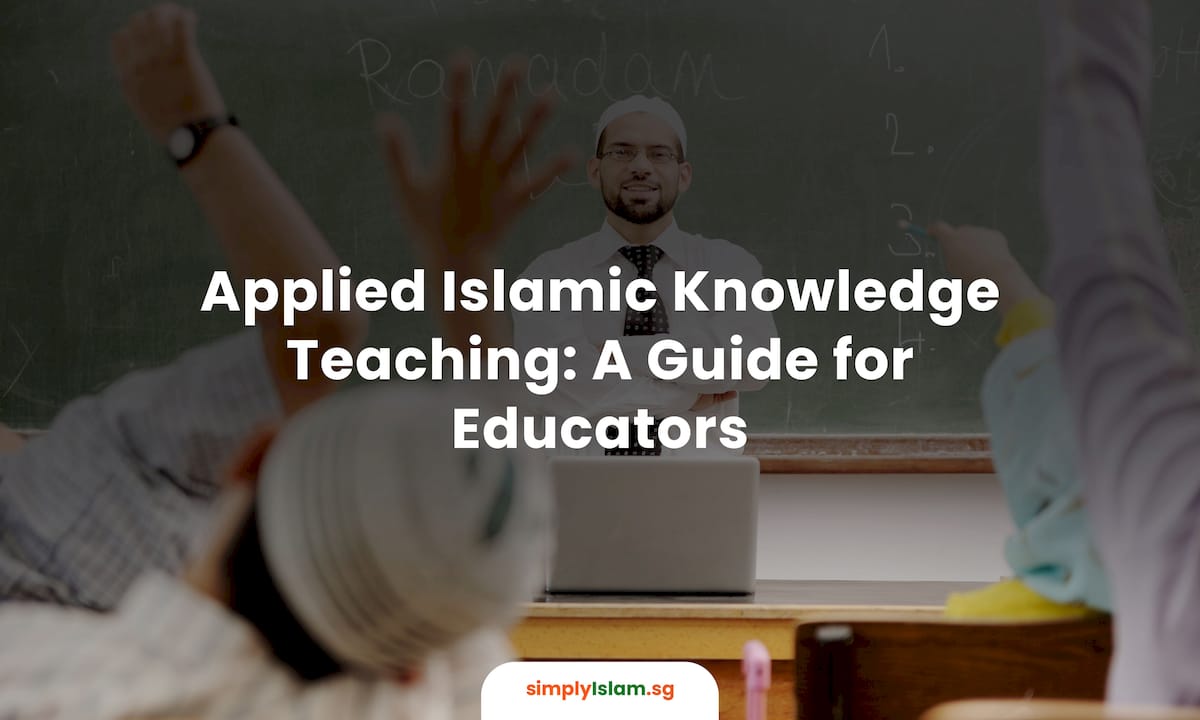

Applied Islamic knowledge teaching is defined as the practical enactment of Islamic principles through dynamic, integrative educational methods that develop learners intellectually, spiritually, morally, and socially.
This approach draws directly from prophetic pedagogy and contemporary educational theory. It treats education not as information transfer but as a means of character formation and worship. For Muslim educators and families navigating modern classrooms, understanding what is applied Islamic knowledge teaching clarifies why method matters as much as content.
SimplyIslam, which has engaged over 22,000 participants in Singapore, grounds its entire teaching model in this principle.
What is applied Islamic knowledge teaching and why does it matter?
Applied Islamic knowledge teaching is the process of engaging learners through prophetic methods and contemporary strategies to actualize Islamic principles in real life. The standard academic term for this approach is Islamic pedagogy. Both terms describe the same core commitment: education that forms the whole person, not just the informed mind.
Islamic pedagogy views education as an act of worship (‘ibadah’) and a moral trust (Amanah), aligning teacher and student in a shared spiritual purpose. That framing changes everything about how a lesson is designed and delivered. A teacher who sees instruction as Amanah prepares differently than one who sees it as a job.
The importance of Islamic education in this model extends beyond religious literacy. It aims for holistic development: the cultivation of Tawhid (the oneness of God) as a worldview, the nurturing of fitrah (innate human nature), and the formation of ethical character through the Sunnah. These are not abstract goals. They shape how a teacher asks questions, responds to mistakes, and models behavior in front of students.
Applied Islamic knowledge teaching also integrates revealed knowledge with rational inquiry. This means a lesson on ethics can draw from Quranic reasoning and contemporary moral philosophy at the same time. That integration is what separates applied Islamic pedagogy from rote memorization of religious texts.

What are the core teaching methods in applied Islamic knowledge education?
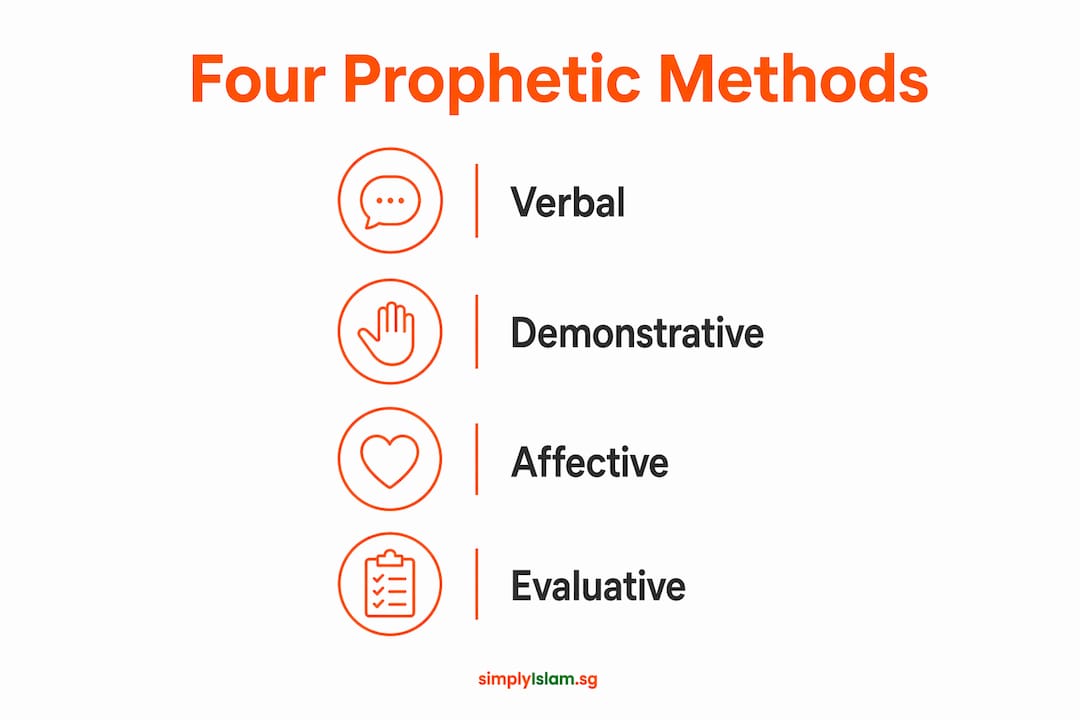
The prophetic tradition provides four validated categories of teaching method. A systematic review of 50 peer-reviewed studies confirmed that prophetic pedagogical practices fall into verbal/cognitive, demonstrative, affective/motivational, and evaluative approaches. Each category maps directly onto modern instructional design principles.
- Verbal/cognitive methods include Socratic questioning, storytelling, and direct instruction. The Prophet Muhammad (peace be upon him) regularly used questions to activate prior knowledge before delivering a teaching. Modern educators recognize this as retrieval practice.
- Demonstrative methods center on role modeling. The teacher embodies the values being taught. Students learn not just from what is said but from how the teacher treats them, responds to errors, and carries themselves.
- Affective/motivational methods use encouragement, du’a (supplication), and emotional connection to build intrinsic motivation. Research in educational psychology confirms that emotional safety accelerates learning.
- Evaluative methods involve feedback, reflection, and self-assessment. The prophetic tradition frequently invited learners to reflect on their understanding and correct themselves.
These four methods work together. A lesson that only delivers information misses three of the four categories entirely.
Pro Tip: When planning a lesson, map each activity to at least two of the four prophetic method categories. A story followed by a reflective question covers verbal, affective, and evaluative methods in under ten minutes.
Applied Islamic knowledge application in the classroom also draws on thematic and reflective teaching. Islamic education curricula increasingly connect religious teachings with real-life issues and promote personal reflection. A lesson on honesty, for example, becomes more effective when students discuss a real scenario from their own lives rather than memorizing a definition.
How do Islamic perspectives shape the theory behind applied Islamic knowledge teaching?
The theoretical foundation of applied Islamic teaching rests on Islamic human sciences, which organize knowledge into three levels. Islamic human sciences conceptualize knowledge as descriptive (what is), normative (what ought to be), and prescriptive (what should be done), all grounded in Islamic logic. This framework gives educators a structured way to think about what they are teaching and why.
The Tawhidic worldview sits at the center of this theory. All knowledge, whether scientific, social, or spiritual, is understood as originating from Allah. That conviction shapes curriculum design. A teacher working from a Tawhidic framework does not treat religious studies and critical thinking as separate subjects. They are expressions of the same pursuit of truth.
| Theoretical Principle | Meaning in Practice |
|---|---|
| Tawhidic worldview | All knowledge connects to divine unity; no subject is secular in isolation |
| Fitrah | Teaching respects and cultivates the learner’s innate moral nature |
| ‘Ibadah (worship) | Every act of learning and teaching carries spiritual weight |
| Amanah (trust) | Educators bear moral responsibility for what and how they teach |
| Integration of knowledge | Revealed and rational knowledge are studied together, not separately |
Education as ‘ibadah reframes the teacher’s role entirely. The teacher is not a content delivery system. The teacher is a moral guide whose character is part of the curriculum. This is why Islamic pedagogy integrates revealed knowledge with rational inquiry, framing education as an act of worship rather than mere career training.
The prescriptive level of Islamic human sciences is where theory becomes practice. It answers the question: given what Islam says about human nature and moral development, how should we actually teach? That question drives the design of every lesson in a genuinely applied Islamic educational setting.
What are common challenges in implementing applied Islamic knowledge teaching?
The gap between theory and practice is the central challenge in applied Islamic pedagogy. Educators often struggle to integrate traditional Islamic values with 21st-century competencies, which requires sustained capacity building. A teacher trained in classical Islamic sciences may lack student-centered facilitation skills. A teacher trained in modern education may lack the theological depth to teach from a Tawhidic framework.
Institutional challenges compound the problem. Curricula designed for standardized testing leave little room for reflective, character-focused teaching. Timetables built around subject silos make integration of knowledge difficult to schedule, let alone sustain.
Successful institutions address this through multiple, simultaneous integration modes rather than a single approach. The International Islamic University Malaysia adopted up to 21 distinct modes of integration to close the theory-practice gap. That number signals something important: no single strategy is enough. Institutional policy, teacher development, curriculum design, and assessment reform must move together.
Abstract concepts present a specific classroom challenge. Principles from Usul al-Fiqh (Islamic jurisprudence) can feel remote to students without lived context. Using real-world analogies translates abstract Islamic jurisprudence into reasoning students can apply. A teacher explaining a legal principle through a familiar neighborhood scenario makes the concept stick far better than a definition alone.
Pro Tip: Build a small library of local analogies for abstract Islamic concepts before the school year begins. Analogies drawn from students’ own cultural context reduce the cognitive distance between principle and practice.
- Invest in ongoing professional development that covers both classical Islamic sciences and modern instructional design.
- Advocate for curriculum structures that allow thematic, cross-subject teaching rather than isolated religious studies periods.
- Use peer observation and mentoring to help teachers develop the affective and evaluative dimensions of prophetic pedagogy.
- Partner with credible Islamic scholars to review curriculum content and ensure theological accuracy alongside pedagogical quality.
How can applied Islamic knowledge teaching be integrated into modern settings?
Practical integration starts with the teacher’s identity. Teachers’ roles have evolved from information transmitters to nurturers and guides, described in Islamic educational tradition as murabbi (nurturer) and mursyid (guide). A murabbi attends to the student’s emotional and spiritual state. A mursyid directs the student toward truth with wisdom and patience. Both roles require deliberate practice, not just good intentions.
Technology expands what applied Islamic teaching can reach. ICT facilitates interactive learning and broadens access to Islamic knowledge for contemporary learners. Microlearning formats, short focused lessons delivered through digital platforms, allow working adults and busy families to engage with Islamic content consistently. SimplyIslam’s evening classes and online courses apply exactly this model, making applied Islamic knowledge accessible without requiring learners to restructure their lives. The role of microlearning in Islamic studies for families shows how short, structured sessions can sustain long-term learning.
For educators ready to apply this in their own settings, these steps provide a clear starting point:
- Audit your current methods. Identify which of the four prophetic method categories (verbal, demonstrative, affective, evaluative) your lessons currently use and which are missing.
- Redesign one lesson per week to include a reflective question, a real-world analogy, and a moment of explicit character modeling.
- Integrate technology intentionally. Use short video content, discussion forums, or digital quizzes to extend learning beyond the classroom session.
- Build relationships before content. Spend the first minutes of each class attending to students’ wellbeing. This is the affective foundation that makes all other teaching more effective.
- Seek qualified guidance. Work with ARS-certified instructors or credentialed scholars who model the murabbi and mursyid roles. SimplyIslam’s courses for Islamic educators connect learners with instructors trained in both prophetic character and modern pedagogy.
- Assess character, not just content. Design assessments that ask students to apply Islamic principles to real decisions, not just recall definitions.
Adult education settings benefit especially from this approach. When working adults see Islamic principles applied to their professional and family lives, engagement deepens. The practical guide for working adults from SimplyIslam illustrates how applied Islamic teaching adapts to learners who bring real-world experience into the classroom.
Key Takeaways
Applied Islamic knowledge teaching is most effective when prophetic pedagogy, institutional support, and modern instructional design work together rather than in isolation.
| Point | Details |
|---|---|
| Definition of applied Islamic teaching | It is the practical enactment of Islamic principles through integrative methods that develop the whole person. |
| Four prophetic method categories | Verbal, demonstrative, affective, and evaluative methods are all validated by peer-reviewed research. |
| Theoretical grounding | The Tawhidic worldview and Islamic human sciences framework give educators a principled basis for curriculum design. |
| Main implementation challenge | Balancing classical Islamic knowledge with modern instructional competencies requires sustained institutional support. |
| Practical first step | Audit current lessons against the four prophetic method categories and redesign one lesson per week. |
FAQ
What is applied Islamic knowledge teaching?
Applied Islamic knowledge teaching is the practical enactment of Islamic principles through integrative educational methods that develop learners intellectually, spiritually, morally, and socially. It draws from prophetic pedagogy and frames education as an act of worship and moral trust.
What are the four prophetic teaching methods in Islamic pedagogy?
The four prophetic teaching methods are verbal/cognitive, demonstrative, affective/motivational, and evaluative approaches. A systematic review of 50 peer-reviewed studies confirmed these as the core categories of effective Islamic pedagogical practice.
How does Islamic pedagogy differ from conventional teaching?
Islamic pedagogy integrates revealed knowledge with rational inquiry and treats education as worship rather than career training. The teacher functions as a moral model (murabbi and mursyid), not just a content deliverer.
Why is the theory-practice gap a problem in Islamic education?
Many educators are trained in either classical Islamic sciences or modern instructional methods, but rarely both. Closing this gap requires sustained professional development and institutional policies that support multiple modes of knowledge integration simultaneously.
How can technology support applied Islamic knowledge teaching?
Technology expands access to Islamic knowledge and enables interactive, microlearning formats that suit busy adult learners. Digital tools work best when they extend the affective and evaluative dimensions of prophetic teaching rather than replacing them with passive content consumption.