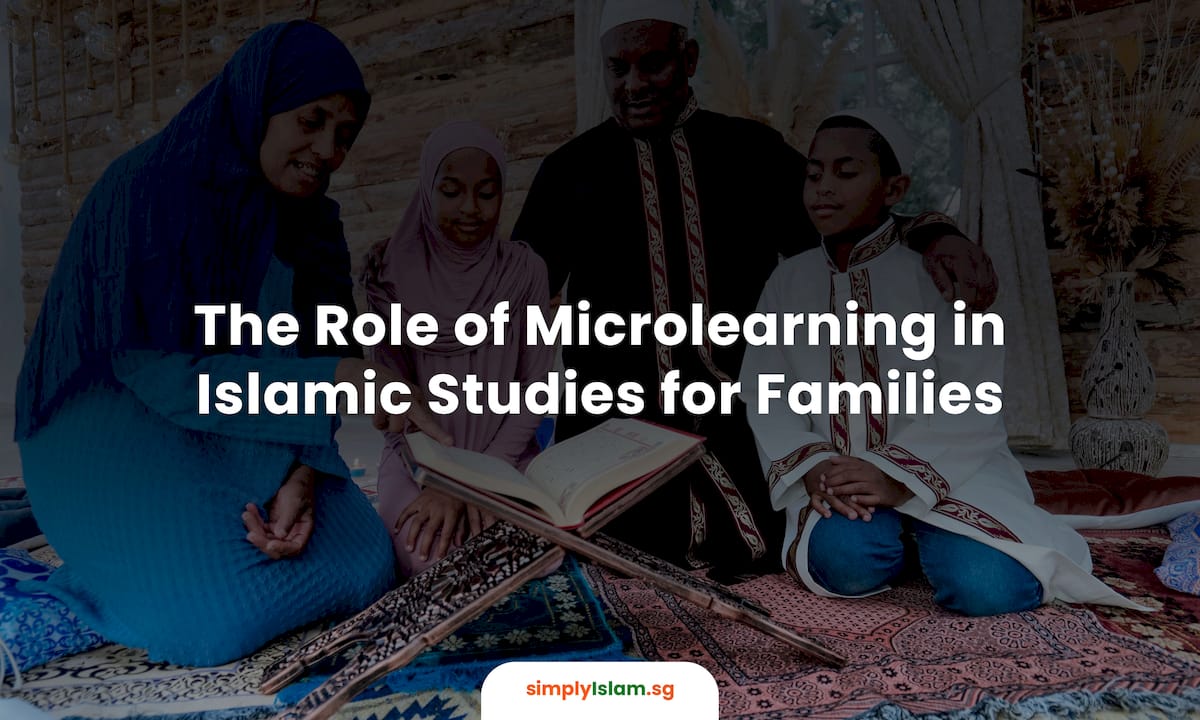



Microlearning is defined as a teaching method that breaks Islamic studies content into short, focused lessons of five to fifteen minutes, designed to improve engagement and retention among learners of all ages.
The role of microlearning in Islamic studies has grown significantly as educators and parents search for ways to connect digital-native children with their faith in a meaningful, lasting way.
Research from madrasah settings in Riau, Indonesia found that microlearning achieved 86.17% effectiveness in Arabic language learning, confirming that structured bite-sized instruction produces measurable results. This guide explains how the approach works, which tools support it, and how to apply it alongside traditional Islamic education.
How does microlearning improve engagement and retention in Islamic studies?
Microlearning works in Islamic studies because it aligns with how the human brain processes and stores information. Hermann Ebbinghaus’s Forgetting Curve shows that learners lose up to 70% of new information within 24 hours without reinforcement.
Spaced repetition, which microlearning naturally supports, counteracts this by returning to the same material in short intervals over time. For subjects like Quran recitation, Hadith memorization, and Tawhid, this structure is not just convenient. It is pedagogically sound.
The benefits of microlearning in Islamic education become especially clear when you look at lesson design. A pilot study on short Surahs found that replacing a 30-minute session with three 8 to 10 minute micro-lessons improved daily practice and recitation articulation over just two weeks.
Students working on Surah al-Falaq and Surah an-Nas showed stronger tajweed accuracy and more consistent daily practice when lessons were shorter and more frequent. That finding matters because it shows that less time per session, structured correctly, produces better outcomes than longer, infrequent classes.
Key reasons why this approach strengthens learning in Islamic studies include:
- Focused attention: Children sustain concentration more easily in 8 to 10 minute windows than in 45-minute lectures, reducing cognitive overload during dense content like Fiqh or Aqeedah.
- Immediate application: Short lessons allow learners to practice a single du’a or Quranic verse right away, reinforcing the Sunnah of acting on knowledge promptly.
- Flexible scheduling: Busy families can fit a micro-lesson into a commute, a lunch break, or the time before Maghrib prayer without disrupting the household routine.
- Confidence building: Completing a short, achievable lesson gives children a sense of progress, which sustains motivation across a longer Islamic studies curriculum.
The best of deeds are those done regularly, even if they are few.” (Sahih al-Bukhari, 6464). This hadith captures the spirit of microlearning perfectly. Consistency in small amounts outperforms occasional intensity.
Pro Tip: When designing a micro-lesson for Islamic content, limit each session to one learning objective. For example, one session covers the meaning of a single ayah, the next covers its pronunciation, and a third covers its application. This mirrors the way the Companions received the Quran, in stages, with reflection between each portion.
What types of microlearning methods and digital tools work for Islamic studies?
The practical side of microlearning in education depends heavily on choosing the right format and platform for your learners. Several digital tools have demonstrated effectiveness in Islamic learning contexts, and understanding how they differ helps educators and parents make informed choices.

AI-based tools like Kahoot and Quizizz positively impact motivation and personalize Islamic learning when integrated thoughtfully. Kahoot works well for group review sessions on Islamic history or Fiqh rulings, while Quizizz supports self-paced individual practice. ChatGPT can generate customized comprehension questions on Hadith passages or explain Arabic grammar concepts at different difficulty levels, making it a flexible support tool for both teachers and parents.
| Tool | Best Use in Islamic Studies | Delivery Mode |
|---|---|---|
| Kahoot | Group quizzes on Islamic history, Fiqh, Aqeedah | Live, teacher-led |
| Quizizz | Self-paced Quran vocabulary and Hadith review | Asynchronous, individual |
| ChatGPT | Personalized Arabic grammar explanations and comprehension questions | Self-paced, blended |
| Duolingo Arabic | Arabic script and vocabulary for beginners | Self-paced, gamified |
| Muslim Pro | Daily Quran reading, du’a, and prayer time reminders | Self-directed, mobile |
Mobile learning apps for children’s Islamic education enhance engagement, interactivity, and spiritual growth, though they cannot fully replace mentorship. Apps like Muslim Pro and Quran Companion provide structured daily reading plans, audio recitation models, and progress tracking.
These features make why mobile learning in Islamic studies works so clear: the phone becomes a consistent, low-barrier access point to faith content that fits into a child’s existing digital habits. You can explore a curated list of useful Islamic apps to identify which ones suit your child’s learning stage.
Self-paced delivery suits independent learners and working adults, while blended delivery, combining a short digital lesson with a live teacher discussion, works best for younger children who need relational reinforcement alongside content. The choice is not either-or. Most effective Islamic studies programs use both.
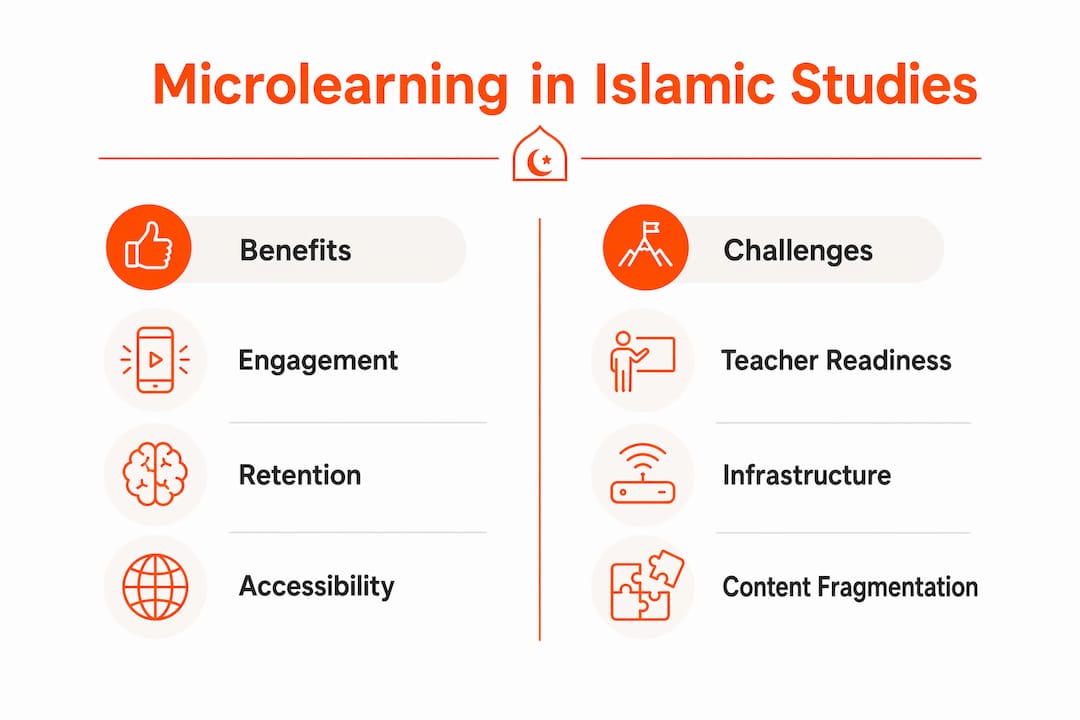
What challenges arise when implementing microlearning in Islamic studies?
Microlearning in Islamic education faces real obstacles, and acknowledging them honestly is the first step toward addressing them well. Teacher readiness and cultural attitudes toward technology significantly affect mobile-assisted Arabic language learning success.
In some Islamic school communities, there is genuine concern that digital tools will erode the relational depth of traditional learning. That concern deserves respect, not dismissal.
Common challenges educators and parents face include:
- Infrastructure gaps: Not all students have reliable devices or internet access, which creates inequity in blended learning environments.
- Teacher training deficits: Many ustaz and ustazah are deeply knowledgeable in Islamic content but have received little training in digital pedagogy or microlearning design.
- Cultural resistance: Some communities view screen-based learning as incompatible with the reverence required for Quranic study.
- Learner self-regulation: Children using apps independently often drift toward entertainment rather than structured learning without adult supervision.
- Content fragmentation: Poorly designed micro-lessons can reduce Islamic education to disconnected facts, stripping away the spiritual context that gives knowledge its meaning.
Smartphone use fosters motivation in Islamic education when paired with self-regulated learning strategies and supervision. Goal awareness, time management, and social-spiritual support are the three factors that determine whether a student benefits from mobile learning or is distracted by it. Parents play the role of shepherd here, guiding their children toward purposeful use of technology rather than leaving them to navigate it alone.
Pro Tip: Set a shared family intention (niyyah) before each digital Islamic studies session. A simple statement like “We are learning this to please Allah and understand our deen better” reframes screen time as an act of worship, not entertainment, and helps children approach the lesson with the right mindset.
How can microlearning complement traditional Islamic education methods?
Microlearning is not a replacement for the madrasah, the halaqah, or the relationship between student and teacher. It is a supplement that extends learning beyond the classroom walls. Educators view microlearning as a complementary tool in blended contexts, with a survey of 405 students and instructors in Saudi universities confirming that the approach works best alongside traditional teaching rather than in place of it.
That finding reflects a principle deeply embedded in Islamic pedagogy: knowledge transmitted through a living teacher carries a spiritual weight that no app can replicate.
The blended model works by mapping content type to the appropriate delivery method. Short Surahs, individual Arabic vocabulary items, and basic Fiqh rulings translate well into micro-lessons. Longer Surahs, complex theological discussions, and character development through the Sunnah require in-person guidance and mentorship.
Mapping content size to lesson duration in Quran studies helps educators build learning paths that are both efficient and spiritually coherent.
| Learning Objective | Recommended Delivery | Session Length |
|---|---|---|
| Memorizing Surah al-Ikhlas | Microlearning app with audio model | 8 minutes |
| Understanding Tawhid concepts | Blended: micro-lesson plus teacher discussion | 10 min + 20 min live |
| Tajweed rules for a specific letter | Video micro-lesson with practice recording | 10 minutes |
| Islamic ethics and character (Akhlaq) | In-person halaqah with storytelling | 30 to 45 minutes |
| Arabic grammar foundations | Self-paced app plus weekly teacher review | 10 min daily + weekly |
Teacher professional development is the factor most often overlooked in this conversation. Integrating digital microlearning tools requires educators to understand not just the technology but how to sequence micro-lessons within a broader Islamic studies curriculum. Simplyislam’s Al-Mishkat Certificate program demonstrates what structured, progressive Islamic learning looks like when content is organized with clear learning objectives at every stage.
Key takeaways
Microlearning strengthens Islamic studies outcomes when it delivers focused, bite-sized lessons that complement in-person mentorship, use evidence-based tools, and are guided by parental and teacher supervision.
| Point | Details |
|---|---|
| Bite-sized lessons improve retention | Replacing long sessions with 8 to 10 minute micro-lessons improves recitation and daily practice within two weeks. |
| Digital tools require mentorship | Apps like Quizizz and Muslim Pro boost engagement but cannot replace the spiritual guidance of a qualified teacher. |
| Self-regulation is non-negotiable | Supervision and goal-setting determine whether smartphone-based Islamic learning benefits or distracts the learner. |
| Blended learning is the strongest model | Combining micro-lessons for vocabulary and short Surahs with in-person sessions for Akhlaq and Tafsir produces the best outcomes. |
| Teacher training unlocks the full benefit | Educators need digital pedagogy skills alongside Islamic content knowledge to design effective micro-lessons. |
Why I believe microlearning is the right fit for this generation
By Lily
The children growing up in Muslim families today have never known a world without smartphones. That is not a problem to solve. It is a reality to work with.
What I have observed, both in educational settings and in conversations with parents, is that the families who struggle most with Islamic education are those trying to replicate a 1990s madrasah model in a 2026 household. The content is sacred. The delivery method does not have to be.
What gives me confidence in microlearning is not just the research. It is the alignment with Islamic tradition itself. The Quran was revealed in stages, over 23 years, in portions the community could absorb, reflect on, and act upon.
That is microlearning in its purest form. The Prophet, peace be upon him, taught his Companions in focused, purposeful exchanges, not marathon lectures.
The risk I see is not that technology will replace Islamic education. The risk is that we adopt the tools without preserving the values. Microlearning works when a parent sits beside their child for ten minutes with Muslim Pro, asks what they learned, and connects it to their daily life. It works when a teacher uses Kahoot to review Fiqh and then opens the floor for genuine questions. The technology is the vehicle. The relationship is the destination.
Bring Islamic learning to life with SimplyIslam
If you are looking for a structured, values-centered way to support your child’s Islamic education, SimplyIslam offers resources designed for exactly this purpose.

SimplyIslam’s online Islamic courses are built around practical, progressive learning that respects both the depth of Islamic tradition and the realities of busy family life.
SimplyIslam Weekend Madrasah offers weekend-only Islamic classes, the kind of interactive learning that keeps children engaged while reinforcing core Islamic knowledge.
For families seeking free starting points, SimplyIslam’s free Islamic resources provide accessible materials to supplement any microlearning approach at home.
With ARS-certified instructors and a community of over 22,000 participants, Simplyislam is a trusted partner for Muslim families in Singapore who want their children to grow in faith and understanding.
FAQ
What is the role of microlearning in Islamic studies?
Microlearning in Islamic studies delivers content in short, focused lessons of 8 to 15 minutes to improve retention and engagement. Research from madrasah settings shows it achieves over 86% effectiveness in Arabic language learning when structured correctly.
Why does mobile learning work for Islamic studies?
Mobile learning works because it meets learners where they already spend time and provides immediate feedback through apps like Quizizz and Muslim Pro. It is most effective when paired with parental supervision and clear learning goals.
What are the biggest challenges of microlearning in Islamic education?
The main challenges are teacher readiness, infrastructure gaps, and the risk of content fragmentation that strips away spiritual context. Addressing these requires teacher training in digital pedagogy and active parental involvement in guiding screen use.
How do you implement microlearning in an Islamic studies curriculum?
Start by mapping content to lesson duration: short Surahs and vocabulary items suit 8 to 10 minute micro-lessons, while Akhlaq and Tafsir require longer in-person sessions. Use tools like Kahoot for group review and self-paced apps for daily practice, then connect each lesson to a broader learning objective.
Can microlearning replace traditional Islamic teaching methods?
Microlearning cannot replace traditional teaching. A survey of 405 students and instructors confirmed it works best as a complement to in-person instruction, not a substitute. The relationship between student and teacher carries a spiritual dimension that digital tools are not designed to replicate.