
Islamic education for working adults is a structured, faith-centered approach to learning that helps busy Muslim professionals deepen their knowledge of Islam without sacrificing their career or family responsibilities. The standard term for this field is adult Islamic learning, and it covers everything from Quranic sciences and Arabic language to Islamic finance and personal development rooted in the Sunnah. If you have ever felt the pull to grow spiritually but struggled to find time between meetings, family duties, and daily prayers, this guide is for you. SimplyIslam and institutions like the Hafidh Institute now offer programs designed for adult learners balancing faith and professional life.
What is Islamic education for working adults?
Islamic education for working adults is the practice of pursuing structured knowledge of the deen through formats that fit around a full-time professional schedule. Education in Islam carries a central historical role, grounded in the Quranic command to read and reflect. That tradition remains fully alive today. Adult programs typically cover Arabic language, Quranic sciences, Tawhid, fiqh, and Islamic ethics. The difference from traditional madrasah study is format: evening classes, weekend intensives, short online modules, and certificate programs replace full-day attendance.
The benefits of Islamic education extend well beyond spiritual reward. Professionals who study Islam report stronger clarity of purpose at work, more grounded decision-making, and a deeper sense of community. When your niyyah (intention) is clear and your knowledge is sound, both your career and your faith grow together.

What types of Islamic education programs are available for working adults?
Working adults have more program options today than at any previous point in history. The key is matching the format to your schedule and learning style.
- Evening and weekend classes. Programs like SimplyIslam’s Islamic evening classes run after work hours and on weekends, specifically for professionals. They cover core subjects without requiring you to take time off.
- Online courses and mobile learning. Platforms offering online Islamic courses let you study at your own pace from any device. This format suits shift workers, frequent travelers, and parents with young children.
- Certificate programs. The Al-Mishkat Certificate in Islamic Studies from SimplyIslam is a structured qualification suited to working adults who want recognized credentials alongside genuine knowledge.
- Professional Islamic finance courses. Institutions like INCEIF University offer specialized qualifications for finance professionals seeking halal career alignment. Tabung Haji’s IQRA’ Plus Programme has funded over 50 students in Islamic finance and related fields since 2019, channeling more than RM2.6 million in zakat sponsorships. That scale of institutional support signals how seriously the Muslim world takes professional Islamic upskilling.
- Community workshops and mentorship. SimplyIslam’s Islamic workshops bring learners together for interactive, discussion-based sessions that go beyond rote memorization.
Pro Tip: If you are new to adult Islamic learning, start with a single evening class or a short online module before committing to a full certificate program. Consistency over intensity is the principle the Prophet, peace be upon him, modeled.
How do Islamic education quality standards protect your learning?
Islamic education quality standards ensure that what you learn is accurate, ethically grounded, and spiritually beneficial. Not every online course meets this bar. The table below compares key markers of quality across different learning environments.
| Quality marker | Strong program | Weak program |
|---|---|---|
| Instructor credentials | ARS-certified or traditionally qualified scholars | Uncredentialed content creators |
| Content ethics | Free from interest-based finance, prohibited themes | Mixes halal and haram topics without distinction |
| Learning environment | Modest, faith-affirming, community-supported | Secular platform with no Islamic framing |
| Accreditation | Recognized certificates, institutional backing | No formal recognition |
| Methodology | Interactive, application-focused | Rote memorization only |
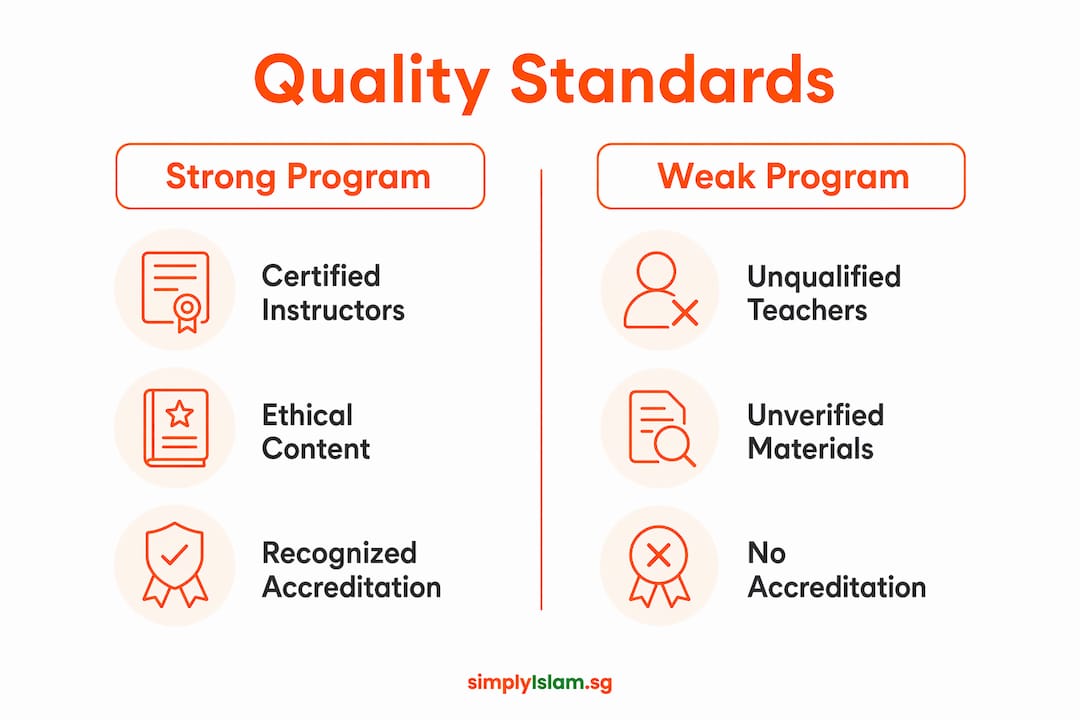
Halal learning platforms offer degrees and courses in IT, business, psychology, and Islamic studies, all designed around professional credibility and deen alignment. The environment you learn in shapes not only what you know but how you grow spiritually and professionally. SimplyIslam uses ARS-certified instructors and an interactive methodology, which places it firmly in the strong program column.
Recognized accreditation matters most in Islamic finance. Qualifications from institutions like INCEIF carry weight with employers and signal that the graduate has met rigorous, faith-aligned standards. For general Islamic studies, a certificate from a trusted institution like SimplyIslam’s Al-Mishkat program serves the same purpose.
Pro Tip: Before enrolling anywhere, ask two questions: Who are the instructors and what are their qualifications? Does the platform actively avoid content involving riba (interest) or other prohibited areas? If the answers are vague, look elsewhere.
How can working adults integrate Islamic learning into a busy schedule?
The biggest obstacle for working professionals is not motivation. It is structure. Without a clear system, good intentions fade by the second week of a new course.
Use the five daily prayers as study anchors
The five daily prayers already divide your day into natural segments. Attaching a short study habit to one prayer per day creates a faith-friendly routine that builds without friction. For example, spend five minutes after Fajr reading a short tafsir passage, or listen to a recorded lecture during your commute between Dhuhr and Asr. Pairing spiritual reflection after Jummah with a career or knowledge goal reinforces both dimensions of your growth.
Apply the 5 Pillar Muslim Goal System
The 5 Pillar Muslim Goal System structures your goals around five domains: Salah, Quran, Charity, Family, and Personal Development. Each pillar gets a specific, measurable target for the week or month. This system prevents the common mistake of treating Islamic learning as separate from the rest of life. When your Quran goal sits alongside your career goal on the same planner page, both feel equally real and equally urgent.
Leverage microlearning and digital tools
Microlearning breaks content into five to fifteen minute segments, which is the format most compatible with a working adult’s attention and schedule. SimplyIslam’s online platform and resources like the role of microlearning in Islamic studies show how short, focused sessions accumulate into deep knowledge over time. Habit trackers, digital planners, and reminder apps help you stay consistent without relying on willpower alone.
Integrate spiritual disciplines into your workday
Intentional practices like tafakkur (deep reflection) and istikhara (seeking divine guidance) are not reserved for major life decisions. Islamic professionals benefit from weaving tafakkur into daily work routines, pausing to reflect on decisions with Islamic ethical intentionality. These disciplines, drawn from traditional Islamic scholarship, bring barakah and purpose to ordinary professional tasks.
How to create a personalized Islamic upskilling plan
A personalized Islamic upskilling plan is a written roadmap that matches your current knowledge level, available time, and spiritual goals to specific courses and habits. Here is how to build one.
-
Assess your current knowledge. Be honest about what you know and where the gaps are. Can you read the Quran with tajweed? Do you understand the basics of fiqh? Identifying gaps prevents you from enrolling in courses that are too advanced or too basic.
-
Audit your available time. Track one typical week and identify windows of 15–30 minutes that are genuinely free. Most working adults find three to five such windows per day. That is enough for consistent progress.
-
Choose the right format. Match your schedule to a program type. If your evenings are free two nights per week, an evening class works. If your schedule shifts weekly, an asynchronous online course is more reliable. SimplyIslam’s online Islamic courses and evening programs both accommodate different professional rhythms.
-
Set faith-aligned goals using niyyah and the SMART framework. The SMART goal framework adapts well to Islamic learning when you add niyyah (intention) and reflection at each stage. A strong goal sounds like: “I will complete one module of the Al-Mishkat certificate each month for six months, with the intention of strengthening my Tawhid.” Specific, time-bound, and spiritually grounded.
-
Build in community and mentorship. Studying alone is harder than studying with others. Join a class cohort, find a study partner, or connect with a qualified instructor. SimplyIslam’s platform offers guidance on finding an Islamic instructor suited to adult learners.
-
Review and adjust every 30 days. Life changes. A plan that worked in january may not work in march. Schedule a monthly review to assess progress, adjust goals, and renew your niyyah. Consistency over perfection is the standard.
Pro Tip: Write your Islamic upskilling plan on paper and keep it somewhere visible. The act of writing activates commitment in a way that a mental note never does. Treat it with the same seriousness you give a work project plan.
Key takeaways
Islamic education for working adults succeeds when flexible formats, quality standards, and a personalized plan work together within a faith-aligned productivity system.
| Point | Details |
|---|---|
| Flexible formats exist | Evening classes, online courses, and certificate programs all accommodate professional schedules. |
| Quality standards matter | Choose programs with credentialed instructors, halal content, and recognized accreditation. |
| Prayer times anchor learning | Attaching study habits to daily prayers builds consistency without extra effort. |
| Personalized plans drive progress | Assess your knowledge gaps, audit your time, and set niyyah-grounded SMART goals. |
| Community accelerates growth | Mentors, study partners, and cohort-based programs sustain motivation over the long term. |
Why I think most working adults underestimate what they can actually learn
Working adults often assume that serious Islamic learning requires years of full-time study at a traditional institution. That assumption keeps many talented, motivated professionals from starting at all. What I have observed is the opposite: adults who begin with a single structured course often progress faster than younger students because they bring life experience, genuine questions, and strong motivation to every lesson.
The gap in most existing offerings is not content. It is context. Too many programs teach Islamic knowledge in isolation from the professional realities their students face. The most meaningful growth happens when a course connects Tawhid to how you make decisions at work, or links the concept of Amanah (trust) to how you treat colleagues and clients. That integration is what separates a transformative Islamic education from a box-ticking exercise.
Technology is a real opportunity here, not a threat. AI tools and digital platforms, used with Islamic ethical intentionality, can make learning more accessible and more personalized than ever before. The key is stewarding those tools with the same mindfulness you bring to any act of worship. Tafakkur and istishara are not ancient relics. They are exactly the kind of reflective disciplines that make a professional sharper, more grounded, and more trustworthy.
My honest encouragement: start smaller than you think you need to, and stay more consistent than you think you can. The barakah in that consistency will surprise you.
— Lily
Start your Islamic learning journey with SimplyIslam
SimplyIslam has served over 22,000 participants across Singapore with ARS-certified instructors, interactive courses, and a community built around genuine faith growth. Whether you are looking for structured evening classes, a recognized certificate, or flexible online modules you can fit around your work week, SimplyIslam has a program designed for exactly where you are right now.
Explore SimplyIslam’s evening classes for professionals or browse the full range of online Islamic courses to find the right fit. You can also access free Islamic resources to get started without any commitment, or check the upcoming Islamic events calendar for workshops and programs near you.
FAQ
What is Islamic education for working adults?
Islamic education for working adults is structured learning in Quranic sciences, Arabic, fiqh, and Islamic ethics delivered through flexible formats like evening classes, online courses, and certificate programs. It is designed to fit around full-time professional and family commitments.
How much time does Islamic upskilling require each week?
Most structured programs for professionals require between two and five hours per week. Microlearning formats can reduce this to fifteen minutes per day while still producing meaningful progress over time.
What are the benefits of Islamic education for professionals?
Islamic education strengthens clarity of purpose, ethical decision-making, and community connection. Professionals who study Islam consistently report greater alignment between their career values and their faith.
How do I choose a quality Islamic education program?
Look for programs with credentialed instructors, halal content standards, recognized accreditation, and an interactive methodology. SimplyIslam’s ARS-certified instructors and the Al-Mishkat certificate are strong benchmarks for quality in Singapore.
Can I create a personalized Islamic upskilling plan on my own?
Yes. Assess your current knowledge, audit your weekly schedule for free windows, set niyyah-grounded SMART goals, and choose a program format that matches your availability. Review and adjust the plan every 30 days to stay on track.