

Charity purifies wealth in Islam by removing spiritual impurities like greed and selfishness, fulfilling a divine obligation, and inviting Barakah (divine blessing) into a believer’s life. The Quran commands this directly: “Take from their wealth a charity by which you purify them and cause them increase” (Surah At-Tawbah, 9:103). Zakat, the third Pillar of Islam, makes this purification mandatory for every Muslim whose wealth meets the Nisab threshold. Understanding why charity purifies wealth in Islam reshapes how you see every dollar you earn and every dollar you give.
What does it mean that charity purifies wealth in Islam?
Purification through charity is not a metaphor. It is a concrete spiritual process that cleanses greed and attachment from the heart, restoring the proper relationship between a believer and their possessions. When you give, you actively break the grip that wealth can develop over your intentions and priorities.

The Islamic perspective on charity begins with a foundational principle: wealth is not yours to own absolutely. Wealth is a trust (Amanah) from Allah, held temporarily by the believer. This framing changes everything. You are not a permanent owner but a steward, and charity is how you fulfill that stewardship faithfully.
When wealth accumulates without giving, it can breed vanity and arrogance. Charity breaks the grip of pride that hoarding produces, protecting the believer from spiritual harm. This is why scholars describe the act of giving as a cleansing practice, not merely a financial transaction.
- Purification removes selfish attachment to material possessions
- Giving restores balance between material wealth and spiritual responsibility
- Charity realigns the heart with its true purpose: worship and gratitude to Allah
- The act of giving confirms that your trust in Allah is greater than your trust in your bank account
Pro Tip: When you feel reluctant to give, treat that reluctance as a signal. It often points to exactly the attachment that charity is designed to remove.
What are the different types of charity and their roles in purifying wealth?
Islam distinguishes between two primary forms of charitable giving, each with a distinct role in wealth purification. Understanding both helps you fulfill your obligations and go beyond them.
Zakat: the obligatory purifier
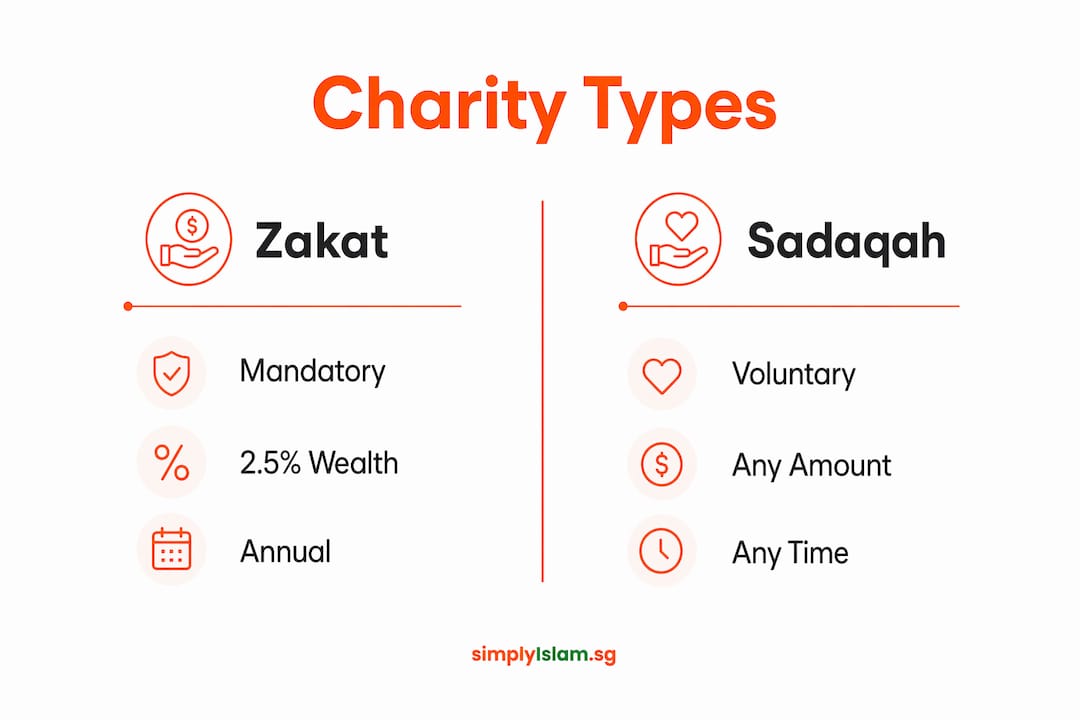
Zakat is a mandatory annual payment of 2.5% on qualifying wealth held for one full lunar year (Hawl) above the Nisab threshold, which equals 85 grams of gold or 595 grams of silver. This is not optional. It is a pillar of the faith, and withholding it is a serious spiritual and ethical failure. Zakat recipients are fixed by divine decree in Surah At-Tawbah (9:60), covering eight categories including the poor, the indebted, and those working to collect Zakat itself.
Sadaqah: the voluntary deepener
Sadaqah carries no minimum threshold or time restriction. You can give any amount, at any time, to almost any worthy cause. This flexibility makes Sadaqah a powerful daily practice rather than an annual obligation. A smile, a kind word, and helping a neighbor all count as Sadaqah in the Prophetic tradition.
| Attribute | Zakat | Sadaqah |
|---|---|---|
| Obligation | Mandatory (Fard) | Voluntary (Nafl) |
| Amount | 2.5% of qualifying wealth | Any amount |
| Timing | Once per lunar year (Hawl) | Anytime |
| Recipients | Eight fixed categories (Quran 9:60) | Broad and flexible |
| Primary purpose | Wealth purification and social justice | Spiritual growth and ongoing blessing |
Both forms attract Barakah. Barakah is divine blessing that multiplies the effect of what you have, not always in dollars, but in sufficiency, peace, and protection from hardship. The Prophet Muhammad ﷺ taught that giving does not decrease wealth. That teaching points to Barakah as the mechanism: what leaves your hand returns in forms that money alone cannot measure.
Pro Tip: Treat Sadaqah as a daily habit rather than a special occasion. Even a small, consistent amount given with sincerity builds stronger spiritual character than a large gift given once a year.
You can explore the differences between Zakat and Sadaqah in more depth to understand which form of giving applies to your specific situation.
How does charity bring spiritual and material benefits to the giver and society?
The benefits of charity in Islam operate on three levels simultaneously: the individual soul, the individual’s material life, and the wider community. Each level reinforces the others.
Spiritual benefits for the giver
Charity softens the heart. Regular giving cultivates empathy because it forces you to think concretely about someone else’s need. It builds humility because it reminds you that your wealth came from Allah, not from your own cleverness alone. Consistent small acts of Sadaqah build empathy and humility more effectively than infrequent large donations, according to scholars like Dr. Aisha Hamdan. Habitual generosity rewires how you relate to money at a fundamental level.
Material blessings through Barakah
The impact of charity on wealth is not limited to the spiritual. Barakah manifests as unexpected provision, protection from loss, and a sense of sufficiency that has nothing to do with your account balance. A family that gives consistently often reports that their needs are met in ways they did not anticipate. This is not coincidence in the Islamic worldview. It is the direct result of fulfilling your role as a trustworthy steward of Allah’s provision.
“Wealth is not diminished by charity. Allah does not increase a servant in anything by pardoning except in honor, and no one humbles himself for the sake of Allah except that Allah raises him.”
— Prophet Muhammad ﷺ (Sahih Muslim)
Social justice and community welfare
Zakat redistributes wealth to eight divinely designated recipient categories, creating a built-in system for reducing poverty and inequality. This is not charity as pity. It is charity as structural justice, embedded in the faith itself. When every Muslim who qualifies pays Zakat, the cumulative effect lifts vulnerable groups and reduces the gap between those who have and those who do not. The Islamic perspective on charity treats social welfare as a religious duty, not a political preference.
One important nuance: charity purifies only lawful (halal) wealth. Giving from earnings acquired through prohibited means does not produce purification. The source of wealth matters as much as the act of giving.
For a broader look at the benefits of giving in Ramadan, including how scholars connect generosity to inner peace, SimplyIslam has gathered detailed guidance from Islamic tradition.
How can Muslims practically fulfill their charity obligations?
Knowing the theology is the first step. Translating it into consistent practice is where many Muslims struggle. These steps make the process concrete.
- Calculate your Nisab. Check the current gold or silver equivalent of the Nisab threshold before your Hawl (lunar year) completes. Many online Zakat calculators use the 85g gold standard. Use one that reflects current gold prices.
- Set your Hawl date. Your Hawl begins the day your wealth first reaches the Nisab. Mark it on your calendar and calculate Zakat on that same date each year.
- Pay Zakat first. Before allocating to Sadaqah or other giving, fulfill your Zakat obligation. It is a right owed to others, not a gift from you.
- Build a Sadaqah habit. Allocate a fixed percentage of your monthly income to voluntary giving. Even 1% given consistently produces stronger spiritual results than irregular large amounts.
- Check your intention (Niyyah). Reward is recorded for sincere intention even if you later face financial hardship and cannot give. Niyyah is not a formality. It is the spiritual engine of the act.
- Give from lawful earnings only. Review the source of your income before giving. Purification applies to halal wealth.
- Go beyond ritual. Zakat is the floor, not the ceiling. The Prophet ﷺ and his companions gave far beyond the obligatory minimum. Treat Zakat as the starting point of your generosity, not its completion.
Stewardship and wealth purification are explored further in Islamic scripture and tradition, with practical examples of how Muslims today apply these principles.
Pro Tip: If you find yourself postponing Zakat because the amount feels large, remember that the 2.5% rate was set precisely to be manageable. Delaying does not reduce the obligation. It only delays the Barakah.
Setting consistent giving goals beyond Zakat is itself a spiritual discipline. Purification through charity is a process, not a single event. The more intentional and regular your giving, the deeper the cleansing effect on your heart and your relationship with wealth.
Key Takeaways
Charity purifies wealth in Islam by cleansing the heart of greed and attachment, fulfilling divine obligations through Zakat and Sadaqah, and inviting Barakah that protects and multiplies what remains.
| Point | Details |
|---|---|
| Wealth is a trust, not ownership | Viewing wealth as Amanah from Allah makes giving a duty, not a sacrifice. |
| Zakat is the obligatory minimum | Pay 2.5% annually on qualifying wealth above the Nisab threshold after one full Hawl. |
| Sadaqah builds daily character | Consistent small voluntary gifts build empathy and humility more than rare large ones. |
| Barakah multiplies what you give | Giving from halal wealth invites divine blessing that shows up as sufficiency and protection. |
| Intention determines spiritual reward | Sincere Niyyah earns reward even when financial hardship prevents giving. |
Charity changed how I think about money
I used to read about Barakah as a comforting idea, something you say to reassure someone who just gave away money they could have kept. Years of watching people give, and watching what happened afterward, changed that view entirely.
The Muslims I have seen give most consistently are not the wealthiest. They are the ones who seem least anxious about money. There is a quality of sufficiency around them that has nothing to do with their income bracket. That is not coincidence. That is the lived reality of what the Prophet ﷺ described.
What strikes me most about the Islamic perspective on charity is how psychologically precise it is. Greed and attachment are not abstract sins. They are specific distortions in how you relate to what you have. Charity corrects those distortions through repeated, intentional action. You cannot give regularly and remain attached. The two states are incompatible.
The hardest part is not the money. It is the sincerity in giving, the Ikhlas, that determines whether the act actually purifies or just moves funds. A gift given to be seen, or given resentfully, does not produce the same internal shift. The theology here is not soft. It is demanding in the best possible way.
My honest advice: start smaller than you think you need to, and start today. The habit matters more than the amount. The heart changes through practice, not through planning.
— Lily
SimplyIslam and the practice of faithful giving
SimplyIslam has helped over 22,000 participants deepen their understanding of Islamic principles, including the obligations and spiritual wisdom behind Zakat and Sadaqah. The platform’s ARS-certified instructors bring both scholarly authority and practical clarity to topics that can feel abstract without proper grounding.

Whether you are calculating Zakat for the first time or looking to build a more consistent Sadaqah practice, SimplyIslam’s Islamic education for working adults offers structured, accessible courses designed around your schedule. The community has also raised over $1.1 million for charity, reflecting a commitment that goes beyond teaching into lived practice. Explore free Islamic resources to begin strengthening your understanding of charity, wealth, and the faith principles that connect them.
FAQ
What does it mean that charity purifies wealth in Islam?
Charity purifies wealth by removing greed, selfishness, and unhealthy attachment from the heart. It fulfills the believer’s duty as a steward of Allah’s provision, as commanded in Surah At-Tawbah (9:103).
What is the difference between Zakat and Sadaqah?
Zakat is a mandatory annual payment of 2.5% on qualifying wealth above the Nisab threshold, while Sadaqah is voluntary giving with no fixed amount or timing. Both purify wealth and attract Barakah, but Zakat carries a legal obligation in Islamic law.
Does giving charity actually increase wealth?
The Prophet Muhammad ﷺ taught that charity does not decrease wealth. It invites Barakah, which manifests as divine blessing, sufficiency, and protection, not always as a direct financial increase but as a quality of provision that exceeds what money alone can provide.
Can charity purify wealth earned through prohibited means?
Charity purifies only lawful (halal) wealth by cleansing it of greed and attachment. Wealth acquired through prohibited means cannot be purified through giving, which is why the source of earnings matters as much as the act of charity itself.
How do I calculate my Zakat obligation?
Calculate Zakat by checking whether your total qualifying wealth exceeds the Nisab threshold (equivalent to 85g of gold or 595g of silver) and has been held for one full lunar year (Hawl). If both conditions are met, pay 2.5% of that total wealth to eligible recipients.