

A certified Quran teacher is one who holds formal authorization to teach the Quran, proven by an Ijazah certificate and a documented transmission chain called a Sanad. This is not a generic teaching diploma. The Ijazah connects a teacher directly to Prophet Muhammad ﷺ through an unbroken chain of scholars spanning 1,400 years. For parents and adults choosing a Quran instructor, understanding this distinction is the difference between authentic Quranic education and well-intentioned but unverified instruction. This guide covers what Quran teacher certification actually means, how to verify it, and what qualities to look for beyond the certificate itself.
What is a certified Quran teacher, and why does Ijazah matter?
A certified Quran teacher holds an Ijazah, an authorized license granted by qualified scholars certifying mastery of Quranic recitation with perfect Tajweed. The word Ijazah comes from Arabic, meaning “permission” or “authorization.” It is not awarded after passing a written exam. A scholar grants it only after personally listening to a student recite the entire Quran, verifying that every letter, rule, and pronunciation meets the required standard.

The Sanad is the backbone of this system. It is a named chain of scholars, each one having received the same authorization from the one before, tracing all the way back to the Prophet ﷺ himself. This means your child’s teacher can name their teacher, who can name theirs, in an unbroken sequence across centuries. That continuity is what makes the Ijazah the gold standard of Quran teacher certification, not just a credential but a living proof of authentic transmission.
Ijazah certificates are not all identical. They typically specify the mode of recitation being certified. Common types include:
- Hafs ‘an Asim: The most widely used recitation mode, covering the majority of the Muslim world.
- Riwayah: Certification in a specific narration or transmission of a recitation mode.
- Qira’at: Advanced certification covering multiple recitation modes, often held by senior scholars.
A teacher certified in Hafs ‘an Asim is qualified to teach the recitation most families in Singapore and Southeast Asia use. A teacher holding multi-Qira’at Ijazah has demonstrated a deeper level of mastery. Knowing which type a teacher holds helps you match their expertise to your learning goals.
“Ijazah is not just a paper credential but an unbroken 1,400-year oral tradition. A teacher lacking understanding of why Tajweed rules exist misses the essence of their role as faith transmitters.”
How to verify a Quran teacher’s credentials effectively
Verifying a teacher’s credentials takes more than asking “Are you certified?” A genuine Ijazah is a historical transmission record naming specific scholars who authorized the teacher. A vague answer or a generic certificate without named scholars is a red flag worth taking seriously.
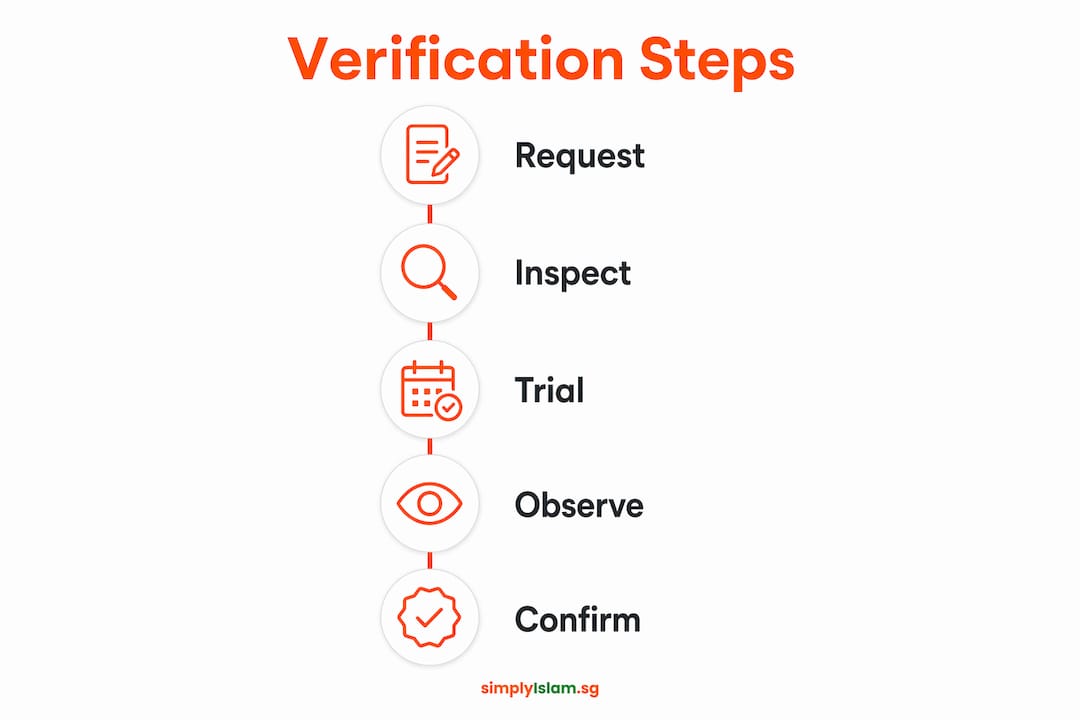
Follow these steps when evaluating any Quran instructor:
- Request the actual Ijazah document. A credentialed teacher will share it willingly. The certificate should name the granting scholar and ideally reference the Sanad chain.
- Ask for the teacher’s Sanad chain. You do not need to verify every name, but the teacher should be able to recite at least the first few links confidently.
- Book a live trial session of 30–60 minutes. Use this time to observe how the teacher explains Tajweed rules, handles mistakes, and engages with the student.
- Introduce a minor Tajweed error intentionally. An effective teacher corrects specifically, explains the reason behind the rule, and guides the student without dismissiveness.
- Observe patience and structure. A qualified instructor tracks progress, welcomes questions, and sets realistic expectations for both children and adults.
Red flags to watch for include defensive responses when asked about credentials, inability to explain why a Tajweed rule exists, and vague claims like “I have been teaching for years” without documented authorization. You can find practical guidance on reviewing teacher credentials before committing to a program.
Pro Tip: During a trial session, deliberately mispronounce a common letter like the Ghain or Qaf. A strong teacher will stop you, name the rule you broke, and demonstrate the correct articulation point. A weak teacher will simply say “no, like this” without explanation.
Academic degrees vs. Ijazah: what is the real difference?
Academic degrees and Ijazah serve different purposes, and the most qualified teachers hold both. Al-Azhar’s Kulliyyah al-Quran offers degree programs that provide systematic study of Quranic sciences, including Tafsir, Quranic linguistics, and pedagogical theory. Graduates of this faculty are among the most academically credentialed Quran educators in the world.
However, an academic degree does not certify recitation mastery. A graduate of Al-Azhar’s Kulliyyah al-Quran may have studied the theory of Tajweed extensively without having received a personal Ijazah in recitation. The Ijazah fills that gap. It certifies that the teacher can recite correctly and has been personally authorized to transmit that recitation to others.
| Credential | What it certifies | Granted by | Practical implication |
|---|---|---|---|
| Ijazah | Recitation mastery and teaching authorization | A qualified scholar through oral transmission | Teacher can certify students’ recitation |
| Academic degree (e.g., Al-Azhar) | Quranic sciences, pedagogy, and Islamic studies | A university faculty | Teacher understands theory and curriculum design |
| Both credentials | Full recitation authority plus pedagogical depth | Scholar and university | Highest standard for teaching Quran |
For parents choosing a teacher, the practical implication is clear. An Ijazah alone confirms authentic recitation. An academic degree alone confirms theoretical knowledge. A teacher with both credentials brings the full package: correct recitation, the ability to explain rules, and structured teaching methods. When evaluating Islamic studies tutors, asking about both types of credentials gives you a complete picture.
What teaching methods do certified Quran teachers use?
Credentials confirm authority. Teaching methods determine outcomes. A certified Quran teacher applies structured Tajweed instruction, clear correction techniques, and consistent progress tracking to produce real learning results.
Certified teachers approach Tajweed as a science, not a set of rules to memorize. They explain the articulation points (Makhaarij al-Huroof) for each letter, demonstrate the correct sound, and give students time to practice before moving forward. This is fundamentally different from a teacher who simply repeats a word until the student mimics it correctly. Understanding the science of Tajweed builds a student’s ability to self-correct over time.
Correction methodology is where certified teachers stand apart. Good teachers correct specifically, name the rule that was broken, and model the correct pronunciation before asking the student to repeat. They do not simply say “wrong” and move on. This approach builds confidence alongside accuracy, which matters especially for children who are still developing their relationship with the Quran.
Key qualities to look for in a certified teacher’s methodology:
- Structured lesson plans that build from basic letter recognition to full recitation with Tajweed rules applied.
- Consistent scheduling with clear milestones so parents can track their child’s progress.
- Positive correction that names the error, explains the rule, and models the correct sound.
- Adaptability between teaching children and adults, adjusting pace and explanation style accordingly.
- Openness to parent involvement, including brief progress updates and realistic timelines.
Pro Tip: Ask the teacher how they track a student’s progress between sessions. A teacher who keeps written or digital notes on each student’s errors and improvements is far more likely to produce consistent results than one who relies on memory alone.
Why choosing a certified Quran teacher matters for your family
Choosing a certified Quran teacher protects something that cannot be recovered once lost: the authentic oral transmission of the Quran. The Quran has been preserved not only in written form but through a living chain of recitation passed from teacher to student across generations. A teacher without Ijazah breaks that chain for every student they teach.
Certification strengthens community trust and preserves the oral tradition that has safeguarded the Quran since the time of the Prophet ﷺ. For parents, this means your child’s recitation is being shaped by a standard that connects directly to the source. That is not a small thing. It is the Amanah, the trust, that every Muslim family carries in raising children with correct faith and practice.
Beyond tradition, certified teachers produce measurably better learning outcomes. Students learn correct Tajweed from the start, avoiding the much harder work of unlearning bad habits later. They build confidence because corrections are clear and constructive. Parents gain peace of mind knowing the teacher’s qualifications are documented, not just claimed. For adults returning to Quranic study, working with a qualified instructor also removes the anxiety of not knowing whether what they are learning is correct. Resources like SimplyIslam’s guide on finding an instructor for adults address exactly this concern.
Key Takeaways
A certified Quran teacher holds an Ijazah with a verified Sanad chain, and verifying both the certificate and the teaching methodology is the most reliable way to protect the quality of your or your child’s Quranic education.
| Point | Details |
|---|---|
| Ijazah is the gold standard | It certifies recitation mastery and connects the teacher to an unbroken 1,400-year chain of transmission. |
| Sanad chain must be named | A genuine Ijazah names specific scholars; a vague certificate without named scholars is a red flag. |
| Academic degrees complement Ijazah | Al-Azhar degrees provide pedagogical depth, but only Ijazah certifies authentic recitation authority. |
| Trial sessions reveal true quality | Introduce a minor Tajweed error to test whether the teacher corrects specifically and explains the rule. |
| Certification protects your family | Choosing a certified teacher preserves authentic oral tradition and builds correct Tajweed from the start. |
What I have learned about choosing a Quran teacher
Most parents I have spoken with focus almost entirely on personality during a trial lesson. They want someone warm, patient, and kind with their child. Those qualities matter, but they are not the whole picture. I have seen teachers with wonderful personalities who could not explain a single Tajweed rule clearly. And I have seen teachers who seemed strict at first but produced students with genuinely beautiful recitation within months.
The correction methodology test is the single most revealing thing you can do in a trial session. Deliberately make a small mistake and watch what happens. Does the teacher name the rule? Do they demonstrate the correct sound? Do they explain why the rule exists? A teacher who does all three is worth your time regardless of how polished their introduction was. A teacher who simply repeats the correct version without explanation is teaching mimicry, not Quranic recitation.
One misconception I encounter often is the belief that a certificate from any Islamic institution equals an Ijazah. It does not. A certificate from a weekend class or a community program may reflect genuine effort and learning, but it is not the same as a scholar personally authorizing a teacher to transmit the Quran. Parents deserve to know that distinction clearly. The signs of a quality Quran class go beyond a framed certificate on the wall. Ask the hard questions. A truly qualified teacher will welcome them.
— Lily
SimplyIslam’s resources for finding qualified Quran teachers
SimplyIslam has supported over 22,000 participants in Singapore with Islamic education programs built around qualified, ARS-certified instructors and a methodology that prioritizes understanding over rote repetition.
Whether you are a parent looking for structured Quran classes for your child or a working adult ready to strengthen your own recitation, SimplyIslam offers practical resources to help you take the next step. The Islamic education guide for working adults is a strong starting point for anyone balancing a busy schedule with the commitment to learn correctly. SimplyIslam’s online Islamic courses connect learners with instructors whose credentials and teaching approaches meet the standards this article describes. Explore what is available and find the right fit for your family’s needs.
FAQ
What is an Ijazah in Quran teaching?
An Ijazah is a formal authorization granted by a qualified scholar certifying that a teacher has mastered Quranic recitation with correct Tajweed and is permitted to teach and transmit the Quran to others.
How is Ijazah different from an academic Quran degree?
An Ijazah certifies practical recitation mastery through personal oral transmission, while an academic degree such as one from Al-Azhar covers Quranic sciences and pedagogy. The most qualified teachers hold both.
What should I ask a Quran teacher before enrolling?
Ask to see the actual Ijazah certificate, request the teacher’s Sanad chain with named scholars, and book a trial session of 30–60 minutes to observe their correction methodology firsthand.
Is a certified Quran teacher necessary for beginners?
A certified teacher is especially important for beginners because correct Tajweed habits formed early are far easier to maintain than bad habits corrected later. Starting with a qualified instructor protects long-term learning outcomes.
Can adults benefit from working with a certified Quran teacher?
Adults benefit significantly from certified instruction because a qualified teacher can explain the reasoning behind Tajweed rules, which helps adult learners understand and retain correct recitation more effectively than repetition alone.