




When we think of Islam’s remarkable spread across continents — from the deserts of Arabia to the jungles of Southeast Asia, from the plains of Africa to the mountains of Central Asia — we often focus on trade routes, conquests, and scholarship. Yet one of the most powerful and enduring forces behind Islam’s expansion has been something far more intimate: the transformative spiritual tradition known as Sufism.
For many Muslims in Singapore and across Southeast Asia, Sufism is not a foreign or exotic concept. It is woven into the very fabric of how Islam arrived in this region. Understanding Sufism — what it is, where it came from, and how it shaped Muslim communities — is essential for any Muslim seeking to deepen their faith and understand their heritage.
What Is Sufism?
Sufism, or tasawwuf in Arabic, is the science of Islamic spirituality — the discipline concerned with purifying the heart, drawing closer to Allah, and cultivating the inward dimensions of Islamic practice. It is not a separate religion or sect; it is the spiritual core of Islam, rooted in the Quran and the Sunnah of the Prophet Muhammad ﷺ.
Scholars have offered many descriptions of Sufism over the centuries. The great 9th-century Sufi Junayd al-Baghdadi described it as the security of the heart and the generosity of the soul. The scholar Abu Bakar al-Kalabadhi noted that the early Sufis were called such because of the purity (safa) of their hearts and the cleanliness of their deeds. Others traced the name to the wool (suf) garments worn by those who chose simplicity over luxury in devotion to Allah.
“Mysticism can be defined as love of the Absolute — for the power that separates true mysticism from mere asceticism is love.” — Professor Annemarie Schimmel
Perhaps the clearest thread running through all of these definitions is love — love of Allah, love of the Prophet ﷺ, and love of truth. It is this love that has made Sufism such a compelling and transformative force throughout Islamic history.

The Origins of Sufism
Sufism did not emerge suddenly or in isolation. Scholars trace its roots to the earliest generations of Islam, to figures like Hasan al-Basri (d. 728), widely regarded as the patriarch of Muslim mysticism. Though Hasan al-Basri did not personally meet the Prophet ﷺ, he sat with hundreds of the Companions and absorbed their piety, their fear of Allah, and their other-worldly orientation.
Al-Basri lived in a period of rapid Islamic expansion, when wealth was flowing into Muslim lands and society was becoming increasingly worldly. His response was a powerful counter-current: he preached sincerity, asceticism, and constant awareness of the hereafter. His student, Abd al-Wahid ibn Zayd, established what historians believe was the first formal khanqah — a Sufi gathering place — at Abadan on the Iraq-Iran border.
Over the centuries, Sufism developed into a rich and diverse tradition, with dozens of recognised orders (tariqat) — among the most prominent being the Qadiriyya, Naqshbandiyya, Shadhiliyya, Tijaniyya, and Chishti orders. Each order traced its spiritual lineage back, chain by chain, to the Prophet Muhammad ﷺ himself.

How Sufism Spread Islam Across the World
The story of how Islam came to Southeast Asia — including Singapore and the Malay Archipelago — is largely a Sufi story. Islam did not arrive here primarily through armies. It came through traders, scholars, and travelling saints, most of them deeply rooted in the Sufi tradition. They arrived with not only goods but a living spirituality — one that resonated with the values of local communities.
In North America, a fascinating parallel story unfolded in the latter half of the 20th century. One of the most remarkable case studies is the Naqshbandi Haqqani order, which established a significant presence in the United States. Through the teachings of Shaykh Nazim al-Haqqani and his representative Shaykh Hisham Kabbani, thousands of Americans — including many converts — were drawn to Islam through the warmth, wisdom, and spiritual depth of the Sufi path.
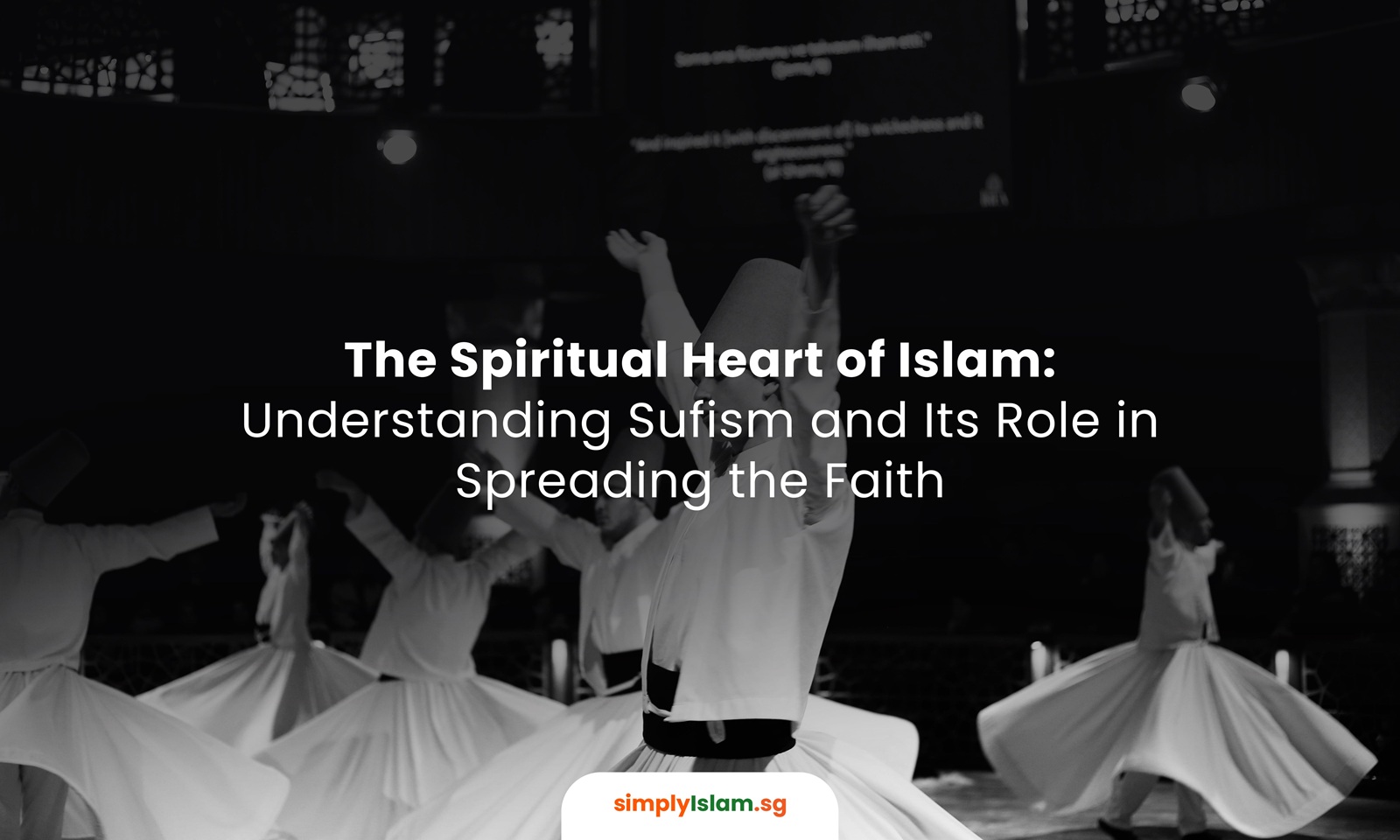
What made this possible? Sufism offers something that purely legalistic or ideological presentations of Islam often cannot: a direct, experiential connection to the Divine. Through dhikr (remembrance of Allah), suhbah (spiritual discourse), and the guidance of a qualified shaykh, seekers find their hearts opened and their lives transformed.
Sufism is not a branch of Islam — it is the root. It is the inward dimension of a faith that has always insisted that external practice without internal sincerity is incomplete.

Sufism in Singapore and the Malay World
For Malay Muslims in Singapore and the broader region, Sufism has been an integral part of religious identity for centuries. The earliest Muslims who came to the Malay Archipelago from Yemen, India, and Persia were largely Sufi practitioners, following the Ashari theological tradition and one or more of the great spiritual orders.
Al-‘Attas, one of the foremost scholars of Islam in Southeast Asia, identified nine Sufi orders of prominence in the historical Malay world: the Alawi, Qadiri, Chishti, Naqshbandi, Khalwati, Rifai, Shattari, Shadhili, and Ahmadi-Idrisi orders. Many of these continue to have living communities of practitioners in Malaysia, Indonesia, and Singapore to this day.
The Hajj journey was also an important vehicle for Sufi transmission. For centuries, Malay pilgrims who travelled to Makkah for Hajj would remain in the Hijaz for months or years, sitting with great scholars and spiritual masters. They would return home carrying not just certificates of Hajj completion, but chains of spiritual transmission, books of Sufi wisdom, and transformed hearts.

What Sufism Offers the Modern Muslim
In an age of social media, information overload, and increasing materialism, the Sufi tradition offers something precious and rare: a technology of the heart. It teaches us how to make our acts of worship more than mere ritual — how to make prayer a genuine conversation with Allah, how to make fasting a journey of inner purification, how to make every moment of life an act of remembrance.
Sufism also teaches us the centrality of love — love of Allah and love of the Prophet ﷺ. This love is not sentimental; it is a rigorous, disciplined, and active love that transforms character, purifies intention, and motivates service to creation. The great Sufi masters were not hermits hiding from the world; they were community builders, teachers, peacemakers, and social reformers.
For the Muslim community in Singapore — living as a minority in a plural, secular, and increasingly complex society — the Sufi tradition offers profound resources. It teaches us how to maintain a living connection to faith amid the pressures of modern life. It reminds us that Islam is not only about correctness of external form but about the quality of the heart.

Reconnecting with Our Spiritual Heritage
Sufism is not something foreign to our tradition — it is the tradition’s innermost dimension. From the companions of the Prophet ﷺ to the great scholars of the Malay Archipelago, the pursuit of inward purity and closeness to Allah has always been at the centre of Islamic life.
At SimplyIslam, we believe that a wholesome Islamic education must include not only fiqh and aqidah, but also the spiritual and ethical dimensions of the faith — what the scholars call ihsan. We invite you to explore this rich tradition, learn about the great masters who shaped it, and find in it nourishment for your own spiritual journey.
May Allah purify our hearts and draw us ever closer to Him. Ameen.
Mohamed Nassir is Chairman of the SimplyIslam Education Group and is Head of Studies at the Inter-Religious Relations in Plural Societies (SRP) Programme at the S. Rajaratnam School of International Studies (RSIS), Nanyang Technological University (NTU), Singapore. His research interests include interfaith studies, Islamic education, and religious exclusivism and extremism.