



Khusyuk (also written khushoo) is the presence of your heart before Allah during prayer — a state of genuine humility, stillness, and inner awareness that transforms salah from routine motion into real worship. The single most effective immediate action to regain it is to slow down every movement until your body settles before your heart can follow.
Quick checklist for your next prayer:
- Silence your phone and step away from the screen shortly before the opening takbir
- Perform wudu slowly and with intention, naming what you are about to do
- Take a few deliberate breaths after standing on the prayer mat, before you raise your hands
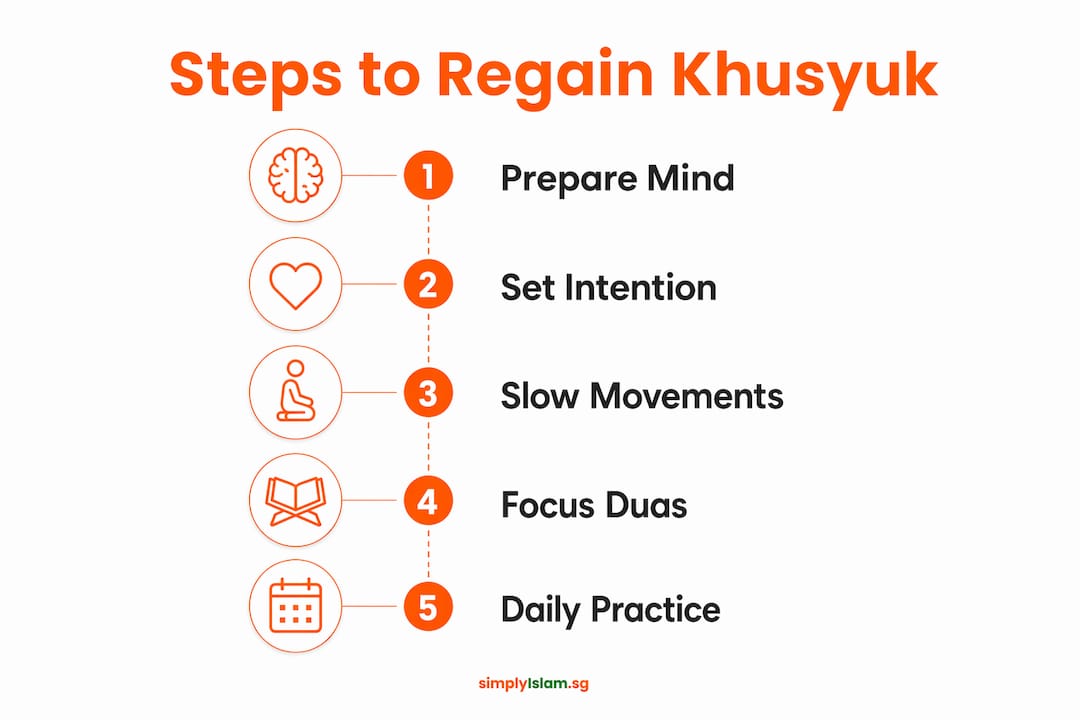
- Slow each posture — ruku’, sujud, and the transition between them — until you feel stillness
- In sujud, add one short personal dua before rising
Fluctuating focus is completely normal. Scholars confirm that prayer remains valid even without full khusyuk, though its absence reduces reward. The goal is not perfection in a single prayer — it is steady, patient improvement over many prayers.
Pro Tip: Think of khusyuk as a muscle, not a mood. You train it with small, repeated actions, not with one heroic effort.
Table of Contents
- What is khusyuk and what does it look like in practice?
- Why does khusyuk matter so much spiritually?
- Why does khusyuk fade, and which cause applies to you?
- How to prepare your mind and body before standing for salah
- Posture-by-posture techniques to maintain focus during prayer
- What to do when your mind drifts during prayer
- Daily habits that build khusyuk over weeks and months
- What Islamic law actually says about khusyuk and common misconceptions
- A 30-day plan to rebuild khusyuk progressively
- Common mistakes that quietly sabotage khusyuk
- Key Takeaways
- The quiet work of coming back
- A prayer course designed for Muslim women who want to start right
- Useful sources for deeper study
What is khusyuk and what does it look like in practice?
Khusyuk is defined by classical scholars as the steadfast presence of the heart, combined with humility and submission before Allah. Imam Ibn Qayyim al-Jauziyyah described it as “the steadfast of the heart when facing Allah SWT, with humility and humbleness,” while Imam Ibn Rajab al-Hanbali traced its root to “the softness of the heart, the calm and submissive state.” These are not poetic descriptions — they point to something you can actually feel and observe.
Scholars distinguish two dimensions: the internal and the external. Both matter, and both can be trained.
Internal signs of khusyuk:
- Heart is present and aware of standing before Allah
- Genuine sense of humility, awe, or even fear of Allah’s greatness
- Reflection on the meaning of what the tongue is reciting
- Absence of mental chatter about worldly concerns
External signs (tuma’ninah):
- Calm, unhurried movements between postures
- Stillness in ruku’ and sujud — bones settle before rising
- Eyes cast downward, gaze not wandering
- Recitation that is measured, not rushed
Tuma’ninah — physical tranquility in the pillars of prayer — is actually a condition for the prayer’s validity. Khusyuk of the heart is the deeper quality that fills that stillness with meaning. You can have tuma’ninah without full khusyuk, but you cannot have genuine khusyuk while rushing through postures.
Why does khusyuk matter so much spiritually?
The Qur’an opens its description of successful believers with a direct reference to this quality: “Successful indeed are the believers, those who humble themselves in their prayer” (Surah Al-Mu’minun, 23:1–2). That is not a minor footnote — it is the first characteristic Allah names for those who attain true success.
The spiritual and practical benefits of cultivating khusyuk extend well beyond the prayer mat:
- Increased reward: A prayer offered with presence carries far greater weight than one performed mechanically, even if both are technically valid.
- Deeper dua: When the heart is present, supplication becomes sincere rather than habitual — and sincerity is what Allah responds to.
- Expiation of sins: The hadith above links a prayer performed with humility and proper bowing to the forgiveness of minor sins between prayers.
- Patience and humility in daily life: Khusyuk as a life orientation tends to improve patience, moral clarity, and even leadership effectiveness outside of prayer.
- Prayer feels restorative: When you are genuinely present, salah shifts from obligation to refuge — a real pause from the noise of the day.
Sincerity in worship and ikhlas are deeply connected to khusyuk. A heart that has learned to show up fully in prayer gradually learns to show up fully everywhere else.
Why does khusyuk fade, and which cause applies to you?
Khusyuk does not disappear randomly. There are identifiable causes, and diagnosing yours is the fastest path to the right fix.
Common causes:
- Rushing: Moving through postures too quickly prevents the body from settling, which keeps the mind unsettled. This is the most common structural barrier.
- Digital overload: Checking your phone immediately before prayer floods the mind with notifications, conversations, and images that linger for minutes afterward.
- Unresolved sins or emotional weight: A heavy conscience or unaddressed guilt creates a background noise that competes with presence.
- Physical needs: Hunger, thirst, or the urge to use the restroom all pull attention away from worship.
- Not understanding the recitation: Repeating Arabic words whose meaning you do not know is like reading a letter in a language you have not learned — the heart cannot engage with what the mind does not grasp.
- Waswas (intrusive whispers): Repetitive, anxious thoughts about whether you performed something correctly are a distraction in themselves, not a sign of genuine spiritual failure.
- Environment: Clutter, noise, or a screen in your line of sight all compete for attention.
Quick self-check questions:
- Did I use my phone in the last five minutes before this prayer?
- Am I physically comfortable — not hungry, not needing the restroom?
- Do I know what I am about to recite, even roughly?
- Is my prayer space free of visual distractions?
Pro Tip: Scholars recommend “remembering death” — treating each prayer as if it might be your last — as one of the most powerful mindset shifts for cultivating urgency and humility in salah. It sounds sobering, but it works precisely because it is true.

How to prepare your mind and body before standing for salah
The three to five minutes before prayer are where khusyuk is either built or lost. A short, deliberate preparation routine makes the difference between walking into salah distracted and walking in ready.
Numbered pre-prayer routine (memorize this):
- Put the phone away — not on silent, but physically out of sight. Do this first.
- Perform wudu with intention. Say Bismillah, move slowly, and think about what each step represents — purification before standing before Allah.
- Stand on the mat 60–90 seconds early. Do not fill that time with your phone. Stand quietly.
- Take three slow breaths. Inhale for four counts, exhale for four. This is not a spiritual exercise — it physically slows your heart rate and reduces reactive distraction.
- Renew your niyyah (intention) consciously. Not just the formula, but the actual awareness: “I am about to stand before Allah.”
- Make a short istighfar — one or two repetitions of Astaghfirullah — to clear the emotional slate.
Mindful wudu and removing distractions before prayer are among the most consistently recommended preparatory practices across classical and contemporary guidance.
At home: Face a plain wall if possible. Remove decorative items from your line of sight. Let family members know you are praying.
At work: Find a quiet room or corner. Even a brief 90-second ramp in a stairwell is better than walking straight from your desk to the mat.
In congregation: Arrive before the iqamah. Use the waiting time for quiet dhikr rather than conversation.
Pro Tip: The right intention in worship is not just a legal formality — it is the switch that turns movement into meaning. Renewing niyyah consciously, even for a prayer you have performed thousands of times, resets your relationship with that specific salah.
Posture-by-posture techniques to maintain focus during prayer
The body and heart are not separate systems in salah. Slowing physical movement is one of the most reliable ways to anchor mental attention — when the body stops rushing, the mind follows.
Posture-by-posture guide:
- Opening takbir: Raise your hands slowly. As you say Allahu Akbar, let the words carry their full weight — you are declaring that Allah is greater than everything you just left behind.
- Standing (qiyam): Recite Al-Fatihah one phrase at a time, pausing briefly between verses. If you know the meaning, let each phrase land before moving to the next. Al-Fatihah is a conversation — Allah responds to each verse as you recite it.
- Ruku’: Place your hands on your knees and hold the position until your back is fully flat and your bones have settled. Say Subhana Rabbiyal Azeem three times slowly, not as a count but as a statement.
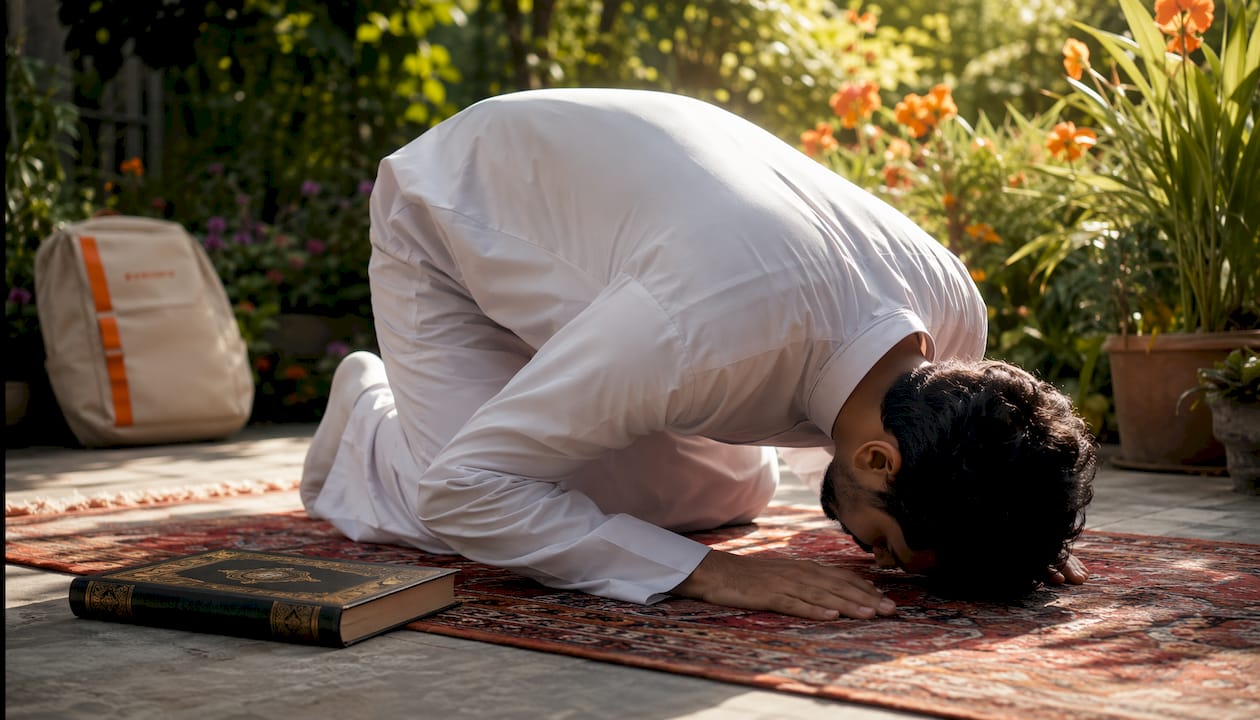
- Sujud: This is the closest position to Allah. Lengthen it. Make a personal dua in your own words — this is permitted and encouraged. The Prophet ﷺ taught: “Allahumma inni a’udhu bika min qalbin la yakhsha’” (O Allah, I seek refuge with You from a heart that has no khusyuk).
- Tashahhud: Read it with your tongue and your heart together. The words address the Prophet ﷺ directly — let that awareness be present.
- Tasleem: Do not rush the closing salams. Each one is a conscious farewell to the prayer state.
When distraction strikes mid-prayer:
- Do not panic or spiral into self-criticism.
- Say A’udhu billahi min ash-shaytan ir-rajim silently.
- Pause for two breaths.
- Return your attention to the current word or phrase — not the beginning of the surah, just where you are now.
Pro Tip: You do not need to slow your prayer to an unusual length to achieve tuma’ninah. A few extra seconds in each posture — enough for bones to settle — is all that is required. Most people underestimate how fast they are moving until they time themselves.
What to do when your mind drifts during prayer
Wandering thoughts during salah are not a sign of spiritual failure. They are a normal feature of a human mind, and passing distractions do not invalidate prayer. What matters is how you respond.
Three-step in-prayer reset:
- Silently say A’udhu billahi min ash-shaytan ir-rajim.
- Take two slow breaths without breaking your posture.
- Return focus to the current word or movement — not the start of the prayer, just this moment.
Post-prayer recovery routine:
- Sit quietly for 30 seconds after the tasleem. Do not reach for your phone.
- Say Astaghfirullah three times for any shortcomings in the prayer.
- Make one short, sincere dua — ask Allah specifically for a heart that is present in the next prayer.
- Write one line in a small notebook: the time, and a 1–3 word note about what distracted you (“phone thoughts,” “rushed ruku’,” “waswas about wudu”). Within two weeks, patterns emerge and you can target the actual cause.
Short dua templates for sujud or after prayer:
- “Allahumma inni a’udhu bika min qalbin la yakhsha’” — O Allah, I seek refuge with You from a heart that has no khusyuk.
- “Allahumma a’inni ‘ala dhikrika wa shukrika wa husni ‘ibadatik” — O Allah, help me to remember You, to be grateful to You, and to worship You well. (Abu Dawud)
These short, repeated duas asking for a present heart are a foundational practice taught by the Prophet ﷺ and recommended consistently by contemporary scholars.
Daily habits that build khusyuk over weeks and months
Khusyuk in salah is shaped by what you do between prayers. A heart that spends its day in heedlessness will struggle to find presence when it stands on the mat.
Daily habit checklist:
- Read or listen to a short Quranic passage with meaning — even three verses with tafsir is enough
- Say the dua for khusyuk (Allahumma inni a’udhu bika min qalbin la yakhsha’) at least once daily, outside of prayer
- Practice regular istighfar — it softens the heart and reduces the emotional noise that competes with presence
- Limit screen time shortly before Isha prayer — the last thing you consume before sleep shapes your morning prayer
- Maintain consistent sleep so Fajr is not a struggle against exhaustion
- Add voluntary fasting days when possible — hunger sharpens awareness and reduces distraction
Weekly sample schedule:
- Daily (every prayer): 90-second pre-prayer ramp — istighfar, slow breath, conscious niyyah
- Three times per week: 10-minute Quran reflection session — read the passage you will recite in prayer, look up its meaning
- Once per week: Pray one voluntary prayer (Duha or Tahajjud) with extra length and deliberate slowness — treat it as a training session for khusyuk
- Once per week: Review your one-line prayer journal and identify one pattern to address
Pro Tip: A one-line daily journal — just the prayer time and a brief note — yields reliable insight within two weeks. “Distracted by phone,” “focused on meaning,” “waswas about wudu” are enough. You cannot fix what you have not named.
What Islamic law actually says about khusyuk and common misconceptions
There is genuine scholarly disagreement about whether khusyuk is obligatory or a perfecting sunnah — and understanding that distinction matters for your peace of mind.
The scholarly positions:
- Obligatory view: Imam al-Ghazali and Imam al-Qurtubi held that khusyuk is required in obligatory prayers, reasoning that a prayer performed with a completely absent heart does not constitute true remembrance of Allah.
- Sunnah view (majority position): Imam al-Nawawi and the majority of scholars hold that khusyuk is a sunnah that perfects prayer. Prayer without it is valid but makruh (disliked) and carries reduced reward.
Common misconceptions to let go of:
- “I must cry to have khusyuk.” Tears can be a sign of khusyuk, but they are not a requirement. Presence and humility are the substance; emotion is one possible expression.
- “Every wandering thought invalidates my prayer.” It does not. Scholars are clear that passing thoughts are not sinful and do not require repeating the prayer.
- “If I repeat the prayer, it will be better.” Repeating prayers out of waswas — without a genuine legal reason — is itself discouraged. It can deepen anxiety rather than improve worship.
- “Khusyuk is for advanced Muslims only.” Every Muslim is called to it. The beginner’s sincere effort carries real reward.
For specific fiqh questions about your prayer, consult a local scholar or a reliable fatwa resource. For women seeking structured guidance on prayer rulings, SimplyIslam’s fiqh prayer guide for ladies covers the Hanafi perspective in accessible detail.
A 30-day plan to rebuild khusyuk progressively
Think of this as a training program, not a test. Each week builds on the last, and small wins compound.
| Week | Focus Goal | Daily Micro-Actions |
|---|---|---|
| Week 1 | Prepare and slow | 90-second pre-prayer ramp; slow every posture by a few extra seconds; phone away before wudu |
| Week 2 | Meaning and reflection | Learn Al-Fatihah’s meaning phrase by phrase; add one personal dua in sujud daily |
| Week 3 | Refine and lengthen | Extend sujud for a longer duration; add one voluntary prayer per week; begin one-line journal |
| Week 4 | Integrate and sustain | Combine all habits; weekly journal review; add Quran reflection three times per week |
Numbered weekly actions:
- Week 1: Each day, perform wudu slowly and stand on the mat a little early. That is the only new habit this week. Do it for every prayer.
- Week 2: Before each prayer, read the meaning of one verse from Al-Fatihah. By Friday, you will have covered the whole surah.
- Week 3: In every sujud, stay down for one extra breath and say the dua for khusyuk. Add one Duha or Tahajjud prayer on the weekend.
- Week 4: Review your journal. Pick the one distraction that appeared most often and design one small environmental fix (move your phone charger, face a different wall, adjust your prayer time by five minutes).
Tracking: Copy this simple weekly self-check into a notebook or phone note:
- Did I complete the pre-prayer ramp at least 80% of prayers this week? Yes / No
- What distracted me most? (one word)
- One thing I will adjust next week:
Pro Tip: Setbacks in week two or three are normal — they are not failure, they are data. The habit of returning after a difficult day is itself a form of khusyuk.
Common mistakes that quietly sabotage khusyuk
These habits are widespread and easy to miss because they feel harmless. Each one has a simple correction.
- Rushing postures → Set a personal rule: never rise from ruku’ or sujud until you have said the dhikr at least three times slowly. Speed is the enemy of presence.
- Using your phone in the prayer space → Move the charger to another room. The prayer space should have no screens in your line of sight.
- Repeating prayers from waswas → Unless a scholar has given you a specific reason to repeat, complete the prayer and move forward. Repetition from anxiety feeds anxiety.
- Treating salah as a checklist → Before each prayer, say one sentence to yourself: “This is not a task. This is a meeting.” It sounds simple; it works.
- Praying while physically uncomfortable → Use the restroom before prayer. Eat a small snack if you are hungry. Physical discomfort is not patience — it is a preventable distraction.
- Skipping the post-prayer moment → The 30 seconds after tasleem are when the heart is most open. Do not waste them on your phone. Sit, breathe, say Astaghfirullah.
No one achieves perfect khusyuk consistently. The goal is direction, not perfection — and every sincere effort is seen by Allah.
Key Takeaways
Khusyuk is a trainable presence of heart that transforms salah from motion into meaning — and the most reliable path back to it is slowing the body, preparing the mind, and asking Allah for help consistently.
| Point | Details |
|---|---|
| Slow the body first | Settling each posture physically anchors mental attention and is the fastest in-prayer fix. |
| Prepare 90 seconds early | A short pre-prayer ramp of istighfar, slow breath, and conscious niyyah primes the heart before the takbir. |
| Learn Al-Fatihah’s meaning | Understanding what you recite phrase by phrase is the single most sustainable long-term improvement. |
| Wandering thoughts are normal | Passing distractions do not invalidate prayer; seek refuge, pause, and return to the current word. |
| SimplyIslam prayer course | Muslim women beginning their prayer journey can build khusyuk through structured, practical lessons at SimplyIslam. |
The quiet work of coming back
Regaining khusyuk is rarely dramatic. It does not usually arrive as a sudden wave of tears or a single transformative prayer. More often, it comes back in small moments: a sujud where you actually stayed long enough to mean the words, a Fajr where the room was quiet and your heart was quieter still. Those moments are real, and they are worth striving for.
What tends to get overlooked in guides like this one is how much the returning matters. Not the perfect prayer — the prayer after the distracted one, where you tried again. That persistence is itself a form of worship. Allah says in the Qur’an: “Those who strive for Our sake, We will surely guide them to Our ways” (Surah Al-Ankabut, 29:69). Striving for khusyuk, imperfectly and repeatedly, is exactly that kind of striving.
Be patient with yourself. Ask Allah often. The heart that keeps turning back is already on its way.
A prayer course designed for Muslim women who want to start right

If you are a Muslim woman who wants to build a solid, focused prayer practice from the ground up, SimplyIslam’s Islamic Essentials for Ladies course is designed precisely for that. Rather than learning in isolation, you get structured, interactive lessons with ARS-certified instructors who teach practical prayer skills — including the postures, recitations, and mindset habits that support genuine khusyuk. The course is beginner-friendly, which means no prior Arabic knowledge is assumed, and the format fits around a busy schedule.
This is not passive content consumption. It is guided learning with real accountability, covering the fiqh, the meaning behind what you recite, and the habits that make prayer feel like a refuge rather than a routine. Over 22,000 participants have learned with SimplyIslam — and the sisters who go through this course leave with both confidence and presence in their salah.
Join the Islamic Essentials for Ladies course and take the first step toward a prayer life that is grounded, focused, and deeply meaningful.
Useful sources for deeper study
The following sources informed this guide and are worth consulting directly for further reading:
- Jabatan Mufti Wilayah Persekutuan — Irsyad Al-Fatwa Series 145: The most thorough scholarly treatment of whether khusyuk is obligatory or sunnah, with classical citations from Imam al-Nawawi, Ibn al-Qayyim, and al-Qurtubi.
- Jabatan Mufti Wilayah Persekutuan — Irsyad Al-Hadith Series 345: Covers the importance of khusyuk with hadith evidence and the Shafi’i fiqh position on its role in prayer.
- Islamic Heritage Center — What Is Khushu in Salah: Practical and accessible overview of khusyuk’s definition, tuma’ninah, and preparatory steps.
- Islam Q&A — Response on Khushu and Prayer: Reliable contemporary fatwa resource addressing the role of physical stillness and the ruling on wandering thoughts.
- Muslim Planner — How to Increase Khushu in Salah: Behavioral and habit-based guidance, including the pre-prayer ramp and one-line journal technique.
- Islam Channel — Khushu: The Essential Quality of Prayer: Scholarly perspective linking khusyuk to character development and daily life outcomes.
- End Reminder — Cultivating Khushu Before, During and After Prayer: A comprehensive guide covering dua templates, post-prayer habits, and long-term spiritual cultivation.
- SimplyIslam — Islamic Essentials for Ladies: Structured beginner prayer course for Muslim women, taught by ARS-certified instructors with a practical, interactive approach.
- SimplyIslam — Free Islamic Resources: Downloadable guides and materials to support your 30-day practice plan and daily habits.
For tight fiqh questions specific to your situation — especially around prayer validity, repetition, or waswas — consult a qualified local scholar. Online resources are a starting point, not a substitute for personal scholarly guidance.