

An Islamic history learning roadmap is a structured, stage-by-stage study plan that takes adult learners from foundational vocabulary to confident, critical engagement with 1,400 years of Muslim civilization. Without structure, most adults stall within weeks, overwhelmed by the sheer scope of the subject. This guide gives you a clear pathway through the key periods, from the Formative Period beginning in 610 CE to the post-colonial present, using thematic study, visual tools, and primary sources. SimplyIslam’s approach, built on ARS-certified instruction and interactive methodology, reflects the same principles this roadmap applies: depth over memorization, understanding over recitation.
What foundational knowledge should adults build first in Islamic history?
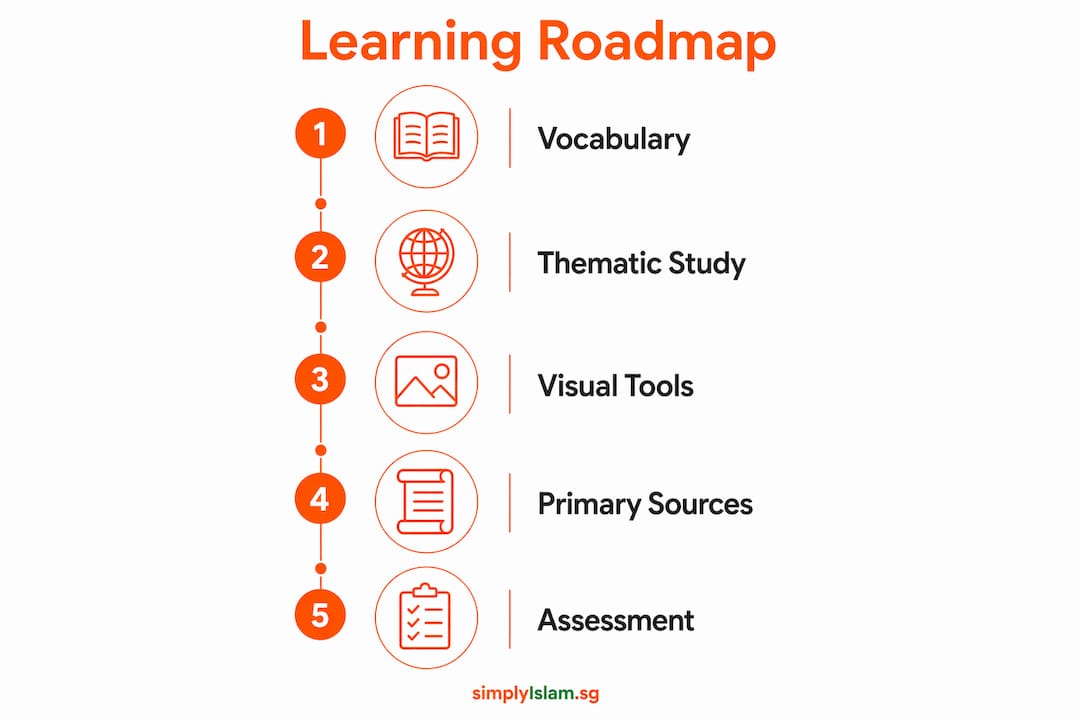
Mastering foundational terminology before tackling complex chronological histories is the single most important first step in adult Islamic history education. Many learners skip this stage and then struggle to understand why events unfolded as they did. The term Seerah, for example, refers specifically to the biography of the Prophet Muhammad (peace be upon him), and it is distinct from the broader field of Islamic history. Conflating the two leads to confusion that compounds over time.
Start by building a working vocabulary around these core concepts:
- Seerah: The prophetic biography, covering the life of the Prophet from birth to death
- Hadith: Reported sayings and actions of the Prophet, distinct from the Quran
- Fiqh: Islamic jurisprudence, which shaped governance and social life across empires
- Historiography: The study of how history is written, who wrote it, and why
- Caliphate: The political-religious institution that governed the Muslim world after the Prophet’s death
- Ummah: The global Muslim community, a concept central to understanding political unity and fragmentation
Once you have this vocabulary, shift your focus to thematic understanding rather than memorizing dates. Thematic engagement with sources produces deeper retention than chronological lists. Understanding why the Abbasid caliphate replaced the Umayyads matters more than knowing the year 750 CE in isolation.
For beginners, the Islam for beginners curriculum at SimplyIslam provides a structured entry point that contextualizes these terms within lived Islamic practice.

Pro Tip: Build a personal glossary document from day one. Add five new terms per week with definitions and historical examples. By month three, you will have a reference that makes advanced texts far more accessible.
How do timelines, maps, and family trees help frame Islamic history?
Visual aids like timelines, maps, and family trees are among the most effective tools for contextualizing Islamic political and cultural history. They transform abstract chronology into spatial and relational understanding. A learner who maps the Umayyad expansion across North Africa and Iberia grasps the scale of early Islamic civilization in a way no paragraph can replicate.
Use this four-step visual study method:
- Create a master timeline. Span from 610 CE to the present and mark the six key periods: Formative (610–661), Umayyad (661–750), Abbasid (750–945), Fragmentation and Sultanates (945–1500), Gunpowder Empires (1500–1800), and Colonial/Post-Colonial (1800 to present). Add three to five major events per period.
- Map each caliphate on a blank Afro-Eurasia outline. Use different colors for the Umayyad, Abbasid, Fatimid, and Ottoman empires. This reveals how Islamic political authority shifted geographically over centuries.
- Build dynasty genealogy charts. Trace the Umayyad and Abbasid family lines. Understanding who was related to whom explains many succession conflicts that shaped Islamic political history.
- Annotate maps with trade routes. The Silk Road and Indian Ocean trade networks connected Muslim merchants to China, East Africa, and Europe. These routes explain how Islamic culture spread beyond military conquest.
The table below shows how each visual tool maps to a specific learning goal:
| Visual Tool | Primary Learning Goal | Example Application |
|---|---|---|
| Master timeline | Chronological orientation | Marking the Battle of Karbala in 680 CE within the Umayyad period |
| Afro-Eurasia map | Geographic scope of empires | Tracing Umayyad expansion into Iberia by 711 CE |
| Dynasty family tree | Political succession clarity | Charting Abbasid lineage to explain the 750 CE revolution |
| Trade route overlay | Cultural diffusion patterns | Showing how Sufi orders spread along Indian Ocean routes |
These tools work because they force you to make connections actively rather than passively reading. The act of drawing or labeling encodes information more durably than highlighting text.
How should adults engage critically with primary sources?
Academic historians stress the necessity of distinguishing between devotional, apologetic, and critical historiography. Each type serves a different purpose, and confusing them produces a distorted picture of Islamic history.
- Devotional historiography presents Islamic history as a spiritual narrative, emphasizing piety and divine guidance. It is valuable for faith formation but not for historical analysis.
- Apologetic historiography defends Islam against criticism, often selectively presenting evidence. It is useful for understanding Muslim self-perception but unreliable as a neutral source.
- Critical historiography applies the same standards of evidence to Islamic history that scholars apply to any other civilization: archaeology, epigraphy, administrative documents, and cross-referencing of sources.
“Treat Islamic history as thematic engagement with diverse primary sources such as early biographies, administrative documents, and epigraphy, not just chronological date recall. The goal is to understand how Muslim societies actually functioned, not simply to affirm or defend a predetermined narrative.”
Accessible primary sources for adult learners include the Sirat Rasul Allah by Ibn Ishaq (available in Alfred Guillaume’s English translation), the Muqaddimah by Ibn Khaldun, and the administrative papyri from early Islamic Egypt, which are available through university digital archives. For understanding how Old Testament historical context informs comparative religious historiography, interfaith primary source study adds valuable perspective.
The most common pitfall is relying solely on popular books written for general audiences. These books often flatten complexity and repeat myths. Supplement them with peer-reviewed journal articles from publications like the International Journal of Middle East Studies.
Pro Tip: When you read any historical claim, ask three questions: Who wrote this? When did they write it? What was their relationship to the events described? These three questions expose bias faster than any other method.
What resources and study strategies work best for adult learners?
A multi-modal approach combining reading, visual aids, primary source study, and audio or online courses produces the deepest understanding for adult learners. No single format is sufficient on its own. The key is building a weekly rhythm that fits a working adult’s schedule.
Recommended resources by category:
- Online courses and MOOCs: University-level courses on platforms like edX and Coursera cover Islamic civilization and history in structured modules of 6–10 weeks. These provide academic rigor without requiring campus attendance.
- Academic podcasts and lecture series: The History of Islam podcast series and university open-courseware lectures from institutions like Yale and Harvard offer free, high-quality audio content for commutes or exercise sessions.
- Core reading list: Begin with Karen Armstrong’s Islam: A Short History for orientation, then progress to Marshall Hodgson’s The Venture of Islam for depth. Hodgson’s three-volume work remains the gold standard for adult Islamic history study.
- Arabic language study: Even basic Modern Standard Arabic accelerates your ability to read translated primary sources with greater accuracy. Conversational Arabic skills also help you engage with scholars and community discussions more meaningfully.
For weekly scheduling, a realistic adult study plan looks like this: two evenings per week for reading (90 minutes each), one weekend session for visual mapping or primary source work (two hours), and daily audio content during commutes. This totals roughly six hours per week, which is sufficient for consistent progress without burnout.
Engaging with academic podcasts and MOOCs also builds the language skills needed for rigorous independent research over time.
How do you measure progress and overcome common challenges?
A structured study roadmap can move an adult from curiosity to confident mastery in 8–12 months when followed consistently. That timeframe is realistic, not aspirational. It assumes roughly six hours of study per week and a willingness to sit with difficult material.
The most common obstacles adult learners face, and how to address them:
- Terminology confusion: Return to your personal glossary before each study session. Spend the first five minutes reviewing ten terms from previous weeks. Spaced repetition prevents vocabulary from fading.
- Overwhelm from scope: Commit to one historical period at a time. Complete the Formative Period fully before moving to the Umayyad Era. Breadth without depth produces shallow knowledge.
- Surface-level information: If a source does not cite its evidence, treat it as opinion. Move toward peer-reviewed material as quickly as your reading level allows.
- Isolation: Study communities accelerate learning. Join a structured class, a study circle, or an online forum where you can discuss what you are reading. Finding an Islamic instructor for adults provides accountability and expert guidance that self-study alone cannot replicate.
Self-assessment is straightforward. After completing each historical period, write a one-page summary from memory. Then compare it to your notes. The gaps you find are your next study targets. This method reveals exactly where your understanding is solid and where it needs reinforcement.
Pro Tip: Set a monthly milestone rather than a daily goal. “By the end of this month, I will be able to explain the causes and consequences of the Abbasid Revolution” is more motivating and measurable than “I will read for 30 minutes today.”
Key Takeaways
A structured, thematic approach to Islamic history study is the most reliable method for adult learners to achieve confident mastery within 8–12 months of consistent effort.
| Point | Details |
|---|---|
| Build vocabulary first | Master terms like Seerah, Hadith, and historiography before tackling chronological study. |
| Use visual tools actively | Timelines, maps, and dynasty charts encode complex history more durably than passive reading. |
| Distinguish historiography types | Separate devotional, apologetic, and critical sources to develop genuine historical understanding. |
| Apply a multi-modal study plan | Combine reading, audio content, primary sources, and online courses for six hours per week. |
| Measure progress by period | Write memory summaries after each historical period to identify gaps and confirm mastery. |
Why thematic study changed how I think about Islamic history
Most adult learners approach Islamic history the way they approached school exams: memorize the dates, name the caliphs, pass the test. I spent two years doing exactly that before realizing I could not explain why anything happened. I knew that the Abbasid Revolution occurred in 750 CE. I had no idea what social and theological tensions made it inevitable.
The shift that changed everything was moving from chronological memorization to thematic questions. Instead of asking “What happened next?” I started asking “What were the competing visions of legitimate authority in early Islam, and how did they shape political outcomes?” That one question unlocked the Umayyad period, the Kharijite movements, and the Shia-Sunni divergence simultaneously.
Adult learners also tend to underestimate how much popular history misleads them. Books written for general audiences often present a single, clean narrative. Real Islamic history is contested, layered, and rich with disagreement among scholars. Engaging with that complexity is not a burden. It is the most intellectually rewarding part of the subject.
The roadmap in this guide works because it builds the skills to ask better questions, not just accumulate more facts. Pair it with a qualified instructor and a structured curriculum, and the 8–12 month mastery timeline becomes genuinely achievable.
— Lily
SimplyIslam’s programs for adult learners
SimplyIslam offers structured Islamic education programs built specifically for working adults who want depth without disrupting their schedules. The practical guide for working adults outlines flexible learning pathways that mirror the roadmap stages covered here, from foundational vocabulary through critical historiography.
The Al-Mishkat Certificate in Islamic Studies provides a formal credential for adults who want recognized achievement alongside genuine knowledge. SimplyIslam’s ARS-certified instructors teach through interactive discussion rather than rote recitation, which aligns directly with the thematic study approach this roadmap recommends. With over 22,000 participants and a track record of community impact, SimplyIslam has the structure and expertise to support your study at every stage. Evening classes for professionals make consistent weekly study practical, even for the busiest schedules.
FAQ
What is an Islamic history learning roadmap for adults?
An Islamic history learning roadmap is a structured, stage-by-stage study plan that guides adult learners from foundational vocabulary through critical engagement with primary sources, covering 1,400 years of Muslim civilization in a logical sequence.
How long does it take to master Islamic history as an adult?
Consistent study of roughly six hours per week can take an adult learner from beginner to confident mastery in 8–12 months, provided the study follows a structured roadmap rather than random reading.
What is the difference between Seerah and Islamic history?
Seerah refers specifically to the biography of the Prophet Muhammad (peace be upon him), while Islamic history covers the full span of Muslim political, cultural, and intellectual civilization from 610 CE to the present.
Should adult learners study Arabic to understand Islamic history?
Basic Modern Standard Arabic significantly improves access to primary sources and translated texts. It is not required to begin, but adding Arabic study in parallel with historical study deepens comprehension over time.
What is the biggest mistake adult learners make when studying Islamic history?
The most common mistake is relying on popular books that present a single, simplified narrative. Distinguishing devotional, apologetic, and critical historiography from the start produces far more accurate and lasting understanding.