


Quranic Arabic is defined as the classical form of Arabic used exclusively in the Quran, distinct from Modern Standard Arabic and regional dialects spoken today. When you start learning Arabic for the Quran, you are not studying a living conversational language. You are studying a precise, preserved scripture language with its own vocabulary, grammar rules, and recitation science. This distinction matters because it shapes every resource you choose and every hour you invest. Institutions like Bayyinah and SimplyIslam have built entire curricula around this specific goal, recognizing that Quranic Arabic learners need a focused path, not a general language course. The good news is that this focused path is shorter and more achievable than most beginners expect.
What do you need to start learning Arabic for the Quran?
Two things stand between you and your first Quranic Arabic lesson: script recognition and a structured program. You cannot skip either one.
Script recognition means learning to read Arabic letters before anything else. Arabic has 28 letters, each with up to four written forms depending on position in a word. Most beginners can recognize all 28 letters within two to four weeks of daily practice. SimplyIslam’s beginner Arabic resources are built specifically for this starting point, guiding learners through the script before introducing vocabulary or grammar.
Once you can read the script, you need a program that teaches Quranic vocabulary, not general Arabic. The tools worth your time include:
- Quran Progress app: Covers over 1,500 Quranic words using a virtual coach and spaced repetition. Daily five-minute sessions build retention without overwhelming you.
- Quranic app: Teaches vocabulary using frequency-based lessons, so you learn the words that appear most often in the Quran first.
- Structured beginner programs: Year-round courses and intensive camps, such as those offered through Explore Arabic, provide accelerated pathways for complete beginners focused on Quranic comprehension.
| Tool type | Best for | Time commitment |
|---|---|---|
| Script recognition course | Absolute beginners | 2–4 weeks |
| Vocabulary app (spaced repetition) | Daily word retention | 5–10 minutes daily |
| Structured program or camp | Grammar and reading fluency | Weeks to months |
| Recorded recitations | Pronunciation and Tajweed | Ongoing |
Pro Tip: Set a daily alarm for five minutes of Quranic vocabulary review. Research shows that daily short sessions improve retention and reading fluency more reliably than occasional long study blocks.
How to build vocabulary and grammar for Quranic Arabic
The most efficient path to Quranic comprehension starts with frequency. The most frequent Quranic words represent about 80% of the Quran’s vocabulary. That means learning roughly 300 to 500 high-frequency words gives you a working understanding of most of what you read. This is the single most important insight for any beginner: depth comes later, but breadth of common words comes first.

Thematic grouping accelerates this process. Rather than memorizing words in random order, group them by topic: words related to Prophets, words describing divine attributes, words used in legal rulings, and words that appear in narrative stories. This method mirrors how the Quran itself is organized thematically, so the vocabulary reinforces itself as you read.
Grammar is the second pillar. Quranic Arabic grammar is built on three core case statuses:
- Raf’a (nominative): Marks the subject of a sentence. Recognizing Raf’a tells you who is performing the action.
- Nasb (accusative): Marks the object or a word in a specific grammatical relationship. Nasb changes the meaning of a sentence significantly.
- Jarr (genitive): Marks possession or the object of a preposition. Understanding Raf’a, Nasb, and Jarr is the foundation of accurate Quran interpretation, according to Bayyinah’s learning framework.
These three case markers appear on nearly every noun in the Quran. A beginner who understands them can begin to parse meaning from verses far earlier than one who skips grammar entirely.
Pro Tip: Use gamified apps that award points for correct answers. The mild competitive element keeps daily practice sessions from feeling like a chore, and consistent daily review is what actually builds long-term retention.
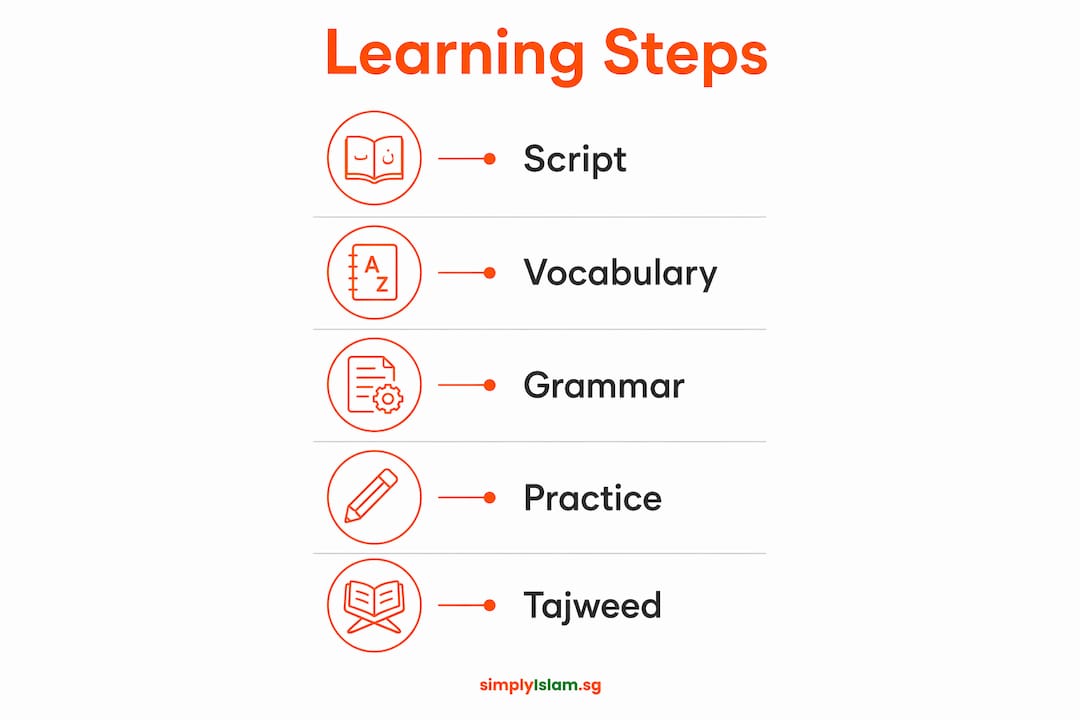
SimplyIslam’s Arabic through the Quran program integrates vocabulary and grammar in exactly this sequence, connecting every lesson directly to Quranic text rather than abstract exercises.
What are the step-by-step methods to practice reading and reciting the Quran in Arabic?
Reading and reciting the Quran in Arabic follows a clear progression. Skipping steps creates gaps that slow you down later. Work through this sequence deliberately:
- Learn Arabic letters and their sounds. Start with isolated letters, then practice connecting them into syllables. Focus on sounds that do not exist in English, such as the “ayn” and “ghayn,” because mispronouncing these changes word meaning.
- Practice short vowel markings (harakat). The Quran is written with full vowel markings, which makes it easier to read than most Arabic texts. Learn fatha, kasra, and damma before moving to full words.
- Read simple Quranic verses aloud. Begin with the shorter surahs at the end of the Quran, such as Surah Al-Ikhlas and Surah Al-Falaq. These verses are short, frequently repeated, and phonetically manageable for beginners.
- Introduce Tajweed rules gradually. Tajweed is the science and method of Quranic recitation, and it governs proper pronunciation at a detailed level. Tajweed study deepens phonetic knowledge and is required for accurate recitation. Beginners do not need to master all Tajweed rules before reading, but learning the basics early prevents bad habits.
- Listen to certified reciters daily. Pair your reading practice with audio from recognized Qaris. Your ear trains your mouth. Listening to correct recitation accelerates your own pronunciation improvement.
- Use apps for structured daily review. Digital tools with recorded recitations and interactive exercises reinforce what you practice in class or on your own.
Beginners with consistent lessons can typically read the Quran within 3–6 months. Full Tajweed proficiency takes 1–2 years. That timeline is realistic and worth every step.
SimplyIslam’s Quran for beginners program follows this exact sequence, making it a practical starting point for anyone who wants guided instruction rather than self-study.
How to overcome common challenges and stay motivated
Learning Quranic Arabic presents real obstacles. Recognizing them early prevents discouragement.
- Unfamiliar script: Arabic reads right to left, and letters change shape depending on their position. Most learners feel disoriented for the first two to three weeks. This feeling passes. Consistent daily exposure to the script resolves it faster than any single study technique.
- Grammar complexity: Quranic Arabic grammar is precise and rule-based. Beginners often try to memorize rules in isolation, which does not work. Grammar sticks when you see it applied in actual Quranic verses. Always connect grammar rules to real text.
- Pronunciation gaps: English speakers often struggle with sounds like “kha,” “ha,” and “ayn.” Recording yourself and comparing your recitation to a certified Qari reveals specific gaps you cannot hear in real time.
- Motivation dips: These are normal and predictable. They usually occur around weeks three and six, when the initial excitement fades but fluency has not yet arrived.
“The best of you are those who learn the Quran and teach it.” (Sahih al-Bukhari)
This hadith is not just an encouragement. It is a reminder that the effort to learn the Quran’s language carries spiritual weight. Connecting your study to this intention, known as niyyah, gives daily practice a purpose beyond language acquisition.
Structured programs solve the motivation problem more reliably than willpower alone. Joining a structured Islamic education program designed for adults provides accountability, peer support, and a teacher who can correct errors before they become habits. SimplyIslam offers evening classes and beginner camps that fit around work and family schedules, making consistency achievable for busy adults.
Setting small, specific goals also helps. Instead of “I want to understand the Quran,” set a goal like “I will learn 10 new Quranic words this week.” Small wins build the confidence that sustains long-term progress.
Key takeaways
Learning Quranic Arabic requires a focused sequence: script recognition, high-frequency vocabulary, core grammar, and daily recitation practice with Tajweed.
| Point | Details |
|---|---|
| Quranic Arabic is distinct | It differs from Modern Standard Arabic and requires Quran-specific vocabulary and grammar study. |
| Frequency-based vocabulary first | The most common Quranic words cover about 80% of the text, so learn these before rare terms. |
| Three grammar cases are foundational | Raf’a, Nasb, and Jarr appear on nearly every noun and unlock accurate meaning comprehension. |
| Tajweed takes 1–2 years to master | Beginners can read the Quran in 3–6 months, but proper recitation requires ongoing Tajweed study. |
| Structured programs outperform self-study | Accountability, peer support, and certified teachers prevent errors and sustain motivation. |
Why I believe the spiritual intention changes everything
When I first started studying Quranic Arabic, I approached it the same way I approached any language: as a skill to acquire. I tracked vocabulary counts, timed my reading sessions, and measured progress in words per minute. The learning happened, but it felt mechanical.
The shift came when I stopped treating the Quran as a text to decode and started treating it as a conversation to enter. That change in intention, the niyyah behind the study, made every session feel different. A verse I had read twenty times suddenly carried weight I had not noticed before. The grammar was the same. The vocabulary was the same. But the relationship to the material was entirely different.
My honest observation after years of working with Quranic Arabic learners is this: the students who progress fastest are not always the most linguistically gifted. They are the ones who connect their study to salah, to du’a, to the verses they recite every day in prayer. When you recognize a word from your daily prayer in a grammar lesson, the lesson sticks. When a vocabulary word appears in a surah you memorized as a child, it becomes permanent.
Start with the Arabic Made Easy resources if you want a gentle, practical entry point. But pair every lesson with the intention to draw closer to the Quran’s meaning. That combination is what separates learners who finish from those who stop.
— Lily
SimplyIslam’s programs for Quranic Arabic learners
SimplyIslam has supported over 22,000 participants in Singapore with structured Islamic education designed for real life. Whether you are a working adult with limited evenings or a parent looking for a beginner-friendly starting point, there is a program built for your schedule.

The Islamic education guide for working adults outlines flexible learning options including evening classes and intensive camps for Quranic Arabic beginners. SimplyIslam’s ARS-certified instructors use interactive methods rather than rote memorization, so you build real comprehension from the first lesson. You can also access free Islamic resources to supplement your study at no cost. If you want to take the next step in your Quranic Arabic learning, SimplyIslam’s programs offer the structure and community that make the difference.
FAQ
What is Quranic Arabic and how does it differ from Modern Standard Arabic?
Quranic Arabic is the classical form of Arabic preserved in the Quran, with its own vocabulary, grammar, and recitation rules. Modern Standard Arabic is a contemporary written form used in media and formal settings, and the two are not interchangeable for Quranic study.
How long does it take to learn Arabic for Quran reading?
Beginners with consistent lessons can typically read the Quran within 3–6 months. Full Tajweed proficiency, which governs proper recitation, generally takes 1–2 years of dedicated study.
What is the best way to build Quranic Arabic vocabulary quickly?
Focus on the most frequent Quranic words first, since they represent about 80% of the Quran’s vocabulary. Spaced repetition apps like the Quran Progress app, which covers over 1,500 Quranic words, make daily review efficient and measurable.
Do I need to learn Tajweed to read the Quran?
Basic Tajweed rules are necessary for correct pronunciation from the start, even if full mastery comes later. SimplyIslam offers dedicated Tajweed courses that build phonetic knowledge progressively for beginners.
Can working adults realistically learn Quranic Arabic?
Structured programs designed for adults, including evening classes and weekend camps, make consistent learning achievable alongside work and family commitments. SimplyIslam’s programs are built specifically for this audience, with flexible schedules and certified instructors.