




A qualified Quran teacher online is defined as a certified instructor who combines formal Islamic credentials with the pedagogical skill to teach effectively across age groups and learning goals. For parents raising children with a strong connection to the Quran, and for adults seeking to deepen their own recitation or understanding, finding the right teacher is one of the most consequential decisions in a child’s Islamic education. Platforms like Munabook, Preply, and Fajr Al-Quran Academy now make it possible to find qualified Quran lessons online from anywhere in the world. The challenge is not access. The challenge is knowing how to choose well.
What qualifications should you look for to find a qualified Quran teacher online?
The most important distinction in online Quran tutoring is the difference between scholarly credentials and teaching ability. Pedagogical skills often outweigh formal certification when it comes to actual teaching effectiveness, especially for non-native speakers and beginners. A teacher holding an Ijazah in Tajweed recitation has mastered the art of recitation. That does not automatically mean they can explain it clearly to a seven-year-old or a working adult with no Arabic background.
When reviewing teacher profiles, look for these specific indicators:
- Ijazah certification in the relevant area (Tajweed, Hifz memorization, or general Quran reading)
- Teaching experience with students at your child’s age or your own level
- Pedagogical training or a background in education, not just Islamic scholarship
- Student reviews that describe specific progress, not just general praise
- Specialization match with your learning goal, whether that is correct pronunciation, full memorization, or beginner reading
Detailed student stories are more trustworthy than one-line endorsements. A review that says “My daughter completed Surah Al-Baqarah in three months with consistent Tajweed correction” tells you far more than “Great teacher, highly recommend.”
Pro Tip: Before searching any platform, write down your specific learning goal. Are you looking for Tajweed correction, Hifz memorization, or basic reading fluency? Matching your goal to a teacher’s documented strength is the single most reliable predictor of a good outcome.
How do you assess teaching style and communication fit?
Teaching style is the factor most parents overlook, and it is often the reason students stop progressing. A teacher’s communication approach, patience, and ability to adapt to a student’s pace matter more than the length of their resume. Reliable communication and consistent scheduling are among the strongest trust signals in online Quran teaching.
Use these steps to evaluate a teacher before committing:
- Watch any available sample video. Look for clarity of explanation, tone with students, and whether they correct errors gently or abruptly.
- Book a trial lesson. Most reputable platforms offer a first session at reduced cost or free. Treat it as a structured interview, not just a sample class.
- Ask direct questions during the trial. Ask how they handle a student who struggles with a specific letter sound, or how they track progress between sessions.
- Observe your child’s reaction. For younger learners, comfort and engagement during the first lesson predict long-term retention far better than the teacher’s credentials alone.
- Assess consistency after two or three sessions. A teacher who arrives prepared, follows up on previous lessons, and adapts pacing to the student’s progress is worth keeping.
Teachers who adapt their curriculum to individual progress, rather than following a fixed script, produce better learning outcomes and higher student satisfaction. This flexibility is especially important for children who learn at uneven speeds or adults balancing Quran study with work and family.
Pro Tip: Prepare two or three specific questions before any trial lesson. Ask the teacher to demonstrate how they would introduce Makharij (articulation points) to a complete beginner. Their answer will reveal their teaching method more clearly than any profile description.

Which platforms help you compare and find the best Quran teacher online?
Several platforms now offer structured ways to search for a qualified Quran instructor, each with different strengths. Understanding what each offers helps you choose the right starting point.
| Platform | Key Strength | Teacher Volume | Trial Option | Pricing Range |
|---|---|---|---|---|
| Preply | Large tutor pool with specialty filters | About 4,000 tutors for Quran classes | Yes, trial lesson available | Varies by tutor |
| Munabook | Structured Quran-specific matching | Quran-focused directory | Yes, demo lessons | Not publicly listed |
| Fajr Al-Quran Academy | Structured curriculum with certified teachers | Academy-based | Yes, trial class | Not publicly listed |
Online Quran class rates typically range between $5 and $25 per hour, depending on the teacher’s experience, certification level, and location. A higher price does not guarantee better teaching. A teacher charging $10 per hour with strong student reviews and a clear Tajweed specialization may outperform a $25-per-hour teacher with impressive credentials but limited feedback.
When evaluating platforms, prioritize these features:
- Filtering by specialization (Tajweed, Hifz, beginner reading, children’s classes)
- Verified credentials displayed on teacher profiles
- Booking flexibility that fits your schedule, especially for families in Singapore managing school and work
- Platform guarantees such as refunds or free rescheduling for missed sessions
For families specifically, SimplyIslam’s guide on quality Quran class indicators offers a practical checklist for evaluating any program, online or in-person.
Step-by-step: how to book and confirm your online Quran teacher
A clear process prevents the most common mistake parents and adult learners make: choosing the first available teacher rather than the right one.
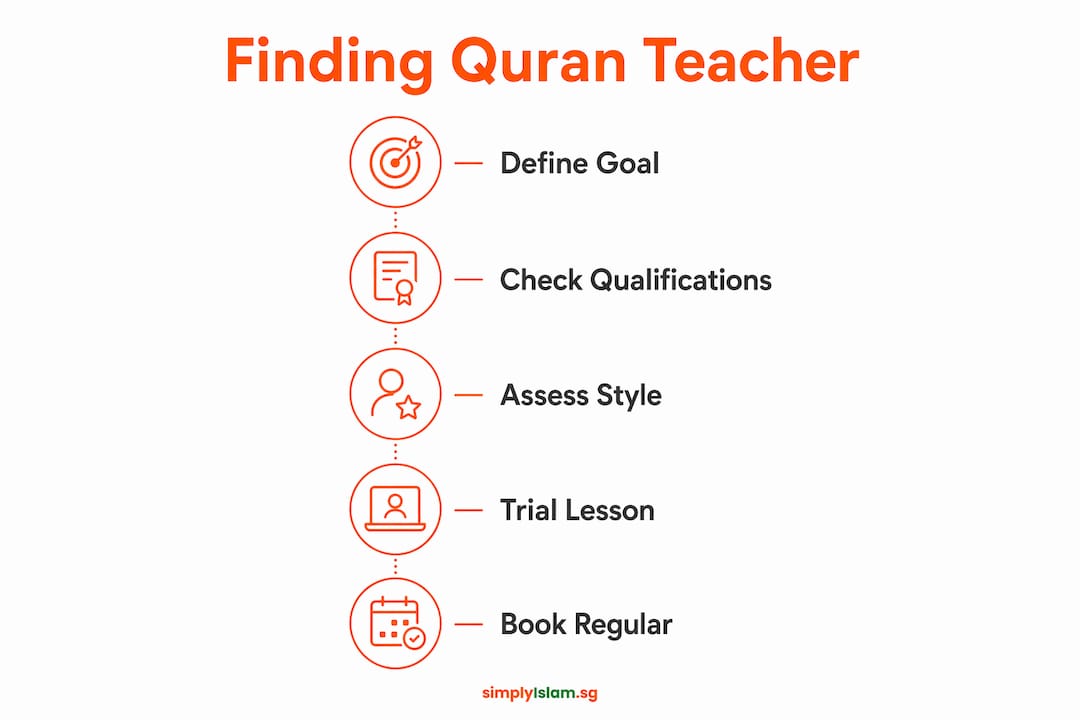
- Write your learning goal in one sentence. “My son needs to correct his Tajweed before he starts Hifz” is a goal. “I want him to learn Quran” is not specific enough to guide your search.
- Shortlist three to five teachers on your chosen platform. Filter by specialization, student reviews, and availability that matches your schedule.
- Contact each teacher before booking. Send a short message describing your goal and asking if they have experience with similar students. Response time and tone are early signals of reliability.
- Book trial lessons with your top two choices. Do not commit to a long-term package before completing at least one trial session.
- Evaluate the trial using a simple checklist. Did the teacher arrive on time? Did they ask about the student’s current level before starting? Did they explain corrections clearly?
- Confirm your choice and set a consistent schedule. Weekly consistency is more important than session length. Two 30-minute sessions per week produce better retention than one 60-minute session.
For adults managing work alongside study, SimplyIslam’s resource on finding an Islamic instructor covers additional considerations specific to adult learners. Adults often need a teacher who can work within compressed time windows and still deliver structured progress.
Common mistakes to avoid when searching for an online Quran teacher
The most frequent errors in this search are predictable, and each one has a clear solution.
- Choosing based on price alone. The cheapest option rarely delivers the consistency and skill a serious learner needs. The most expensive option is not automatically the best. Evaluate value, not cost.
- Ignoring teaching compatibility. A teacher with an Ijazah but a rigid, lecture-style approach will frustrate a child who needs encouragement and interaction. The most qualified scholar is not always the best teacher for your specific learner.
- Giving up after one poor trial. A single bad experience does not mean online Quran tutoring does not work. It means that particular teacher was not the right fit. Try at least two or three teachers before drawing conclusions.
- Neglecting scheduling consistency. Booking lessons sporadically, whenever time allows, breaks the rhythm of learning. Set a fixed weekly time and protect it.
- Skipping the review of student feedback. Platforms like Preply and Munabook display student reviews for a reason. Read them carefully before booking.
“Whoever treads a path seeking knowledge, Allah will make easy for him a path to Paradise.” (Sahih Muslim 2699)
This hadith is a reminder that the effort to find the right teacher is itself an act of worship. Approach the search with intention, patience, and trust that the right fit exists.
Key Takeaways
Finding a qualified Quran teacher online requires matching your specific learning goal to a teacher’s documented strengths, evaluating teaching style through trial lessons, and prioritizing consistency over credentials alone.
| Point | Details |
|---|---|
| Define your goal first | Specify whether you need Tajweed, Hifz, or beginner reading before searching any platform. |
| Credentials plus pedagogy | An Ijazah matters, but teaching experience with similar learners predicts outcomes more reliably. |
| Trial lessons are non-negotiable | One structured trial session reveals teaching style, pacing, and communication better than any profile. |
| Platform choice affects access | Preply lists about 4,000 Quran tutors; Munabook and Fajr Al-Quran Academy offer more structured matching. |
| Consistency drives progress | Two shorter sessions per week outperform one long session for retention and motivation. |
What I have learned about choosing the right online Quran teacher
After years of observing how families and adult learners approach this search, one pattern stands out clearly. Parents spend the most time comparing credentials and the least time evaluating how a teacher actually communicates. That is the wrong priority.
The teachers who produce the most consistent progress are not always the ones with the longest list of certifications. They are the ones who ask questions before they start teaching. They want to know where the student is, what has been tried before, and what the student finds difficult. That curiosity about the learner is the mark of a genuine educator.
I have also seen parents give up after one disappointing trial lesson and conclude that virtual Quran classes simply do not work for their child. That conclusion is almost always premature. The right teacher changes everything. One family I know tried three teachers before finding one who understood their daughter’s learning pace. She completed her first Juz within six months. The first two teachers were more credentialed. The third was a better fit.
For adults, the challenge is different. Many feel self-conscious starting Quran reading as adults, especially if they grew up without formal instruction. The right teacher treats that starting point with respect, not impatience. If a teacher makes you feel rushed or embarrassed, that is not a reflection of your ability. It is a signal to keep searching.
Use supplementary tools between lessons. Apps that support Quran memorization and recitation practice help reinforce what a teacher covers. Progress between sessions accelerates when students arrive prepared rather than starting from scratch each time. You can also explore SimplyIslam’s beginner Quran reading resource as a structured starting point alongside your teacher search.
The search itself is an act of care. Whether you are doing this for your child’s fitrah or for your own spiritual growth, the intention behind it carries weight. Take your time. The right teacher is worth finding.
— Lily
SimplyIslam’s resources for families and adults learning Quran online
SimplyIslam supports Muslim families and working adults in Singapore with structured Islamic education that goes beyond rote learning. Whether you are a parent looking for the right framework for your child’s Quran education or an adult fitting study into a full schedule, SimplyIslam’s courses and guides are built for real life.

SimplyIslam’s practical guide for working adults covers how to structure Islamic learning around professional and family commitments, including Quran study. The platform has engaged over 22,000 participants and raised more than $1.1 million for charity, reflecting a community that takes education seriously. Explore SimplyIslam’s online Islamic courses and free Islamic resources to find the right starting point for your family or your own learning path.
FAQ
What makes a Quran teacher “qualified” for online teaching?
A qualified online Quran teacher holds relevant certification such as an Ijazah in Tajweed or memorization, and has documented experience teaching students at your level. Pedagogical skill and clear communication matter as much as formal credentials.
How much do online Quran classes typically cost?
Online Quran tutoring rates range from $5 to $25 per hour depending on the teacher’s experience, specialization, and location. Higher cost does not guarantee better teaching quality.
How do I know if a trial lesson went well?
A successful trial lesson is one where the teacher asked about your current level before starting, explained corrections clearly, and arrived on time. Your child’s comfort and engagement during the session are equally reliable signals.
Where can I find Quran teachers online?
Platforms like Preply, Munabook, and Fajr Al-Quran Academy each offer searchable teacher directories with filters for specialization. SimplyIslam also provides guidance on hiring qualified tutors for families navigating this search.
How often should my child have Quran lessons online?
Two shorter sessions per week, such as 30 minutes each, produce better retention than a single long weekly session. Consistent scheduling protects the rhythm of learning and reduces the time spent reviewing forgotten material each lesson.