The crowds in the mosque during taraweeh, endless supply of air kathira (a drink consisting of kathira, syrup, nuts, malva seeds and others), Geylang Serai bazaar, Eid or Raya songs – these are the things that have contributed to the Ramadan experience in Singapore and may not even be given an ounce of attention anymore. But for Nurulhuda Hussein in Prague, those are the very things she misses.
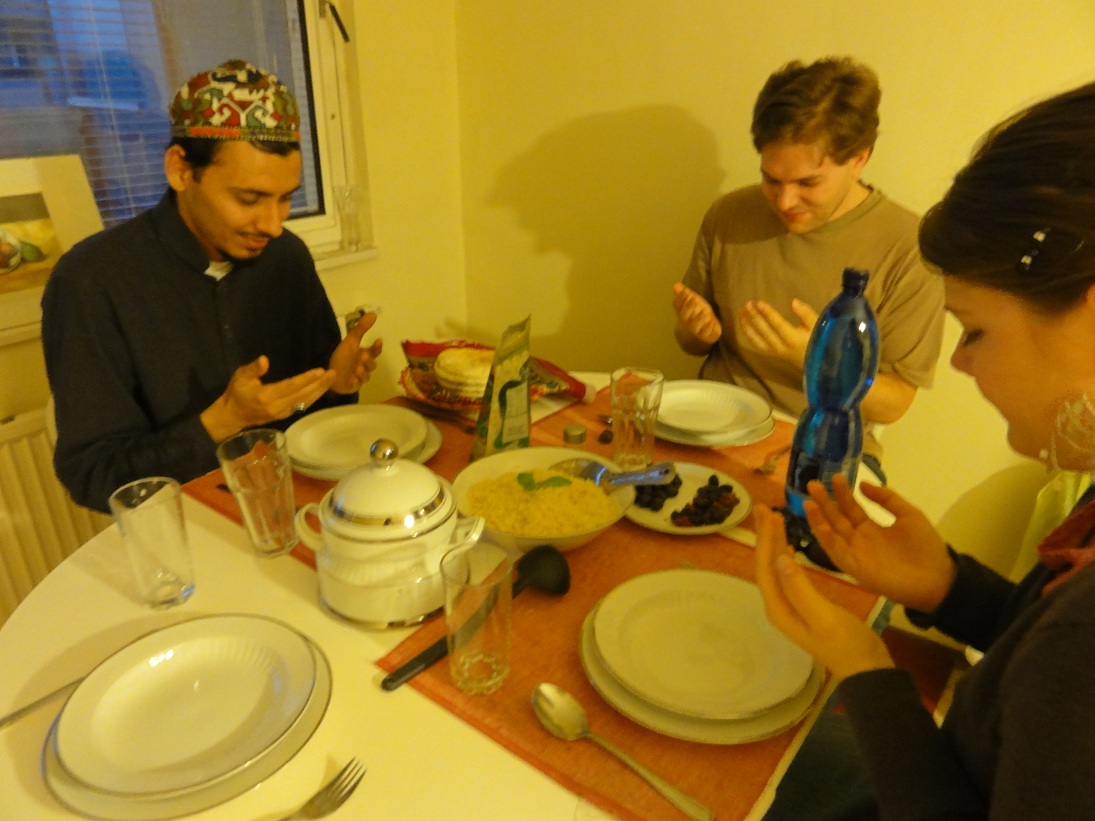
“For almost 4 years now, I have celebrated Ramadan in Prague. I miss the whole Ramadan atmosphere in Singapore. Iftar with my beloved family, bazaars selling Ramadan delicacies and sight of Muslims going to mosques for Tarawih prayers. To cope with the absence of these in Prague, most often I have iftar with my Czech Muslim friends at my home or theirs, as well as pray Tarawih together in order to revive the “family” spirit of Ramadan. Learning to cook some of the local cuisine of Singapore helps a bit in easing the sad feeling of being away from home.”

She explains,
“Prague, unlike other bigger cities of Europe have a very low number of Muslim communities. Thus, the vibe of Ramadan is almost non-existent in comparison to France, Netherlands or Germany where many Muslims reside.
Another special aspect in Prague and some parts of Europe alike is that there is no presence of a Mufti or an official Islamic body like in Singapore. Hence, it is not always easy to determine exactly when the start of Ramadan or Eid is. It is very common here to have differences in the commencement of Ramadan. Very often, we chose to follow Turkey or Germany while some other groups decide to follow Mecca which results in starting of Ramadan a day later for the latter group.”
[pullquote_left]There is no presence of a Mufti or an official Islamic body like in Singapore. Hence, it is not always easy to determine exactly when the start of Ramadan or Eid is.[/pullquote_left]
Apart from the lack of Ramadan atmosphere and an official Islamic body, Prague is also experiencing summer at the moment, making Nurulhuda’s fast one that lasts for 19 hours! Her days typically start at 2 AM to prepare and have her sahur (pre-dawn meal) since fajr (sunrise) is at 345AM. She takes a short nap and get up again at 6AM to get ready for work.
By 7PM, she’s home and starts to prepare for iftar. “I’ll be busy in the kitchen cooking something as per my inspiration for that day,” she laughs.
Iftar is served at 9PM after which she does her maghrib & taraweeh prayers. She adds, “Lastly, a nice cup of tea to end the night before retiring in bed for a good night’s rest.”
This is her daily routine in Ramadan except Fridays – “On Friday evenings, I am usually with my group of friends for a dhikr gathering in a Meditation Centre and iftar dinner will be taken in a nearby restaurant.”
When asked about how the majority non-Muslim community react to her 19-hour fasts, she says,
[quote]”I have to repetitively reassure my Czech colleagues that I am absolutely fine and healthy while fasting. Mostly, they perceive fasting as something extreme and unhealthy to go for extended hours without food or water. However, after 4 years, some of them are finally certain that Ramadan seems perfectly fine. In fact they even admired my willpower to go through with it without being tempted to eat or drink during the day while still performing daily tasks attentively in the office.”[/quote]
Lastly, we asked for some words of wisdom from our friend in Prague & this is what she has to say,
“In the holy month of Ramadan, very often all of us meticulously keep our actions and characters in check. We try hard not to be angry nor speak too much about useless issues and practice more tolerance and patience towards our society and surroundings while observing our fast. Going forward, we (includes me too) should also aim to keep “Ramadan” every day of our lives as the observation of our moral characters should not be limited to only in the actual month of Ramadan. Instead, it must be a continuous effort to seek improvement of ourselves day by day.
Insha’Allah, with patience and determination, we will all definitely succeed.
Last but not least, Ramadan Kareem from me and Czech Muslims society in Prague.”
May Allah accept all our fasts, whether it be 12 hours or 19 hours, our every prostration and our every letter that we recite from the Holy Qur’an. May these last days and nights of Ramadan be filled with barakah, remembrance of Allah, increased worship and His Forgiveness.